Join an extraordinary 7-night Egypt Solar Eclipse Cruise aboard the elegant Turquoise Dahabiya and experience one of the rarest astronomical events of our lifetime. On August 2, 2027, the Moon’s shadow will pass directly across southern Egypt, creating the longest total solar eclipse visible anywhere on Earth, with an astonishing 6 minutes and 23 seconds of totality.
This exclusive journey combines the wonders of Ancient Egypt with the intimacy of a luxury Dahabiya sailing experience. Travel from Aswan to Luxor and beyond, visiting magnificent temples, exploring legendary archaeological sites, and witnessing the eclipse from one of the world’s most sought-after viewing locations.
With only a limited number of guests on board, this is far more than a cruise—it is a once-in-a-lifetime opportunity to experience the magic of the Nile and the spectacle of the cosmos in perfect harmony.
Monday, August 2, 2027 — Maximum totality at 1:10 PM
Itinerary is designed around eclipse day — timing is fixed. Minor additions possible on arrival day.
All visits and destinations listed in this itinerary are confirmed. The sequence within each day — morning versus afternoon — adjusts to conditions on the ground, group pace, weather, and the Esna Lock schedule where relevant. Every site listed will be visited.
Overnight: Aswan Main Visits: Philae Temple · Aswan High Dam · Unfinished Obelisk
Your Egypt solar eclipse cruise begins in Aswan — the southern gateway to Egypt, where the Nile runs clear and narrow between granite boulders and the landscape shifts from desert to Nubian.
Upon arrival, a private transfer brings you from the airport or your hotel directly to the Dahabiya to settle in. The afternoon opens with a boat crossing to the Temple of Philae on Agilkia Island — an island sanctuary dedicated to the goddess Isis, relocated stone by stone during the 1960s rescue operation before the waters of Lake Nasser rose. Few temples in Egypt are as atmospheric at the end of the day: the water, the light, and the scale of the columns all work together in a way that photographs rarely capture.
From there, visit the Aswan High Dam to understand how completely the Nile was transformed in the twentieth century, then the Unfinished Obelisk in the ancient granite quarries — abandoned mid-cut after a fracture appeared in the stone, it remains the most revealing glimpse anywhere in Egypt of how the ancients moved from raw rock to finished monument.
Travel Note: Day 1 is deliberately unhurried. August in Aswan reaches 42–44°C by early afternoon. Arrive, drink water, and let your body adjust. Tomorrow requires a very early departure — sleep as early as possible tonight.
Overnight: Daraw Main Visits: Abu Simbel Temples · Herdiab Island · Daraw
Departure before sunrise for Abu Simbel, 280 km south of Aswan through open desert. The temples of Ramesses II and Nefertari were carved directly into a sandstone cliff more than 3,200 years ago — and then cut apart and lifted 65 meters up the hillside in the 1960s to save them from Lake Nasser. What you see today is the result of one of the most complex archaeological engineering operations ever attempted. The four colossal seated figures of Ramesses II on the main facade each stand 20 meters tall. Inside, the sanctuary was oriented so that sunlight reaches the innermost statues on two specific dates each year. The ancient Egyptians understood the sky. You are here, in part, because of that.
In the afternoon, the Dahabiya sails north. A stop at Herdiab Island — a calm sandbank in the middle of the Nile — offers the chance to swim in the river before continuing to Daraw, a Nubian riverside town that appears on almost no standard cruise itinerary.
Travel Note: The mandatory police convoy from Aswan to Abu Simbel departs at approximately 3:00–4:00 AM. This is the only very early start of the entire journey and it cannot be adjusted. It is also the longest single transfer: allow 2.5–3 hours each way. Bring water, a light layer for the pre-dawn desert chill, and a camera already prepared for morning light at the temple facade.
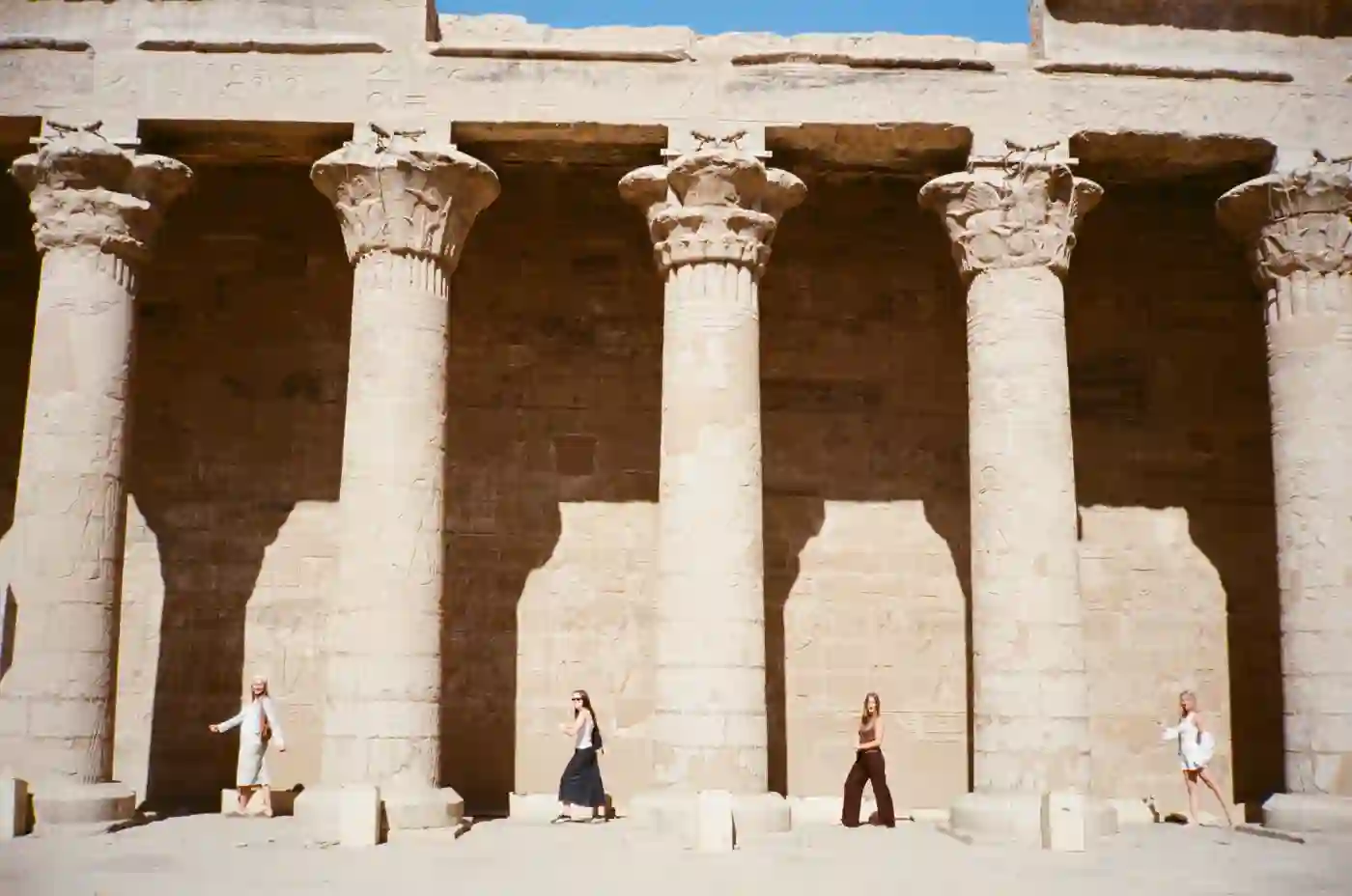
Overnight: El-Hegz or Esna Main Visits: Kom Ombo Temple · Edfu Temple (Temple of Horus)
Morning at Kom Ombo — the double temple that stands at a wide curve of the Nile, uniquely dedicated to two gods in perfectly mirrored sanctuaries: Sobek the crocodile on one side, Horus the falcon on the other. The temple’s position directly above the water is unlike anything else on the Nile route, and the collection of ancient surgical instruments and crocodile mummies displayed here is genuinely unexpected.
The Dahabiya sails north to Edfu in the afternoon. The Temple of Horus at Edfu is the best-preserved major temple in Egypt — its massive pylons, painted inner chambers, and detailed reliefs remain largely intact in a way that Luxor and Karnak, despite their greater fame, are not. Walking through it at the pace of a small private group, rather than in a queue behind a larger cruise’s passengers, is a meaningfully different experience.
Travel Note: Both temples fit comfortably in one day without rushing. Between them, the Dahabiya moves quietly up the river — there is no fixed schedule to follow and no loudspeaker calling you back to the boat.
Overnight: Luxor Main Visits: Esna Lock · Karnak Temple · Luxor Temple
The morning opens with the passage through the Esna Lock before the Dahabiya continues north toward Luxor.
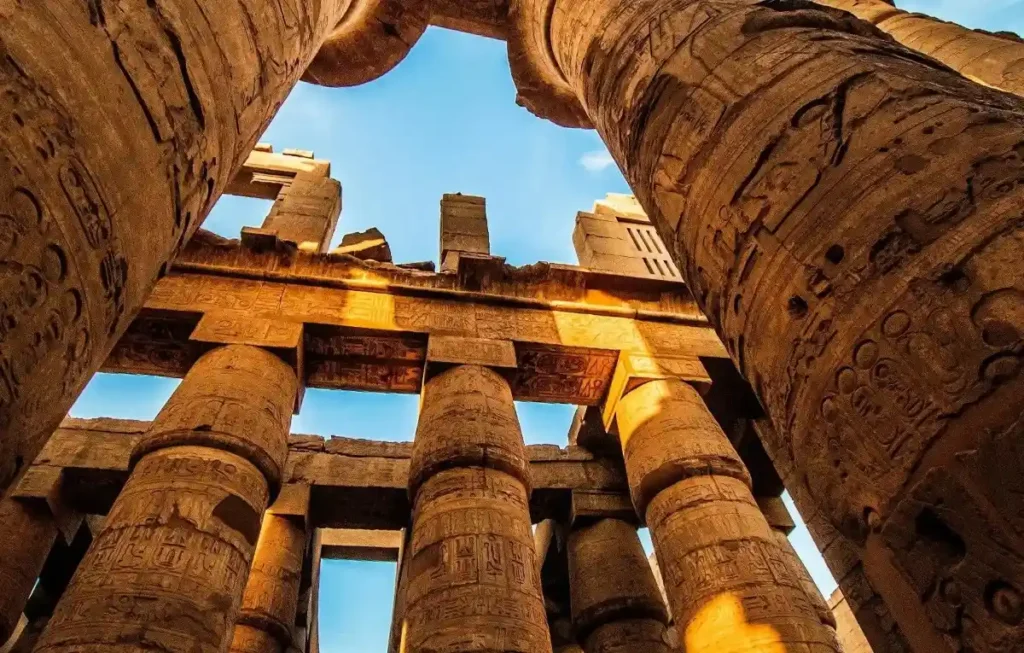
Upon arrival, the day moves to Karnak Temple — the largest religious complex ever constructed, expanded by successive pharaohs across 2,000 years and aligned with an astronomical precision that modern visitors consistently underestimate. The hypostyle hall alone contains 134 columns, the tallest standing over 23 meters, and the scale of the space only becomes real when you are standing inside it. This is your first encounter with the city that, in two days’ time, will stand at the center of the longest solar eclipse of the century — and Karnak, more than anywhere else in Luxor, makes clear how seriously the ancient Egyptians took the sky above it.
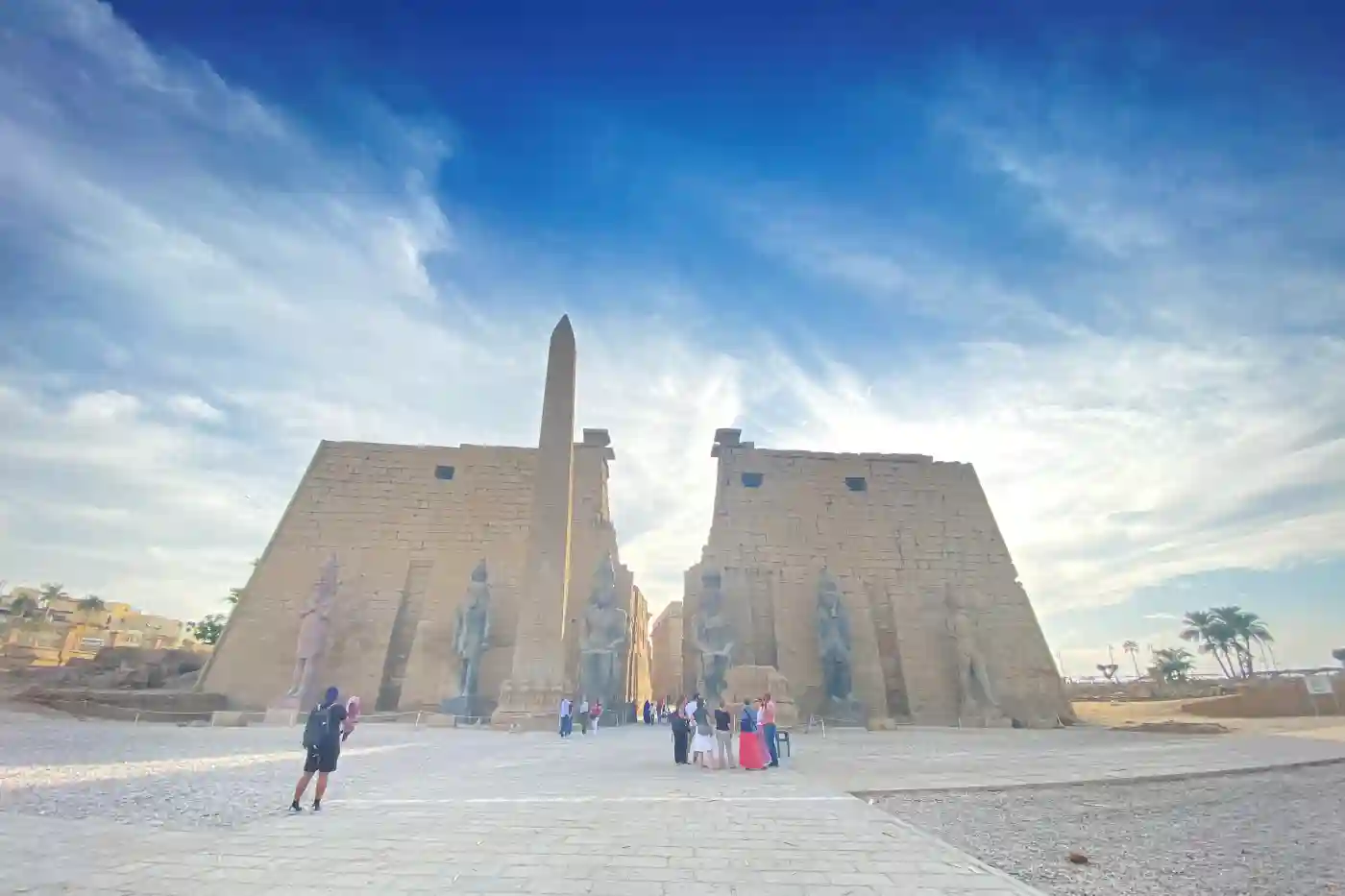
In the afternoon, Luxor Temple — the Avenue of Sphinxes stretching north toward Karnak, the Roman chapel embedded inside an ancient sanctuary, the towering pylon of Ramesses II with its single remaining obelisk. The temple reads differently at this hour, when the afternoon light falls directly across the carved reliefs and the crowds of the morning have thinned.
Travel Note: Esna Lock passage timing is controlled by the Nile Authority and cannot be guaranteed to a specific hour — waiting on deck while the lock fills is part of the Dahabiya experience, not a delay. Plan Karnak for the morning before the heat peaks; Luxor Temple in the afternoon benefits from better light on the facade and fewer visitors than at noon.
Overnight: Luxor Main Visits: Valley of the Kings
The day before the eclipse is spent in the Valley of the Kings — the royal necropolis on the West Bank where the pharaohs of the New Kingdom were buried in hidden rock-cut tombs for five centuries. The painted burial chambers of Ramesses VI, Seti I, and Tutankhamun represent some of the most detailed funerary art in the ancient world, each tomb a complete theological program carved and painted by the craftsmen of Deir el-Medina — the same village you will visit tomorrow morning, on eclipse day.
The connection is not incidental. The men who decorated these tombs with astronomical charts, solar barques, and the nightly journey of the sun through the underworld lived 400 meters away in Deir el-Medina. Tomorrow you will stand on their ground and watch the sun disappear in the middle of the day. Today you are inside the monuments they built to make sense of exactly that.
The evening is reserved for the eclipse briefing aboard the Dahabiya — covering the full sequence from first contact to fourth contact, safe viewing technique, solar filter use, and photography setup.
Travel Note: The Valley of the Kings is best visited before 10:00 AM before the heat builds inside the tombs. August afternoons in Luxor reach 40–42°C — the eclipse briefing on the shaded Dahabiya deck in the late afternoon is the right use of the rest of the day. Rest well tonight.
Overnight: Qena Main Visits: Deir el-Medina · Medinet Habu · Total Solar Eclipse — Luxor West Bank
Today, the West Bank of Luxor becomes the best place on Earth.
The morning begins at Deir el-Medina — the village of the royal tomb craftsmen, a small, well-preserved community of painted burial chambers and workers’ houses tucked into the hillside above the Valley of the Queens. These were the people who spent their working lives underground, cutting and decorating the tombs of the pharaohs by lamplight. Their own tombs, by contrast, are colorful, personal, and surprisingly intimate. Continue to Medinet Habu, the mortuary temple of Ramesses III — its painted reliefs among the most vivid in Egypt, its stone walls standing on this exact ground since 1150 BC.
At 11:00 AM, on the open ground of the West Bank, the eclipse sequence begins. You are not watching from a cruise deck or a hotel rooftop. You are standing on the same terrain where the builders and astronomers of ancient Thebes once stood, watching the same sky.
Eclipse Sequence — August 2, 2027, Luxor West Bank:
At 4:00 PM, the group boards the Dahabiya and sails north toward Qena.
Travel Note: Eclipse viewing takes place outdoors on the West Bank from 11:00 AM to 3:00 PM — four hours under direct August sun in Luxor. Wide-brim hat, high-SPF sunscreen, and at least 1.5 liters of water per person are non-negotiable. Solar filter glasses are provided and required for every phase of the eclipse except totality itself. Remove them only at second contact — replace them immediately at third contact. During the 6 minutes 23 seconds of totality, naked-eye viewing is not only safe — it is the only way to see the corona fully.
Overnight: Luxor Main Visits: Dendera Temple (Temple of Hathor)
The day after the eclipse, the Temple of Hathor at Dendera becomes the most fitting possible destination.
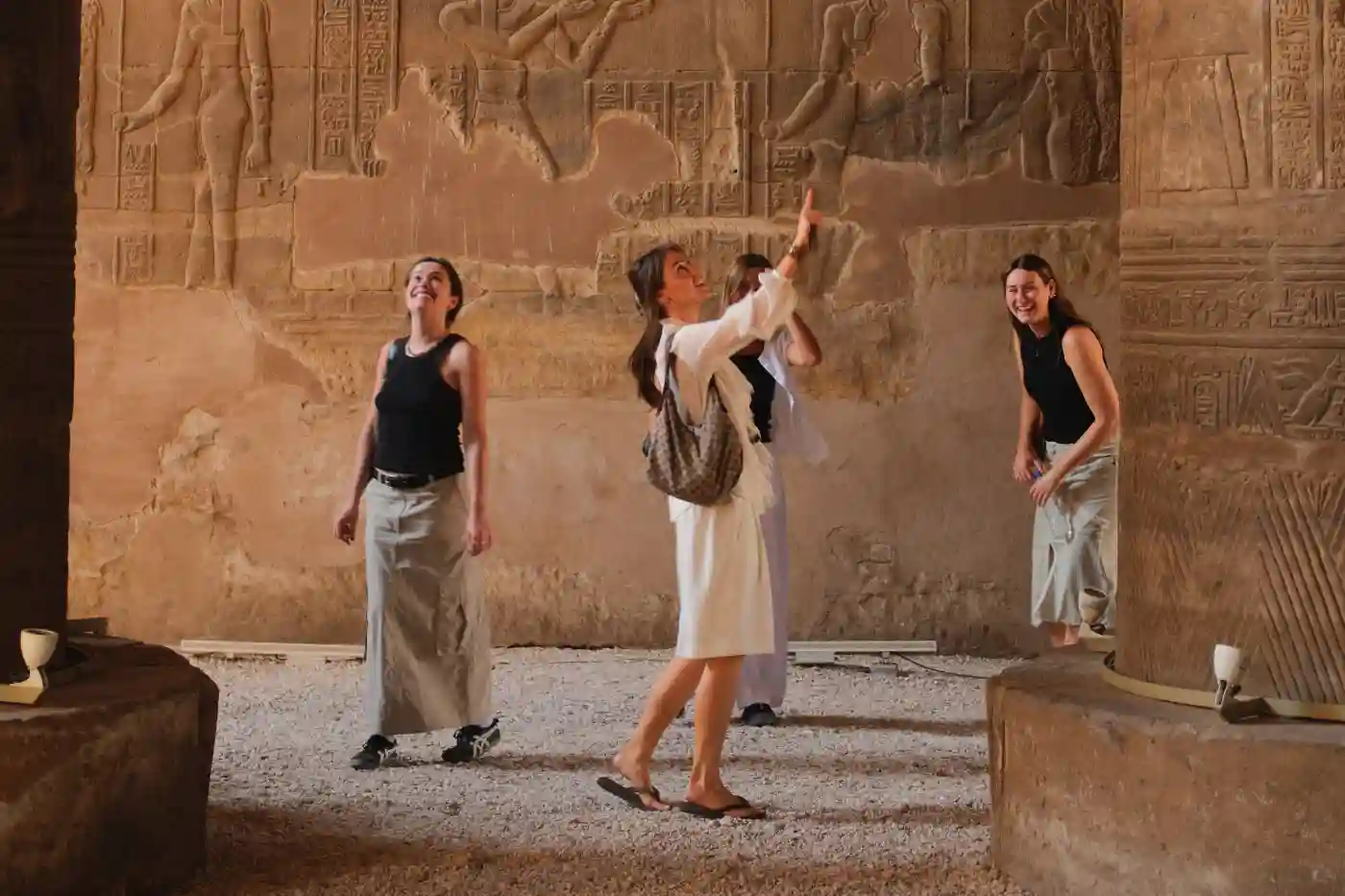
The temple ceiling contains the most detailed astronomical map produced in the ancient world — a complete circular zodiac recording the positions of the stars, the planets, and the constellations as the Egyptians understood them. The original Dendera Zodiac was removed by French archaeologists in 1820 and is now in the Louvre; a precise replica occupies its original position in the inner pronaos. The outer pronaos ceiling is original and covers the full Egyptian astronomical calendar in carved relief — decans, planets, lunar months, and the hours of day and night laid out across a surface that has been here, largely intact, since roughly 50 BC.
Visiting Dendera the morning after witnessing a total solar eclipse is a specific kind of experience. The culture that produced this ceiling was watching the same sky, from the same stretch of the Nile, with a precision that modern visitors consistently underestimate. The eclipse does not make Dendera more interesting as a tourist site — it makes it more legible as a document.
Sail back to Luxor in the afternoon. Final evening aboard the Dahabiya.
Travel Note: Dendera is approximately 60 km north of Luxor — around one hour by road from the river. The temple interior is dim in places; a small torch or headlamp is useful for reading the ceiling details in the inner chambers. Allow 2–3 hours for a thorough visit. The temple is significantly less crowded than Karnak or Luxor Temple and rewards a slow pace.
After breakfast aboard the Dahabiya, check out and transfer privately to Luxor Airport or your onward destination. The Turquoise team manages all departure logistics and luggage coordination.
Travel Note: For late-afternoon or evening flights, ask about luggage storage and options for a quiet final morning on the West Bank — the sites are at their best before 9:00 AM, before the heat and the larger tour groups arrive.
Luxor lies near the center of the eclipse path of totality, allowing visitors to experience one of the longest durations of complete darkness during the event. Combined with Egypt’s typically clear summer skies and Luxor’s remarkable historical setting, it offers an exceptional location for eclipse viewing.
As the eclipse is expected to attract travelers from around the world and Dahabiya capacity is limited, booking as early as possible is highly recommended. Availability is expected to become increasingly limited as the event approaches.
This journey combines a prime eclipse viewing location in Luxor, luxury Dahabiya sailing, small-group exclusivity, world-famous archaeological sites, and one of the longest periods of totality available anywhere on Earth. It offers a unique blend of astronomy, history, culture, and luxury travel.
A cruise provides a more exclusive and comfortable environment, combining luxury accommodation, exceptional sightseeing, and a unique viewing platform on the Nile. It allows guests to experience both the eclipse and the timeless beauty of Ancient Egypt within one carefully designed journey.
Posted on Philippe BVerified Adventure in Egypt 🥰 Pharaonic Unforgettable moment thanks to our beloved guides Mohamed and Ahmed 2 brothers to know by their benevolence and their knowledgeTo recommend around youPosted on Laetitia GVerified Pharaonic! Wonderful journey along the Nile. Thanks to Mohamed for his kindness and professionalism. An unforgettable journeyPosted on Aglaia AVerified Excellent Trip On this second visit to Egypt, we traveled on this boat on the Nile from Luxor to Aswan. It was a small and fine boat with room for about 20 people. Downstairs were the luxurious rooms with windows and upstairs was an open area with a dining table, benches, loungers and a pool. The crew and owner were very friendly, the food was excellent and on three of the five evenings we were invited to dance, which created a great sense of community.A trip with this ship and the crew is definitely recommended.Posted on Claudia KVerified Wonderful days and nights on the Nile We are completely satisfied! The food has excellent high quality. The service Team is polite, openminded, helpful, charming, loving. They enlightened us with live drumming, chanting and dancing during three evenings, which created an athmosphere of inclusion for all guests who wanted to join. The ship is light, spacious, clean, offering occasions to sit together, talk, play or laying on the sofa shady or sunny.Claudia & ChristianPosted on Magdalena FVerified Dream vacation in dahabiya I travelled with them in January with my husband and a couple of friends.I couldn't imagine how wonderful the journey would be in this dahabiya.From day one the whole crew was very polite and very attentive.The cleanliness is perfect, all the details very careful. The cabins very spacious and comfortable. Anyway we were just going to sleep, because we made life on the beautiful deck that has all the amenities so you can relax and enjoy the crossing of the wonderful Nile.Excellent and varied food.I recommend you 100%, I am sure we will repeat in the not too distant future.I send a hug to Abdul, Hussein and all the crew who made my vacation an unforgettable moment 😘By the way, thank you also for your patience with my Egyptian lessons 🤣Posted on Chunliu WVerified Great and Relaxing Trip Up the Nile The Turquoise is a very charming Dahabiya. The rooms are clean and white-modern, with comfortable big beds in the suites and twins in the cabins. It probably would have been nice to have some cabins with double/queen beds. The pillows were way too thick and need most of the stuffing to be taken out, or ideally a many new pillows with varying thickness and firmness. There should probably have been a small sofa or love seat in the suites. The rooms all have very big windows, which makes for excellent views of the Nile. The salon / indoor living room should have a projector on one wall for movie nights. The crew was helpful and accommodating. They removed the tarpaulin covers over the pool at my request, in hopes that the sun would heat the pool, however above that tarp was a big solar panel, and so the sun never even shone in the pool. Mohammed (the owner) even got us two kayaks to use, which was absolutely fantastic and personal service, and really a great way to relax. The pool was freezing cold in the winter, and ideally should have some kind of heating system for high season, as even after a long day of sightseeing, it was too cold to be enjoyable. Perhaps a small heating element could be placed in the pool during the day when we go on tour, and then when we come back in late afternoon the water would be warm. The food was good, although maybe the breakfast was a bit lacking in different selections. Most of our group wanted a proper coffee maker, not just instant coffee. Alcohol was a bit difficult and expensive to come by, but eventually a member of the crew helped us to find some at expensive rates. The sights were amazing and our guide, Dr. Mo, was incredibly knowledgeable and personable. However, we were almost tired of seeing temples by the end of the trip; it might be a good idea to have a rest day in the middle of the trip to lay on deck, read, kayak, watch movies, etc. Overall, a great experience, very peaceful and enjoyable, and highly recommended.Posted on Mario EVerified Travel on the Nile I'm Mario, I traveled in January.A wonderful experience, exquisite attention, a luxurious trip because Abdul and all his crew made this trip unforgettable.In the dahabiya all the details taken care of to the maximum, the perfect cabins, the exquisite and varied food.The focus on the dahabiya and the programmed activities were successful.Our desire is to repeat journey with them.Posted on edyericVerified Incroyable Excellent family trip in a beautiful boat away from the big liners The crew is lovely and very knowledgeable Thank you.Posted on edy eVerified An unforgettable experience We are a family of 4 and had a great trip. Beautiful and very comfortable boat, staff with little care and full of kindness, excellent meals.... We highly recommend.
WhatsApp us