
Do you worry that booking a cruise 4 days 3 nights is just a recipe for feeling rushed, herded, and exhausted?
It’s a valid concern. When you look at a shorter itinerary, it’s easy to assume you’ll either be running breathless between temples to tick off boxes, or conversely, stuck on a boat with nothing to do but stare at the water. But the reality of sailing on a small Dahabiya is that it changes your relationship with time. On a Turquoise Dahabiya sailing, with only 16 guests, you aren’t fighting the crowds; you’re bypassing them. This isn’t about “magic”—it’s about the tangible luxury of silence. This walkthrough explains exactly what happens between Aswan and Esna: the unhurried mornings, the sites the big ships can’t reach, and the genuine rhythm of life on the river. Here is what your four days actually look like when you stop racing and start traveling.
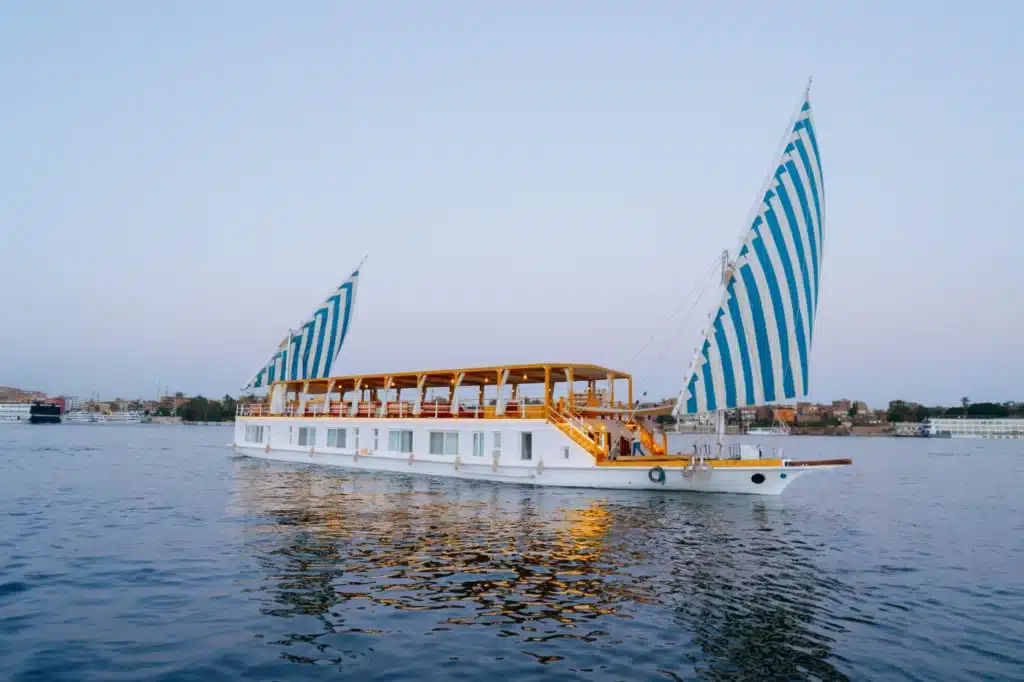
4 Days Cruise on a Dahabiya at a Glance
Essential voyage details:
- Route: Aswan to Esna (or reverse), sailing downstream with the current
- Duration: 4 days, 3 nights immersed in the Nile’s rhythm
- Vessel style: Traditional Dahabiya with modern comforts—natural sailing when winds cooperate, quiet motor assist when needed
- Guest capacity: Maximum 16 travelers, creating intimate dinner conversations and uncrowded temple visits
- Core highlights: Kom Ombo’s double temple, Gebel el-Silsila’s ancient quarries, Edfu’s towering Temple of Horus, El Kab’s cliff tombs, plus hidden island moorings
- Perfect for: Travelers wanting authentic slow-travel Nile immersion without committing an entire week, those seeking depth over breadth
This timeframe represents a sweet equilibrium—sufficient days to shed your arrival stress and settle into river time, compact enough to integrate seamlessly into broader Egypt itineraries including Cairo, Abu Simbel, or Red Sea extensions. You’re neither rushing frantically nor drifting aimlessly; you’re moving at precisely the pace the Nile has preferred for five millennia.
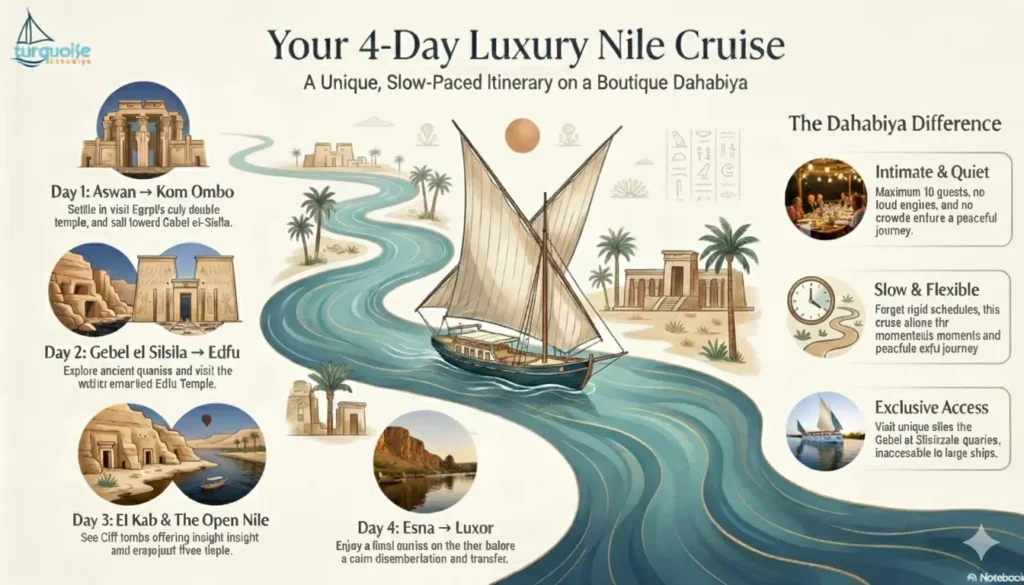
Day 1: Aswan to Kom Ombo—When the River Becomes Your Address
Morning Transfer and First Impressions
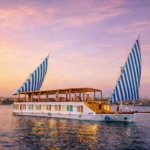
Your Dahabiya journey begins not with a departure gate announcement but with a quiet morning pickup in Aswan. Whether collected from your hotel, the drive to the mooring point feels already different from standard tourism—no massive vessel dominating the waterfront, no crowds queuing with luggage trolleys. Instead, you find an elegant wooden boat tied along a quiet stretch of river, two graceful masts tilted skyward, crew members standing ready with genuine smiles rather than rehearsed welcomes.
Stepping aboard immediately calibrates your expectations downward in scale, upward in quality. This isn’t a floating hotel; it’s a floating home. The sun deck stretches invitingly with cushioned loungers and shaded dining areas. Your cabin—whether one of five standard rooms or three suites—opens to reveal polished wood, comfortable bedding, a proper bathroom (those worrying about Dahabiya facilities can exhale now), and windows framing the Nile directly. No interior corridors, no elevator rides, no getting lost searching for your room number.
First hour essentials:
- Welcome drinks served on deck while crew explains safety procedures without drama or excessive formality
- Captain’s brief introduction to the journey, spoken conversationally rather than through loudspeakers
- Time to unpack properly—a luxury recognizing you’ll actually live here for four days
Afternoon: Kom Ombo and the Double Temple
By early afternoon, the Dahabiya has sailed to your first archaeological encounter: Kom Ombo. Unlike massive cruise ships depositing 200 passengers simultaneously, your group of 16 disembarks quietly, walks the short path to the temple entrance, and enters a space where your Egyptologist can speak at normal volume without competing microphones.
Kom Ombo’s uniqueness reveals itself immediately—this is Egypt’s only double temple, with perfect symmetry dedicating one half to Sobek the crocodile god, the other to Haroeris the falcon-headed elder Horus. Your guide doesn’t merely recite these facts; she reads hieroglyphic inscriptions aloud, translates ancient medical instruments carved into walls (this temple housed one of antiquity’s teaching hospitals), points out Nilometers that measured flood levels for tax calculations.
What distinguishes this from rushed cruise ship visits becomes apparent in what doesn’t happen: no guide checking watches, no groups behind you waiting impatiently, no sense that you’re stealing moments from a ticking clock. When someone asks about the crocodile mummies in the small museum, the group simply pauses there, examines the preserved reptiles, discusses ancient animal cults. Fifteen extra minutes? Thirty? Time stops mattering.
Evening transition into river life:
- Return to the Dahabiya for late afternoon tea and the day’s first unhurried sailing
- Dinner served on deck under stars just emerging—conversation flows easily among 16 guests who’ve begun recognizing each other
- Mooring for the night at Gebel el-Silsila, an ancient quarry site whose sandstone cliffs glow amber in the last light
Day 2: Gebel el-Silsila to Edfu—When History Becomes Tangible
Morning Among the Ancient Quarries
Dawn arrives quietly without alarm clocks or announcements. Those who wake early discover the sun deck already set for breakfast—fresh Egyptian bread, local honey, seasonal fruits, strong coffee. The Dahabiya rocks almost imperceptibly at its mooring; the only sounds are water, birds, and distant village life across the river.
After breakfast, your group walks to Gebel el-Silsila’s rock temples and quarries—a site most Nile cruises skip entirely because large vessels cannot moor here. This is where pharaohs sourced sandstone for their temples; chisel marks still score the cliff faces, and unfinished blocks lie abandoned as if workers left yesterday rather than three thousand years ago. Rock-cut shrines dedicated to Horemheb, Seti I, and Ramesses II nestle into the cliffs, intimate chapels where ancient quarry workers prayed before dangerous shifts.
Your Egyptologist explains how engineers calculated stress points, how workers split stone using wooden wedges and water, how massive blocks traveled downriver to Luxor and beyond. But the profound moment arrives when everyone simply stands quietly, hands touching the same stone that built Karnak and Luxor temples, feeling the continuum between ancient hands and modern ones.
Afternoon Sailing and Edfu Temple
The sail from Gebel el-Silsila to Edfu unfolds as what many guests later describe as the journey’s emotional centerpiece. The Dahabiya glides downstream, sails billowing when wind cooperates, motor providing gentle assist when needed. You’re not racing toward a destination—you’re inhabiting the transition itself.
Some guests read on the shaded lounge. Others photograph feluccas passing with their white lateen sails brilliant against desert hills. A couple sketches in watercolors. Someone naps. Conversation drifts between Egyptian mythology and entirely unrelated topics—where people live, what brought them to Egypt, shared travel stories. The Nile itself becomes entertainment: watching farmers work fields unchanged since pharaonic times, egrets fishing in shallows, village children waving from muddy banks.
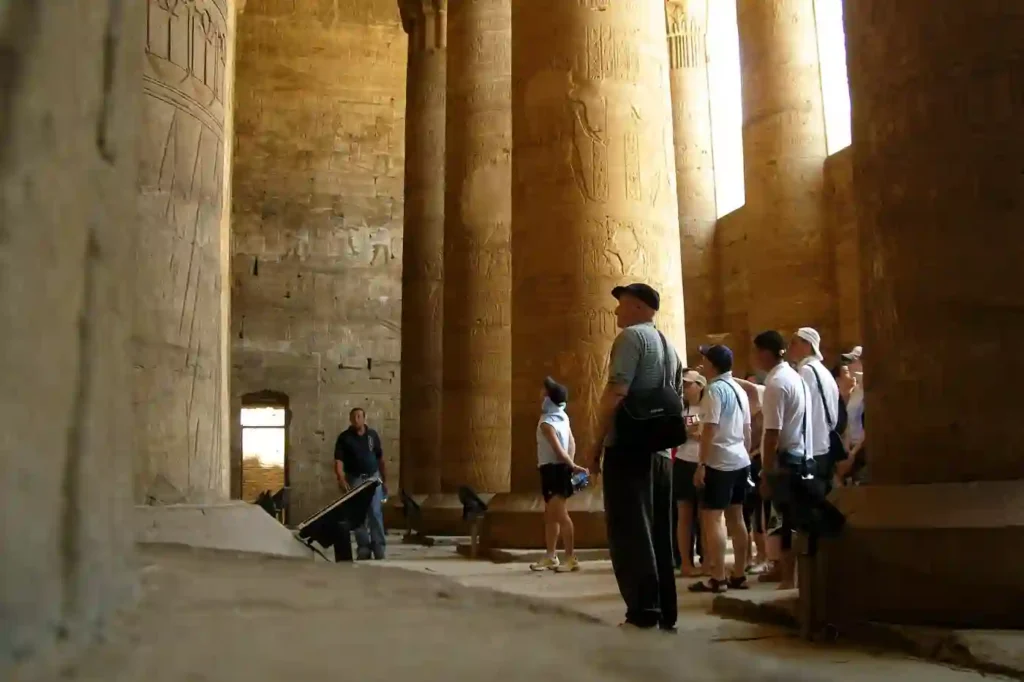
By late afternoon, Edfu appears. The Temple of Horus—Egypt’s best-preserved major temple—dominates the landscape with its massive pylon entrance. Rather than the chaos of large ships coordinating hundreds through
narrow passages, your small group explores methodically. The hypostyle hall’s towering columns, the holy of holies where the god’s statue once resided, the annual festival reliefs depicting Horus avenging his father Osiris—each element receives proper attention.
What distinguishes boutique Dahabiya timing:
- You visit during optimal light when shadows enhance carved details
- Crowds from morning cruise ship waves have departed
- Your guide answers questions without rushing toward the next group arriving
- Photography happens naturally without competition for clear shots
Evening at Island Anchorage
The Dahabiya moors at El Fawaza island for the night. Dinner might be served on the riverbank itself—crew sets up tables, lanterns, and a small campfire. Egyptian music plays softly. Conversation deepens among guests who are no longer strangers but temporary river companions sharing an uncommon experience.
Day 3: Villages, Tombs, and the Rhythm You’ve Finally Found
Morning at El Kab’s Cliff Tombs
By the third day, something has shifted internally. You no longer feel like a tourist visiting Egypt; you feel like someone temporarily living on the Nile who happens to stop at extraordinary places. This subtle transition defines why four days works—it’s long enough for stress to fully dissolve, short enough that every site still feels significant rather than repetitive.
El Kab, your morning destination, exemplifies the “hidden Egypt” only small vessels access. This ancient city of Nekheb predates the pyramids, and its cliff tombs offer windows into regional governors’ lives during the New Kingdom. The tombs’ painted scenes—hunting in marshes, agricultural life, family members—feel more human-scaled than royal tombs’ grand cosmic narratives.
Your Egyptologist points out biographical texts carved into walls, reading passages where officials boast of building wells, distributing food during famines, maintaining justice. These aren’t pharaohs; they’re successful administrators who wanted posterity to remember their contributions. The intimacy of the space—you’re often alone inside tombs—creates rare moments for contemplation impossible in the Valley of the Kings’ crowds.
Mid-morning decisions and flexibility:
One advantage of small-group Dahabiya travel reveals itself unexpectedly. Someone mentions wanting to swim in the Nile. The captain considers wind and current, identifies a safe spot downstream, and an hour later the Dahabiya moors at an uninhabited island. Swimsuits appear, laughter echoes across water, and for forty minutes everyone experiences the Nile not as scenic backdrop but as living element surrounding you.
Could this happen on a 200-passenger cruise ship? Never. The itinerary is locked, the schedule non-negotiable, the liability too great. But with 16 guests, a flexible captain, and guides who prioritize experience over rigid adherence to brochures, spontaneous magic becomes possible.
Afternoon Sailing Toward Esna
The sail to Esna passes through some of the Nile’s most picturesque stretches—palm-lined banks, traditional villages, fields cultivated since pharaohs ruled. This is when you might finally finish that novel you’ve been carrying, or simply sit watching the river without feeling obligated to do anything productive.
Some guests journal—the Dahabiya’s leisurely pace inspires reflection in ways rushed travel never does. Others engage the Egyptologist in extended conversations about topics morning temple visits sparked. A couple discusses with the captain how traditional Dahabiya sailing techniques evolved over centuries, learning nautical terminology in Arabic.
By sunset, as the crew prepares your final evening’s dinner, you realize four days has created something resembling community. You know fellow passengers’ names, their travel histories, what they do when not exploring Egypt. Tomorrow’s farewell will feel genuine because these three days have been genuinely shared.
Day 4: Esna Arrival and Re-Entry to the World Beyond
Final Morning on the Nile
The fourth day begins with bittersweet awareness—this is your last Nile sunrise from the Dahabiya’s deck. Some guests wake extra early, unwilling to miss final moments. Breakfast feels less hurried than usual; everyone lingers, conversations already turning nostalgic despite the journey not yet ended.
If timing allows, a quick visit to Esna Temple offers a final archaeological encounter. This Greco-Roman temple, buried nine meters below modern street level, features some of Egypt’s finest ceiling paintings—astronomical charts, zodiac symbols, hieroglyphic hymns to Khnum the creator god—recently restored to brilliant colors. It’s smaller than Edfu or Kom Ombo, but after three days of progressive immersion, you now notice details you’d have missed initially: particular cartouches, symbolic arrangements, artistic quirks.
Practical Re-Entry
Disembarkation from a Dahabiya lacks the chaos of large ship departures. Your luggage appears without confusion. Crew farewells feel personal—these aren’t staff serving hundreds, but people who’ve shared four days with just sixteen guests. Email addresses are exchanged. Plans for future Egypt visits are discussed.
The transfer to Luxor (approximately one hour north) delivers you to hotels, airports, or next segments of your Egypt adventure. Some guests continue to the Red Sea. Others spend additional nights exploring Luxor’s West Bank more thoroughly. A few head directly to Cairo, carrying Nile memories forward.
What guests consistently report remembering:
- Specific sounds: water against the hull at night, the captain’s Arabic commands to crew, laughter echoing across quiet island moorings
- Small human moments: the crew member who learned your coffee preference, the fellow traveler who shared your fascination with hieroglyphs, the sunset when everyone spontaneously gathered on deck without prompting
- The sensation of time itself changing texture—four days that felt simultaneously brief and infinite
Who a 4 Days 3 Nights Dahabiya Cruise Serves Perfectly?
Multi-Destination Travelers
If you have 10–14 days in Egypt, four days on the Nile provides immersion without dominating your itinerary. Pair it with Cairo, Abu Simbel, or the Red Sea.
Couples and Solo Travelers Seeking Depth
You value quality over quantity. You prefer meaningful conversations and unhurried exploration to packed schedules and entertainment shows.
First-Time Visitors Testing Slow Travel
Four days is long enough to feel the benefits of slow travel, short enough to feel safe experimenting with a new pace.
Planning Your 4 Days Cruise with Turquoise Dahabiya
The difference between booking a generic Nile cruise and planning a Turquoise Dahabiya journey lies in the conversation that happens before you commit. Rather than simply processing your reservation, the team asks questions: What fascinates you about Egypt? Are you reading specific books about ancient history? Do you prefer mornings or afternoons for active exploration? Have you traveled in developing countries before, or will Egypt’s sensory intensity be new?
These questions aren’t idle curiosity—they inform how guides calibrate their commentary, how captains time movements, how crew anticipates needs. The four-day structure provides framework, but within it lies remarkable flexibility.
Direction decisions matter: Aswan to Esna flows downstream with the current, typically offering more actual sailing time as wind and water cooperate. Esna to Aswan travels upstream, sometimes requiring more motor assistance but allowing different perspectives on the same sites. Most travelers cannot detect significant experience differences between directions, but photography enthusiasts might prefer specific lighting directions depending on when you visit temples.
Broader itinerary integration: Perhaps you’re arriving in Aswan after visiting Abu Simbel’s temples. Or maybe you want Luxor’s West Bank tombs after disembarking near Esna. See our sample 4 days 3 nights Dahabiya itineraries showing how the cruise integrates into 10-day, 14-day, or longer Egypt adventures.
Timing considerations: October through April offers comfortable temperatures. December through February brings cool evenings perfect for campfire dinners but requiring warm layers. March and April provide brilliant light for photography. Find out how we time temple visits to avoid the rush—Turquoise Dahabiya’s scheduling expertise ensures you visit Edfu and Kom Ombo when lighting is optimal and crowds minimal.
Cabin selection: Discover Turquoise Dahabiya cabins and onboard spaces—while all accommodations provide comfort and Nile views, understanding whether you prefer compact coziness or suite spaciousness helps you book appropriately. Solo travelers receive honest advice about whether booking a private cabin or joining a departure where another solo traveler has booked makes more sense.
Contact our Egypt-based team to design your Nile segment—whether you have questions about combining the cruise with Cairo extensions, need advice about optimal travel months for your priorities, or simply want to understand exactly what a day aboard feels like, the team provides detailed, pressure-free guidance.
Ready to Spend 4 Days Living with the Nile
cruise 4 days 3 nights FAQs
Will a cruise 4 days 3 nights feel rushed?
No. A cruise 4 days 3 nights on a Dahabiya is designed for depth, not speed, with relaxed temple visits and long sailing periods that eliminate the rushed feeling common on large Nile cruises.
What is included in a cruise 4 days 3 nights?
A 4 days 3 nights Dahabiya cruise includes all meals, soft drinks, an expert Egyptologist, entrance fees, Aswan–Luxor transfers, and full use of onboard facilities; only alcohol and tips are extra.
Is a cruise 4 days 3 nights suitable for older adults?
Yes. A cruise 4 days 3 nights is comfortable for most older travelers, offering gentle onboard movement and flexible, slow-paced site visits, provided guests can walk short distances on uneven ground.
Is a cruise 4 days 3 nights good for first-time visitors to Egypt?
Absolutely. A cruise 4 days 3 nights offers first-time visitors an authentic Nile experience with iconic temples, small-group travel, and enough time to adjust to Egypt without feeling overwhelmed.
Can I extend my trip before or after a cruise 4 days 3 nights?
Yes. Many travelers extend their 4 days 3 nights cruise with additional nights in Aswan or Luxor, and Turquoise Dahabiya can arrange seamless hotels, guides, and transfers.