
Have you ever stood before a massive ancient complex, guidebook in hand, completely overwhelmed by where to start or what you’re actually seeing? At Karnak Temple—the world’s largest ancient religious site spanning 100 hectares—this happens to thousands of visitors daily. Here’s what changes when you experience it with an expert Egyptologist who brings 2,000 years of history to life.
This isn’t a list of facts about Karnak Temple. This is what it feels like to walk through the world’s largest ancient religious complex with a guide who’s spent decades studying it. We’ll take you column by column through the Great Hypostyle Hall, show you hieroglyphs that reveal ancient rituals, explain why pharaohs kept building here for 2,000 years, and discover hidden corners most visitors miss. By the end, you’ll understand why Karnak Temple tours with expert guidance aren’t optional—they’re the difference between seeing and truly understanding one of humanity’s greatest architectural achievements.
Why Karnak Temple Tours Matter: The Scale That Overwhelms?
Karnak Temple isn’t a temple. It’s a religious city.
One hundred hectares. Two hundred fifty acres. Larger than most ancient settlements. Built continuously for 2,000 years—from 2055 BCE to 100 CE—by over 30 pharaohs, each adding their vision to what came before. The result: multiple temples, massive halls, towering obelisks, sacred lakes, countless chapels, and shrines layered upon shrines. Hieroglyphs cover every surface. Symbolism stacks upon symbolism.
There’s no clear path through Karnak Temple. No obvious beginning or end. No signs explaining what you’re looking at. First-time visitors wander, photograph impressive columns, and leave confused. They’ve “seen” Karnak but haven’t understood it.
This is where a proper tour transforms everything.
With an Egyptologist guide—someone who reads hieroglyphs fluently, who’s studied this complex for decades, who can explain not just what you’re seeing but why it matters—Karnak stops being overwhelming and becomes revelatory. You don’t just see columns shaped like papyrus. You understand they represent the primordial marsh where creation began. You don’t just photograph reliefs of pharaohs. You read the stories they tell about cosmic order and divine kingship. You don’t just walk through halls. You experience how ancient priests moved through sacred space, from earthly realm to divine presence.
What makes Turquoise Dahabiya’s Karnak Temple tours different:
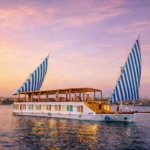
When you travel with us aboard our traditional Dahabiya vessels, this tour comes with significant advantages. Your full-time Egyptologist guide (decades of specialization) travels with you throughout your Nile journey. By the time you reach Karnak, they already know your interests, your curiosity level, your pace. Your small group—max 8-12 fellow travelers—means everyone hears clearly, questions are welcomed, and the guide can adjust timing to where fascination strikes.
Most importantly: timing. Dahabiya schedules allow sunrise arrivals at Karnak Temple, before the massive tour groups descend. You experience the Great Hypostyle Hall in golden morning light, nearly alone, when the space feels most sacred. This isn’t just convenience—it’s transformation.
Ready to understand Karnak Temple rather than just photograph it? Let us take you inside.
Whether you choose our 4-night classic Nile cruise or 7-night extended journey, Karnak Temple tour with our expert Egyptologists are included, giving you the deep understanding that transforms this ancient complex from overwhelming to unforgettable.
Walking Through Karnak Temple: A Guided Journey
Arrival: First Impressions
The van drops you at Karnak’s entrance just after sunrise. The air is still cool, golden light slanting across the parking area. Your guide—Dr. Amira, an Egyptologist who completed her PhD studying Karnak’s construction phases—gathers your small group of ten.
Before you stretch the avenue of ram-headed sphinxes, recently restored, leading toward the massive entrance pylon. Each sphinx has a small pharaoh figure protected between its paws. Hundreds of them line the processional way.
You squint against the morning sun. Carved figures. A pharaoh, larger than life, striking down enemies.
You pass through the gateway into the first courtyard, and the realization hits: this entrance pylon is just the beginning. The complex extends far beyond what you can see—temples within temples, halls beyond halls, sacred spaces layering into the distance.
The Great Hypostyle Hall: Forest of Stone
You walk through a smaller pylon, and suddenly the world goes dark.
Your eyes adjust. Then you see them.
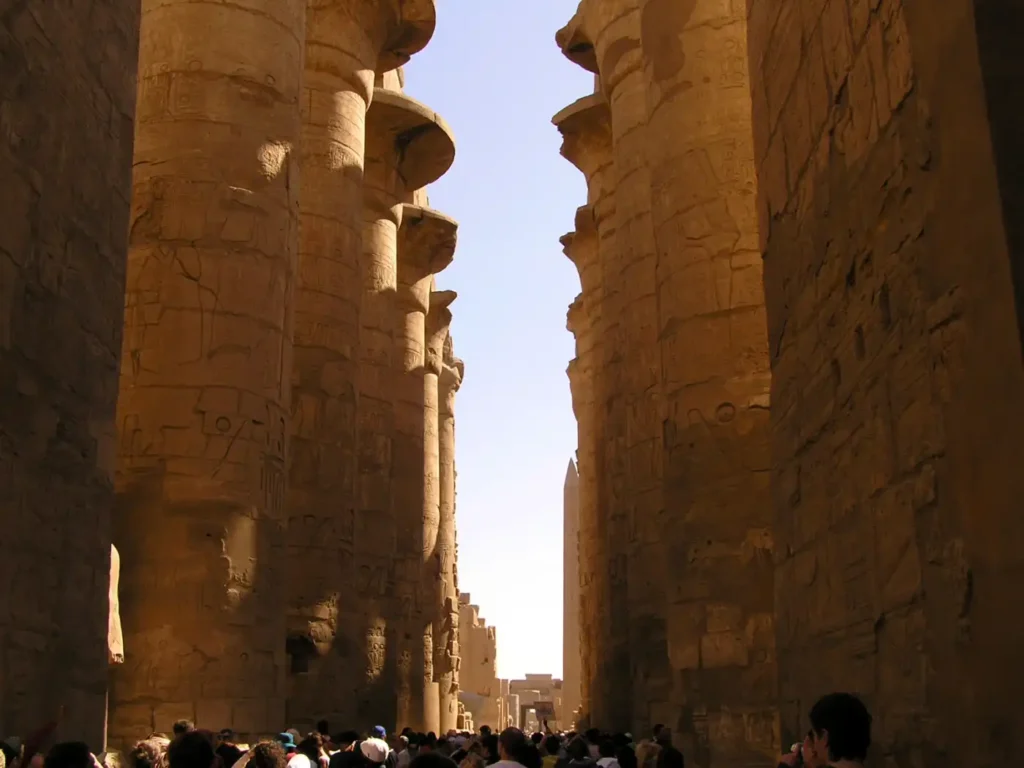
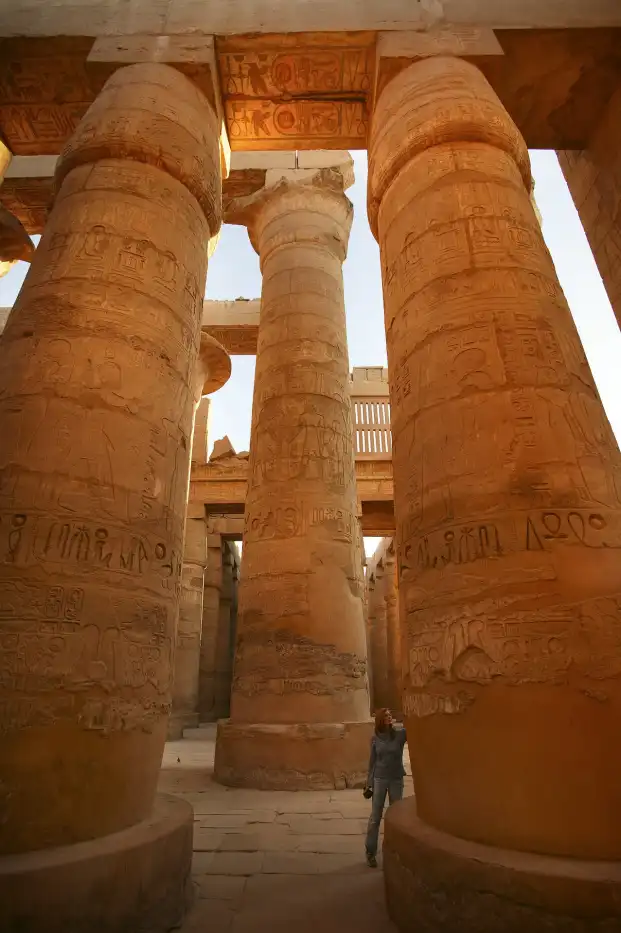
One hundred thirty-four columns rising from the stone floor like a petrified forest, each so massive it takes five people holding hands to encircle one. The central columns—the tallest—soar 21 meters high, wider than a bus, their capitals carved into open papyrus umbels that once supported a painted ceiling now long gone.
You stand in near-darkness, surrounded by stone giants. Shafts of light pierce through clerestory windows high above, illuminating swirling dust motes, creating an atmosphere both mystical and overwhelming. The scale doesn’t compute. Your brain can’t process how humans carved these columns, moved them, erected them, decorated them.
It took 200 workers to move one column, imagine coordinating that across 134 columns. Now imagine carving every surface with hieroglyphs. This hall represents the life’s work of hundreds of artisans over decades.
Our guide walks you toward the central aisle. “This hall replicates a papyrus marsh—the primordial swamp where, according to Egyptian mythology, creation began. The central columns are papyrus with open umbels—mature plants. The side columns have closed buds—young plants. The roof was painted blue with stars, representing the sky. The floor represents earth. You’re walking through the moment of creation itself. Every temple replicates this cosmology.”
You look up. Light streams through the clerestory windows—narrow openings between the different roof heights of central and side aisles. The effect is theatrical, almost divine.
She leads you to a column covered with carved hieroglyphs. “This cartouche—Seti I. This one—Ramesses II. Father and son both left their marks here. Seti began the hall. Ramesses completed it, then carved his name over much of his father’s work.” She smiles. “Even pharaohs engaged in self-promotion.”
A relief catches your eye: a pharaoh in a chariot, bow drawn, enemies fleeing in chaos.
Another column shows offering scenes: the pharaoh presenting food, incense, and clothing to Amun-Ra.
You look up one more time, light streaming through high windows, columns vanishing into shadow, and you feel it: awe bordering on reverence. You understand, suddenly, why pharaohs kept building here for 2,000 years. Some places demand to be made sacred.
The Sacred Lake: Where Priests Purified
Emerging from the Great Hypostyle Hall into blinding sunlight feels like surfacing from deep water. You blink, eyes adjusting, the heat already building despite the early hour.
You arrive at a rectangular pool of still water reflecting the morning sky. The Sacred Lake: approximately 120 meters by 77 meters, stone-lined, water supplied by groundwater connected to the Nile.
Priests bathed here before performing rituals, purity was essential—physical and spiritual. Four times daily, they entered the lake, washed completely, dressed in fresh linen, then proceeded to the temple. Without purification, approaching the god was forbidden.
Near the lake stands a massive granite scarab statue on a pedestal.
“Khepri, the scarab god, associated with rebirth and transformation—the scarab beetle rolls dung balls, and Egyptians believed it rolled the sun across the sky. Pilgrims walked around this scarab seven times, believing it brought blessings. Want to try?
Some of your group walk around the scarab, smiling, half-joking but also half-believing. Even millennia later, the impulse to participate in ritual remains.
You sit on a warm stone at the lake’s edge, looking at the reflection of columns in still water. Dr. Amira gives you time—no rush, no schedule pressure. A few minutes to simply be present.
The Avenue of Sphinxes: Ancient Procession Route
Our Egyptologist guide leads you toward the southern edge of the complex, where an avenue of ram-headed sphinxes stretches toward the horizon—recently restored, hundreds of them lining a processional way that once connected Karnak Temple to Luxor Temple, three kilometers away.
Once a year, during the Opet Festival, priests carried sacred barques—ceremonial boats—containing statues of Amun, his consort Mut, and their son Khonsu from Karnak to Luxor Temple. Crowds lined this avenue. Musicians played drums and sistra. Incense burned. The gods traveled among their people.
You walk a short section of the avenue, imagining the procession: priests in white linen, crowds singing, the sacred barques swaying on the shoulders of carriers, smoke and music and the palpable belief that divinity itself was passing by.
This wasn’t metaphor, Egyptians believed the god inhabited the statue. When it moved, the god moved. When it rested in Luxor Temple for days, the god was visiting. This procession was the most important event in Thebes’s religious calendar—proof that the gods were present, engaged, protecting Egypt.
Hidden Corners
Then the guide leads you away from the main tourist path toward the complex’s eastern section.
The Festival Hall of Thutmose III
You enter a hall with unusual architecture—columns shaped not like papyrus or lotus, but like tent poles.
Thutmose III built this to commemorate his military campaigns in Syria,the tent-pole columns reference the military encampments where he lived during those campaigns. Look at the walls.
You see reliefs depicting exotic plants and animals: strange birds, unfamiliar flora, creatures Egyptians had never seen before.
Egypt’s earliest botanical garden—carved in stone. Thutmose brought back specimens from his campaigns and had them documented here. Evidence that Egyptian interest in the world extended beyond their borders.
The Chapels of the Hearing Ear
This is crucial,Common Egyptians couldn’t enter the temple. Only priests, pharaohs, and authorized personnel. But religion wasn’t just for elites. Look at these chapels.
You peer into a small chamber. The walls are carved with ears—dozens of them, all sizes.
Chapels of the Hearing Ear,where ordinary people came here to pray, believing the god Amun listened through these carved ears. They left offerings, petitioned for help, and sought blessings. These chapels prove that despite temple restrictions, regular Egyptians had direct access to divine power.
The Akhenaten Blocks
In a storage area, our expert guid points to reconstructed stone blocks covered with unusual carvings.
Akhenaten—the heretic pharaoh who tried to replace all gods with one sun god, the Aten—built temples here at Karnak. After his death, priests systematically dismantled his monuments, using the blocks as fill in later construction. Archaeologists have spent decades extracting and reconstructing them.
Then points out differences: the art style is more naturalistic, less formal than traditional Egyptian reliefs. The subject matter focuses obsessively on the sun disk.
Akhenaten’s religious revolution failed, but these blocks prove it happened. Evidence of Egypt’s most dramatic theological crisis—when one pharaoh tried to overturn 2,000 years of polytheistic tradition.
The priesthood opposed him. The people resisted. When he died, his successor—Tutankhamun—restored the old gods, and Egypt worked systematically to erase Akhenaten from history. But you can’t erase stone. These blocks survived.
What Makes a Great Karnak Temple Tour
After three hours walking through Karnak Temple with Dr. Amira, you understand something crucial: without her, you would have been lost.
Not physically lost—there are paths, signs, other tourists to follow. But intellectually and spiritually lost. You would have photographed impressive columns without understanding they represent creation mythology. You would have seen reliefs without reading the stories they tell. You would have walked through halls without experiencing how sacred space intensifies toward the divine.
This is what separates a great Karnak tour from wandering alone:
Expert Egyptologist Guide
Our expert egyptologist guides didn’t consult guidebooks or memorize scripts. She read hieroglyphs on sight, explained obscure symbolism fluently, answered complex questions without hesitation, and shared insights from decades of specialized research. Her PhD dissertation focused on Karnak’s construction phases—she knows this complex as intimately as most people know their neighborhoods.
This level of expertise transforms Karnak from confusing to comprehensible, from overwhelming to revelatory.
Optimal Timing
Your sunrise arrival at Karnak Temple meant experiencing the Great Hypostyle Hall in golden light with minimal crowds. By the time massive tour groups arrived around 9:30 AM, you were finishing, having had the most sacred spaces nearly to yourselves.
This timing advantage—a signature benefit of traveling with Turquoise Dahabiya—isn’t just logistical convenience. It’s the difference between sacred and commercial, contemplative and chaotic.
Small Group Intimacy
Ten people. Small enough that everyone heard Dr. Amira clearly without megaphones or earpieces. Small enough that questions were welcomed and answered thoroughly. Small enough that pacing adjusted to genuine interest—lingering in the hypostyle hall because the group was fascinated, moving quickly through less significant areas.
Compare this to tour groups of 40+ people where half can’t hear the guide, questions get dismissed, and pacing follows a rigid schedule regardless of interest.
Flexible Pacing and Personalization
When Margaret asked about women’s roles in ancient Egyptian religion, Dr. Amira didn’t brush it aside—she spent ten minutes discussing female pharaohs, priestesses, and goddesses, because the question revealed genuine curiosity. When Tom wanted extra time photographing the hypostyle hall’s light shafts, the group waited, because the Dahabiya wasn’t leaving on a fixed schedule.
This flexibility—impossible on rigid tour itineraries—allows your Karnak tours to become conversations rather than lectures, explorations rather than checklists.
Integration with Broader Journey
Your tour wasn’t an isolated site visit. It was part of a broader Luxor experience integrated into your multi-day Nile journey aboard the Dahabiya. Yesterday, you visited the Valley of the Kings. Tomorrow, you’ll explore Luxor Temple. Dr. Amira connects these sites, showing how they form a coherent sacred geography.
This integration—unique to extended Nile cruises like Turquoise Dahabiya’s Luxor itineraries—means Karnak Temple makes sense within Egypt’s broader religious and cultural landscape, not as an isolated monument.
Our 4-night Luxor to Aswan journey includes Karnak Temple alongside the Valley of the Kings, Edfu, and Kom Ombo—perfect for first-time visitors. For deeper exploration, our 7-night extended itinerary adds hidden sites like Esna Temple and authentic Nubian village experiences, allowing more time to absorb each temple’s significance.
Practical Essentials for Your Karnak Temple Tour
What to Bring:
- Comfortable walking shoes with good support—you’ll walk 2-3 kilometers on stone surfaces
- Sun protection: wide-brimmed hat, high-SPF sunscreen, sunglasses with UV protection
- Water bottle (1-2 liters)—dehydration is the most common problem visitors face
- Modest clothing covering shoulders and knees (temple etiquette and sun protection)
- Camera—photography is permitted throughout
- Small daypack for essentials
- Cash for any purchases at the entrance area
Physical Expectations:
- Duration: 2.5–3.5 hours for thorough tour
- Walking distance: Approximately 2-3 kilometers within the complex
- Terrain: Mostly flat stone surfaces, some uneven areas, occasional stairs
- Shade: Very limited—most areas are exposed to sun
- Accessibility: Some areas have stairs or narrow passages; inform your guide in advance of mobility concerns
Best Times to Visit:
- Season: October–April (temperatures 20–30°C, comfortable for extended walking)
- Time of day: Sunrise to 9 AM (optimal light, cooler temperatures, fewer crowds)
- Avoid: 10 AM–2 PM when heat intensifies and large tour groups arrive
- Alternative: Late afternoon (4–6 PM) offers softer light but more crowds than morning
What to Expect:
- Security screening at entrance (standard, quick)
- Entrance fees typically included in guided tours
- Restrooms available near entrance; limited facilities inside
- Vendors near entrance selling souvenirs, drinks—prices are negotiable
- The complex is actively excavated and restored—you may see archaeologists at work
Temperature Management:
- October–April: Pleasant, 20–30°C daytime, bring light layers for early morning coolness
- May–September: Hot, 35–42°C+, requires sunrise touring and significant hydration
- Heat exhaustion is real—drink water continuously, take breaks in shade, don’t push through dizziness
Ready to experience Karnak Temple with expert guidance that transforms confusion into comprehension? Contact Turquoise Dahabiya to plan your Luxor journey with PhD Egyptologist guides who bring ancient Egypt to life.
Why Karnak Temple isn’t Optional—They’re Essential?
Here’s the uncomfortable truth: without an expert guide, most visitors leave Karnak Temple having seen it but not understood it.
They photograph the massive columns. They walk through the halls. They check “Karnak Temple” off their Egypt bucket list. Then they leave, vaguely impressed but fundamentally confused. What did they just see? Why does it matter? How does it fit into ancient Egyptian civilization?
Without a guide, Karnak Temple is:
- Overwhelming: 100 hectares, no clear path, no obvious narrative
- Confusing: Whose cartouche is that? Why are there multiple pylons? What do these reliefs mean?
- Exhausting: You wander aimlessly in heat, waste energy on less significant areas, miss the highlights
- Photographed but not comprehended: Pretty pictures, zero understanding
With an expert Egyptologist guide, Karnak Temple becomes:
- Comprehensible: Guide provides structure, explains what you’re seeing, connects pieces into coherent narrative
- Fascinating: Stories behind reliefs brought alive, rituals explained, history made personal
- Efficient: Hit the essential areas, skip redundancies, optimize energy and time
- Transformative: You leave understanding why Karnak mattered—and matters still
The difference is profound. It’s the difference between tourism and education, between seeing and understanding, between checking a box and being changed.
Your Karnak Temple Tour Begins Here
Experience Karnak Temple as part of your Nile journey:
Scared Waters – 4 Day Dahabiya Nile Cruise Aswan to Esna – Karnak Temple, Valley of the Kings, Edfu, Kom Ombo, and Aswan with expert Egyptologist guides. Perfect for first-time visitors seeking Egypt’s essential highlights.
Elegant Scape – 7 Days Private Dahabiya Nile Cruise – Everything in the classic route plus Gebel el-Silsila’s ancient quarries, El-Kab’s forgotten ruins, and immersive Nubian village experiences. Ideal for those seeking deeper cultural connection and unhurried exploration.
Want a private, customized experience?
Contact our Egyptology specialists who’ll design a Karnak Temple tour focused on your specific interests—whether that’s architecture, mythology, hieroglyphs, or daily life in ancient Egypt.
The largest religious complex in the ancient world is waiting. Experience it aboard Turquoise Dahabiya with guides who show you not just what it was, but what it means.