
Have you ever boarded a Nile cruise only to feel overwhelmed by crowds, tight schedules, and a rushed itinerary?
If so, you’re not alone. Many travelers come to Egypt seeking something deeper—something quieter, slower, and more meaningful.
An old fashioned Nile cruise, known today as a Dahabiya Nile cruise, offers exactly that. It’s not just a journey between Luxor and Aswan—it’s a return to the golden age of travel, where time slows down, the Nile sets the pace, and every moment feels personal, authentic, and unforgettable.
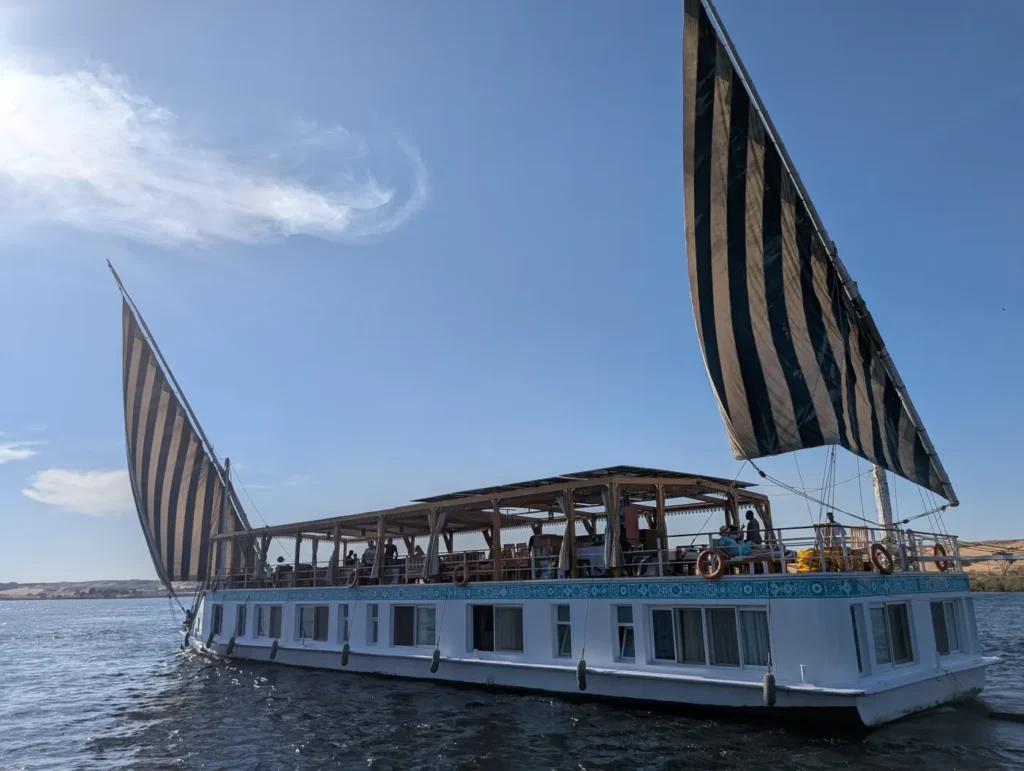
How Nile Travel Worked in the 1800s?
Before steamships, trains, or massive cruise liners, the Nile River itself was Egypt’s main highway. Travelers moving between Cairo, Luxor, and Aswan had one primary option: chartering a Dahabiya, the traditional Egyptian sailing vessel that would become their floating home for weeks or even months.
Sailing with the Wind
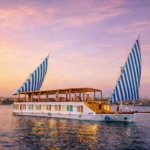
Dahabiyas were elegant wooden boats powered entirely by wind and current, featuring two tall lateen sails that caught the prevailing north winds as vessels traveled upstream from Cairo toward Luxor and Aswan. Traveling downstream, the Nile’s current did most of the work while crew adjusted sails to maintain control. This meant journeys unfolded at nature’s pace—sometimes brisk when winds were favorable, sometimes languid when winds died and the boat drifted peacefully with barely perceptible movement.
- Travel times were measured in weeks, not days—Cairo to Aswan could take three to six weeks depending on wind and stops
- No engines meant profound silence broken only by water, wind, sails, and the occasional call of crew members
- Weather and river conditions determined daily progress; travelers learned patience and presence rather than demanding fixed arrival times
Life On Deck
The Dahabiya became a traveler’s entire world for the duration of the journey. Unlike today’s cruise ships with their entertainment complexes and crowded promenades, life centered on the open deck where passengers spent most waking hours.
- Mornings began with coffee or tea served on deck as the Nile’s mist lifted to reveal palm-lined banks and distant desert cliffs
- Days unfolded in reading, sketching, writing journals, watching riverbank life, and conversing with fellow travelers
- Meals were simple but atmospheric affairs—tables set on deck with linens, lanterns, and whatever provisions had been loaded at the last major town
Cabins were small, simple chambers below deck—often just large enough for a narrow bed, a trunk for belongings, and a washstand. Travelers packed their lives into steamer trunks rather than wheeled suitcases, and wrote by lamplight rather than posting to social media. The lack of modern distractions forced a different kind of travel—deeper observation, slower absorption, more meaningful connection to place.
Days Shaped by the River
Unlike today’s rigid itineraries with printed departure times and mandatory excursions, old-fashioned Nile cruises followed rhythms dictated by wind, crew capabilities, and traveler whims.
- Passengers decided how long to stay at temples—one traveler might spend three days sketching hieroglyphs at Philae while another spent a week camping near Abu Simbel
- Mooring happened wherever suited the moment: quiet islands, village landings, deserted banks opposite temple ruins
- Provisions were gathered through stops at riverside markets where crew bartered for bread, vegetables, chickens, and fresh water
This flexibility created journeys that felt more like expeditions than vacations—each traveler’s Nile experience was genuinely unique, shaped by their interests, the season they traveled, and serendipitous encounters along the way.
Who Chose This Way of Traveling the Nile?
The old fashioned nile cruise attracted a particular breed of traveler—those for whom the journey itself mattered as much as the destination, and who possessed both the time and resources to embrace months-long adventures.
The Writers on the Nile
Novelists, poets, and essayists found the Nile’s slow pace perfect for creativity and reflection. Gustave Flaubert famously sailed up the Nile in 1849-50, filling journals with observations that would shape his later work. Florence Nightingale traveled by Dahabiya in 1849, writing detailed letters home that reveal both the grandeur and the domestic intimacy of river life. Amelia Edwards, whose 1877 book “A Thousand Miles Up the Nile” became a Victorian bestseller, spent an entire winter aboard a chartered Dahabiya, sketching temples and documenting landscapes with passionate precision.
- These writers treated the Dahabiya as a moving study—mornings spent exploring temples, afternoons devoted to writing and sketching onboard
- Extended stays at sites allowed deep observation impossible during brief modern shore excursions
- The isolation and quiet of river travel provided space for the contemplation that produces great writing
Nobles and Grand Tours
Wealthy European and American families included Egypt in their “Grand Tour” itineraries, often spending entire winters escaping cold northern climates. For them, chartering a Dahabiya was akin to renting a private villa—they brought servants, luggage trunks full of formal clothing, and often hired musicians or additional staff.
- Families might spend three to six months traveling up and down the Nile, treating it as a seasonal residence rather than a brief vacation
- Children were tutored onboard, learning ancient history by visiting the actual sites their lessons described
- Social life developed among the small community of travelers—Dahabiyas would moor together at popular sites, and passengers would visit neighboring boats for tea or dinner
Archaeologists and the Age of Discovery
The 19th century witnessed Egypt’s rediscovery by European scholars, and the Dahabiya was their essential research vessel. Howard Carter, before discovering Tutankhamun’s tomb, spent seasons traveling by Dahabiya to survey sites. Archaeologists could anchor near promising locations for weeks, conducting excavations while living aboard.
- Extended access to remote sites enabled serious archaeological work impossible with modern cruise schedules
- Scholars traveled with libraries of reference books, measuring instruments, and drawing supplies that filled entire cabins
- The slow pace allowed relationships with local guides and workers who shared knowledge of hidden tombs and forgotten ruins
Why This Style of Nile Travel Disappeared?
The transformation from intimate Dahabiya journeys to mass tourism cruise ships didn’t happen overnight—it unfolded across decades as technology, economics, and changing travel expectations reshaped how people experienced the Nile.
The Arrival of Steam and Speed
Steamships appeared on the Nile in the mid-1800s, initially coexisting with traditional Dahabiyas but gradually offering an alternative for travelers with less time. Thomas Cook, the pioneering travel entrepreneur, began organizing steamship tours in the 1870s that promised Cairo to Aswan in days rather than weeks. The appeal was obvious: businessmen and tourists with limited vacation time could now “do” Egypt in a fraction of the time.
- Steamships adhered to fixed schedules, making travel predictable and easier to coordinate with railway and hotel bookings
- Group tours with set itineraries lowered costs through economies of scale, making Nile travel accessible to middle-class tourists
- The romantic allure of sail gave way to Victorian efficiency—why drift for weeks when you could steam upriver in comfort?
The Rise of Mass Tourism Infrastructure
The 20th century accelerated these changes dramatically. Railways connected Luxor and Aswan to Cairo and Alexandria. Roads allowed bus tours to major temples. By the 1960s and 70s, purpose-built cruise ships—floating hotels with hundreds of cabins—began dominating the Luxor-Aswan route.
- Modern cruise ships process thousands of tourists through identical itineraries with military precision
- Shore excursions became brief, scheduled visits where guides herd groups through temples on tight timetables
- The intimacy of small-boat travel vanished beneath the economic logic of volume tourism
What Was Lost in the Transformation
Mass tourism made Egypt accessible to millions who otherwise could never afford the time or expense of traditional Dahabiya travel. This democratization brought genuine benefits. Yet something essential disappeared in the process:
- Silence and slowness: Modern cruise ships run on engines and electricity, filling the air with mechanical hum; their schedules prioritize efficiency over contemplation
- Flexibility to linger: When you’re on a 200-passenger ship with a fixed itinerary, you visit Edfu Temple for exactly 90 minutes whether the light is magical or the crowds overwhelming
- The feeling of private voyage: Sharing the Nile with a handful of companions feels fundamentally different from sharing it with hundreds of strangers following identical routes
The trade-off became clear: convenience and affordability in exchange for the intimate, unhurried immersion that defined classic Nile travel. For decades, travelers accepted this bargain because alternatives seemed to have vanished entirely.
How Dahabiyas Revive the Old-Fashioned Nile Cruise Today?
The Dahabiya never completely disappeared—it survived in small numbers, overshadowed by mass tourism but preserved by Egyptians who recognized its value. In recent decades, discerning travelers weary of crowded cruise ships have rediscovered these elegant vessels, and companies like Turquoise Dahabiya have refined the experience into something that honors tradition while embracing modern comfort.
What a Modern Dahabiya Offers?
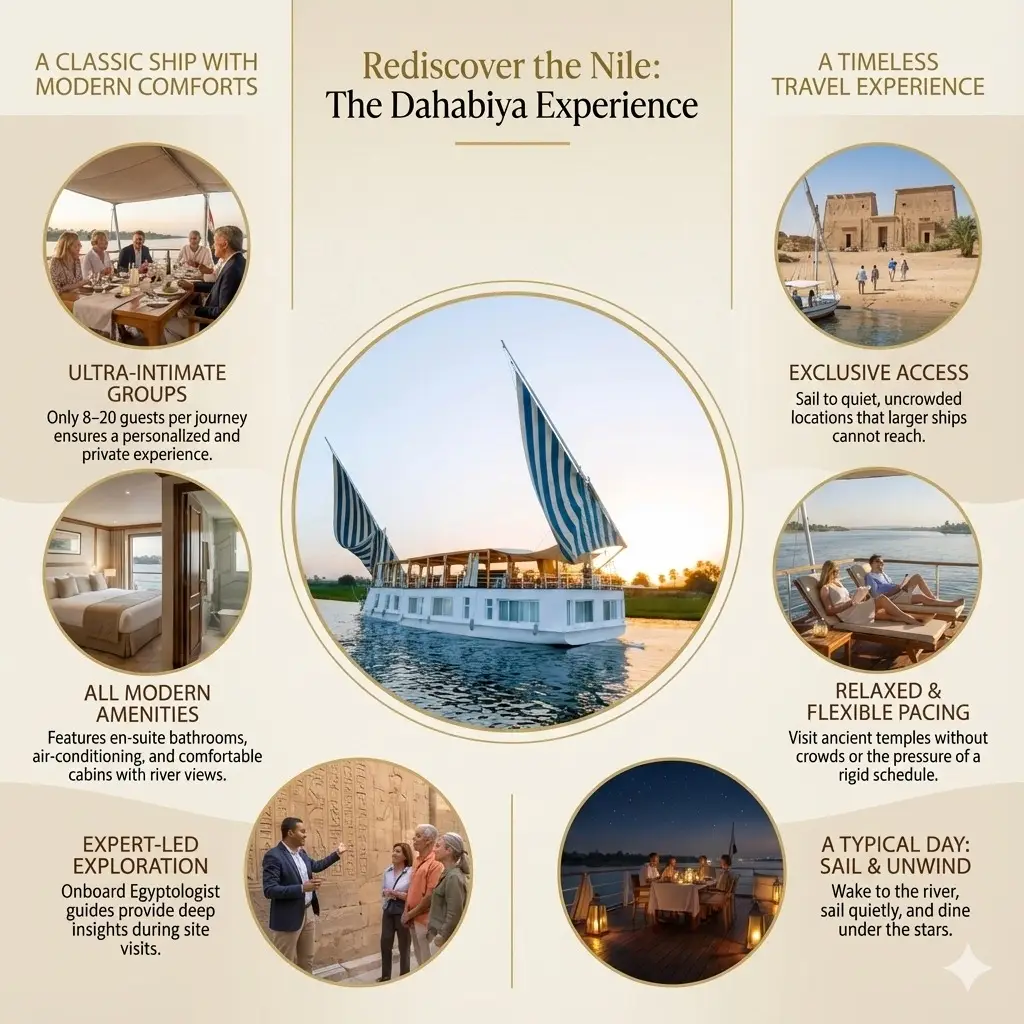
Today’s Dahabiyas like Turquoise blend the intimate scale and sailing focus of 19th-century vessels with contemporary safety, service, and amenities. A modern Dahabiya typically accommodates just 8-20 guests (Turquoise Dahabiya hosts a maximum of 16) in elegantly appointed cabins with en-suite bathrooms, air conditioning, and large windows framing Nile views.
The vessels still feature traditional two-masted lateen sail configurations, and while a small motor assists when winds are unfavorable or schedules require, the emphasis remains on natural, quiet sailing. This isn’t about rejecting modernity—it’s about using technology selectively to preserve the essential character of slow river travel while ensuring guest comfort and safety.
- Small guest numbers mean genuine personal attention from crew and guides, not the anonymous service of large ships
- Ability to moor at quiet islands, deserted banks, and lesser-known sites inaccessible to large cruise vessels
- Flexible pacing that allows lingering at temples when light and atmosphere are perfect, or departing early when sites are crowded
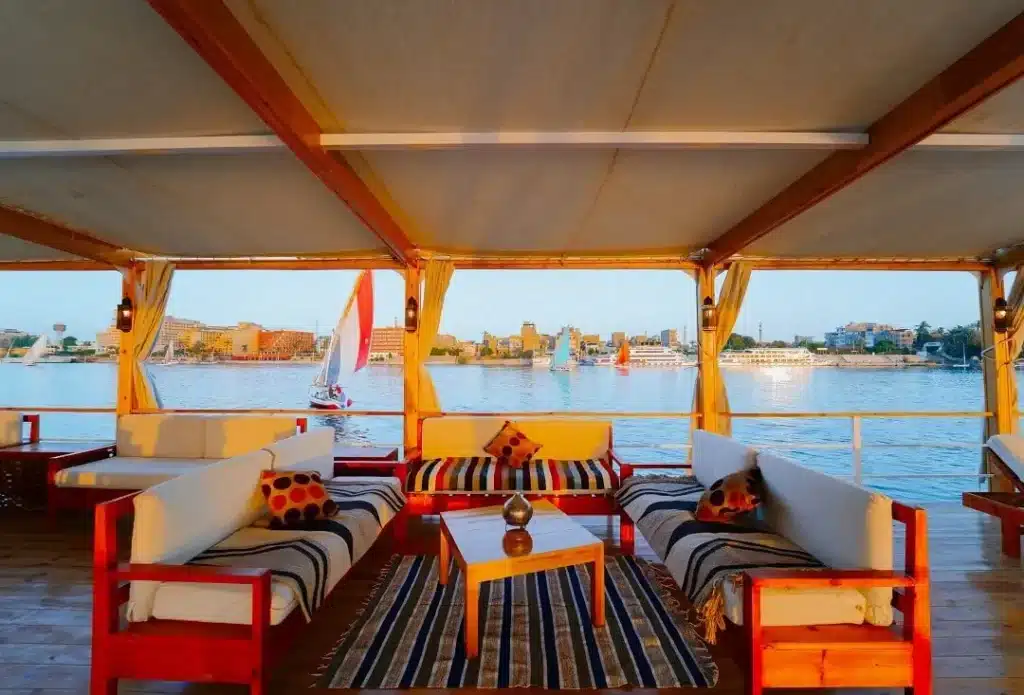
- Open sun decks and shaded lounging areas where the river remains your constant companion, not something glimpsed briefly between ship activities
The Turquoise Dahabiya Difference
While several companies operate Dahabiyas on the Nile today, Turquoise Dahabiya distinguishes itself through thoughtful curation that balances old-world atmosphere with modern expertise. When you sail with Turquoise Dahabiya, you’re not simply replicating the past—you’re experiencing an elevated version that retains everything essential about traditional Nile travel while adding contemporary polish.
Expert Egyptologist Guidance: Unlike 19th-century travelers who relied on hired dragomans of varying knowledge, Turquoise Dahabiya Nile cruise itineraries between Luxor and Aswan include qualified Egyptologist guides who transform temple visits from sightseeing into genuine education. They read hieroglyphs, explain religious symbolism, answer questions at length, and adjust their commentary to match your interests.
Thoughtful Cuisine and Service: Meals aboard the classic old fashioned cruise were often rustic affairs dependent on what provisions could be sourced at river villages. Today’s Turquoise Dahabiya serves thoughtfully prepared Egyptian and international cuisine using fresh ingredients, accommodates dietary restrictions with advance notice, and creates dining experiences—breakfast on deck as you moor at sunrise, lunch served family-style under shade canopies, dinner by lantern light under stars—that evoke the past while meeting contemporary standards.
Elegant Accommodations: Our Dahabiya cabins and suites provide private bathrooms, comfortable beds, climate control, and tasteful décor that references traditional Egyptian craftsmanship without sacrificing modern comfort. You experience the intimacy and atmosphere of old-world Nile travel without sleeping on narrow berths or washing from basins.
Curated Flexibility: The beauty of Dahabiya travel has always been its adaptability. Turquoise maintains this spirit—if you want to swim at a quiet island, we moor there. If you’re fascinated by a particular temple and want extra time, we adjust. If you’d rather skip an optional excursion and read on deck, that’s honored. Discover how a Turquoise Dahabiya itinerary works day by day and you’ll see this flexibility woven throughout.


What an Old-World Day on a Turquoise Dahabiya Looks Like
Let the abstract become concrete—here’s how a typical day unfolds when you choose this style of Nile travel, showing how the spirit of classic pre-mass tourism cruising lives on with modern grace.
Waking to the Nile at First Light
You wake naturally—no loudspeaker announcements, no corridor noise from hundreds of passengers preparing for mandatory breakfast seatings. Soft morning light filters through your cabin window, illuminating the palms and fields sliding past as the Dahabiya drifts with barely perceptible movement. You dress at your own pace and climb to the sun deck where crew has already set out fresh coffee, tea, warm Egyptian bread, local honey, and seasonal fruit.
Perhaps two or three fellow travelers join you, conversation flowing easily over breakfast without the chaos of crowded buffet lines. Your Egyptologist appears, coffee in hand, mentioning that you’ll reach Edfu Temple around mid-morning. There’s no rush—the temple has stood for two millennia; another hour makes no difference.
Temples Without the Rush
By 9:30 AM, the Dahabiya moors near Edfu. With just 16 guests, disembarkation takes minutes, not the 45-minute ordeal of large ships. You walk to the Temple of Horus as a small group—your guide can speak at normal volume, and you can actually hear the responses and ask follow-up questions without competing with five other tour groups.
Inside the temple, your guide reads hieroglyphs aloud, explaining how this perfectly preserved Ptolemaic sanctuary functioned. When you pause to photograph a particular relief, no one rushes you—there’s no schedule pressure, no massive group waiting impatiently behind. You spend two hours at Edfu, genuinely understanding rather than superficially photographing, then return to the Dahabiya for lunch while other ships are still processing their crowds through.
Quiet Afternoons Under Full Sails
After lunch, the crew raises sails and the Dahabiya glides south toward Kom Ombo. You’ve chosen to spend the afternoon on deck with a book, periodically looking up to watch feluccas pass, egrets fishing in the shallows, farmers working fields that have been cultivated since pharaonic times. A couple from your group sketches in watercolors. Another passenger naps in the shaded lounge.
This is the heart of what makes an old-world Nile cruise distinctive: unhurried time where the journey itself becomes the destination. You’re not being entertained or managed—you’re simply present with the river, exactly as travelers were 150 years ago, but with comfortable seating, cold drinks, and the knowledge that your next shower will be in a modern bathroom rather than poured from a basin.
Dinner by Romantic Light
As sunset turns the western cliffs copper and gold, the Dahabiya moors on an uninhabited island. Dinner is served on deck—tables set with linens and lanterns, the menu featuring grilled Nile perch, Egyptian mezze, fresh salads, local wines. Conversation flows easily among the 16 guests who’ve become familiar companions over several days. Your guide joins the table, and someone asks about tomorrow’s visit to Kom Ombo’s crocodile mummies. The discussion weaves through ancient Egyptian religion, modern archaeology, and personal travel experiences.
After dinner, you remain on deck under stars so brilliant they seem impossible to urban dwellers. The only sounds are water lapping the hull, distant village sounds carrying across the river, perhaps the haunting notes of a nay flute from a nearby felucca. This moment—this profound quiet broken only by natural sounds—is what’s missing from mass tourism. And it’s what travelers in the 1800s experienced nightly, just as you’re experiencing it now.
Ready to Experience the Nile Before Mass Tourism
The frustration you felt imagining crowded ships and rushed schedules wasn’t misplaced—it was your instinct recognizing that the Nile deserves better. The river that carried pharaohs and inspired writers for millennia shouldn’t be experienced as a checklist ticked between breakfast buffets and gift shop stops.
An old fashioned nile cruise isn’t actually old-fashioned at all—it’s simply the right-sized, right-paced way to travel one of the world’s most storied rivers. When you see our Turquoise Dahabiya Nile cruise routes, you’ll notice they cover the same temples and sites as large ships, but the experience of reaching them differs entirely. You’ll move quietly, linger thoughtfully, and return each evening to a vessel that feels like a private yacht shared with a handful of interesting companions rather than a floating hotel shared with hundreds of strangers.
Whether you have four nights or seven, whether you’re traveling solo, as a couple, or with close friends, Turquoise Dahabiya creates the space for the kind of Nile journey you’ve been imagining—the one that lets you breathe, observe, absorb, and return home genuinely transformed rather than merely photographed. Contact our team to design your own slow Nile journey and discover how modern comfort and old-world elegance create something more meaningful than either could alone.
Frequently Asked Questions About an Old Fashioned Nile Cruise
What is an old fashioned Nile cruise?
An old fashioned Nile cruise is a traditional way of sailing the Nile that focuses on slow travel, wind-powered sailing, and an intimate connection with the river, rather than large ships and crowded modern cruise ports.
How is an old fashioned Nile cruise different from modern Nile cruises?
Unlike modern cruise ships, an old fashioned Nile cruise is typically conducted on a Dahabiya, a small sailing boat with fewer cabins, quieter routes, and a more personal, relaxed atmosphere.
Is an old fashioned Nile cruise still comfortable and luxurious?
Yes. While the experience reflects traditional Nile sailing, modern Dahabiyas like Turquoise Dahabiya combine classic charm with refined comfort, elegant cabins, and attentive service.
Who is an old fashioned Nile cruise best suited for?
This type of cruise is ideal for travelers who value authenticity, privacy, and cultural depth, including couples, honeymooners, and travelers seeking a peaceful, crowd-free Nile experience.
Why choose Turquoise Dahabiya for an old fashioned Nile cruise?
Turquoise Dahabiya preserves the spirit of traditional Nile sailing while offering a carefully curated journey, personalized service, and access to serene river locations beyond the reach of large cruise ships.
The Nile was never meant to be rushed.
If you truly want to experience its beauty, history, and soul—then an old fashioned Nile cruise aboard a Dahabiya is the journey you’ve been looking for.