


What secrets does the ancient Egyptian Dendera Zodiac actually reveal—and how can you decode this 2,000-year-old astronomical masterpiece?
Understanding the ancient Egyptian Zodiac isn’t just about recognizing pretty carvings—it’s the difference between seeing ancient art and understanding ancient wisdom, between photographing a ceiling and grasping how priests tracked celestial cycles with stunning precision. In this guide, we break down how to read the zodiac, what astronomical knowledge it contains, and how visiting Dendera Temple as part of your Nile journey can transform your understanding of ancient Egypt—so you can experience this masterpiece with true comprehension.
What You Need to Know About the Ancient Egyptian Dendera Zodiac?
Before we decode its secrets, here’s what every visitor should understand:
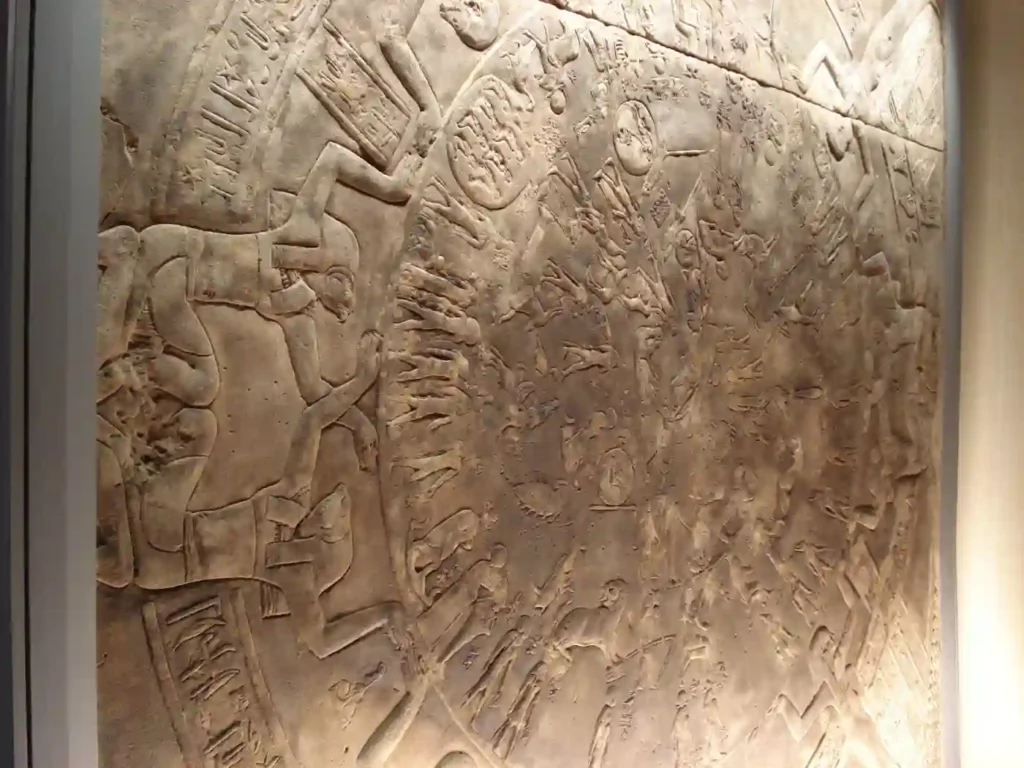
- What It Is: The Dendera Zodiac is a circular astronomical ceiling relief approximately 2.5 meters in diameter, carved into the ceiling of a small chapel on the roof of Dendera Temple (Temple of Hathor). It depicts a complete 360° map of the night sky as ancient priests observed it around 50 BCE.
- Where to See It: The original ancient Egyptian Zodiac was removed in 1821 and now resides in the Louvre Museum in Paris. However, a detailed replica remains installed in its original location at Dendera Temple, approximately 60 kilometers north of Luxor. Most travelers experience the zodiac in its sacred context at Dendera Temple itself—accessible as part of extended Nile cruise itineraries.
- When It Was Created: Around 50 BCE during the Ptolemaic period, when Greek rulers governed Egypt. The zodiac represents a fascinating synthesis of Egyptian astronomical traditions (decans, deities, sacred geometry) with Greek Hellenistic astrology (the 12 zodiac signs).
- Why It Matters: This Zodiac is the only complete ancient zodiac ceiling found in Egypt. It proves that Ptolemaic-era priests possessed sophisticated astronomical knowledge—they tracked planetary movements, predicted eclipses, calculated celestial cycles, and mapped the heavens with remarkable precision. This wasn’t primitive superstition. This was science woven into spirituality.
- Visiting Context: Dendera Temple is not typically included in standard 3–4 night Nile cruises, which focus on the Luxor–Aswan corridor. However, extended Nile journeys—particularly those aboard Dahabiya vessels with flexible itineraries—can include Dendera Temple as a half-day or full-day excursion from Luxor. This flexibility allows you to experience one of Egypt’s most intellectually fascinating sites without sacrificing the core temple circuit.
Ready to Experience Dendera? Explore our Luxor Extended Route that includes both Dendera and the Village of Garagos with dedicated Egyptologist guides who specialize in ancient astronomy.

The Ancient Egyptian Zodiac: What You’re Actually Looking At?
Walk into the rooftop chapel at Dendera Temple, look up, and you’ll see a circular stone relief that has mystified scholars, astrologers, and travelers for two centuries. But what are you actually seeing?
The Structure: Three Rings of Cosmic Knowledge
The Egyptian Zodiac is organized in three concentric rings, each representing a different layer of astronomical and spiritual knowledge:
The Outer Ring: The 36 Egyptian Decans
The outermost ring depicts 36 figures—deities and symbolic representations of the Egyptian decans. Decans were 10-day divisions of the year, totaling 360 days (plus five epagomenal days to complete the solar year). Each decan corresponded to a specific group of stars that rose heliacally (at dawn) during that 10-day period.
For ancient Egyptians, decans weren’t just timekeeping tools—they were divine beings who governed fate, protected travelers, and influenced the success of agricultural cycles. Priests used decans to determine when to plant crops, perform temple rituals, and celebrate festivals aligned with the Nile’s flood.
The Middle Ring: The 12 Greek Zodiac Signs
The middle ring shows the 12 zodiac constellations familiar to modern astrology: Aries, Taurus, Gemini, Cancer, Leo, Virgo, Libra, Scorpio, Sagittarius, Capricorn, Aquarius, and Pisces. This is the Greek contribution to the Egyptian Zodiac.
However, the zodiac signs aren’t depicted exactly as they appear in Western astrology. Egyptian symbolism blends with Greek forms. For example, Cancer (the crab) is often shown as a scarab beetle—a sacred Egyptian symbol of transformation and rebirth. Leo remains a lion, but styled in Egyptian artistic conventions. This hybrid iconography reveals how Ptolemaic priests synthesized two cultural traditions into one coherent system.
The Inner Circle: Planetary Positions and Celestial Events
The innermost circle is the most scientifically sophisticated element of this Zodiac. It shows the positions of planets—Jupiter, Saturn, and others—at a specific moment in time. Scholars have used these planetary positions to astronomically date the zodiac to approximately 50 BCE, likely during the reign of Cleopatra VII.
This inner circle also contains symbols representing celestial events: eclipses, conjunctions (when planets align), and possibly references to the precession of the equinoxes (Earth’s 26,000-year axial wobble—though this remains debated).
The Supporting Framework: Gods Holding the Sky
Surrounding the zodiac, 36 figures—representing Egyptian deities—support the heavens. Chief among them is the goddess Nut, who personified the sky. Her body arches over the earth, swallowing the sun each evening and birthing it each dawn. The god Shu, representing air, holds Nut aloft, separating sky from earth.
This framing isn’t decorative—it’s theological. The ancient Egyptian Dendera Zodiac embodies the Egyptian belief that the cosmos is divine, ordered, and supported by gods. The heavens don’t just exist; they are actively maintained by divine will.
What this Zodiac Reveals About Ancient Astronomy?
it isn’t simply art. It’s a functional astronomical instrument—a star map, ritual calendar, and astrological tool combined. Here’s what it reveals about the sophistication of Ptolemaic-era astronomy:
Planetary Tracking with Precision
The zodiac’s inner circle shows the positions of Jupiter, Saturn, and other visible planets at a specific moment. Scholars have reverse-calculated these positions and determined the zodiac depicts the sky as it appeared around 50 BCE.
This means ancient priests at Dendera Temple were systematically observing and recording planetary movements over years—possibly decades. They understood that planets move against the backdrop of fixed stars, following predictable cycles. Jupiter’s 12-year orbit, Saturn’s 29-year cycle—these weren’t mysteries to them. They were tracked, calculated, and recorded.
Eclipse Prediction: The Saros Cycle
One of the most remarkable aspects of the Egyptian Zodiac is evidence that priests understood eclipse patterns. Specifically, they appear to have known about the Saros cycle—an 18-year, 11-day pattern after which eclipses repeat.
Certain symbols on the zodiac correspond to nodes where the sun and moon’s paths intersect—the precise locations where eclipses occur. This suggests that Dendera Temple priests could predict when solar and lunar eclipses would happen, allowing them to prepare rituals, interpret omens, and demonstrate their cosmic authority.
Eclipse prediction wasn’t trivial. It required decades of continuous observation, meticulous record-keeping, and mathematical calculation.
The Precession Debate: Did They Know?
Here’s where the ancient Egyptian Zodiac becomes controversial.
Some researchers argue that the zodiac encodes knowledge of Earth’s axial precession—a slow wobble in Earth’s rotation that causes the position of stars to shift over a 26,000-year cycle. If true, this would mean ancient Egyptians understood an astronomical phenomenon that wasn’t “officially” discovered until Greek astronomer Hipparchus described it around 150 BCE.
The evidence? The placement of certain constellations on the zodiac appears slightly shifted from where they “should” be relative to the cardinal directions. This shift, some argue, accounts for precessional movement.
However, mainstream Egyptologists remain skeptical. The shift could be artistic license, symbolic rather than literal, or simply a quirk of how the zodiac was designed. Proving precession knowledge requires more definitive textual evidence—which hasn’t been found.
Still, the debate itself reveals how sophisticated the ancient Egyptian Zodiac is. Whether or not they understood precession, they were clearly tracking celestial cycles with extraordinary precision.
A Cosmic Calendar for Temple Rituals
The zodiac wasn’t just academic—it was functional. Priests used it as a ritual calendar to determine auspicious times for temple ceremonies.
Certain festivals at Dendera Temple were tied to celestial events. The annual “Feast of the Beautiful Reunion,” celebrating the union of Hathor (goddess of Dendera) with Horus (god of Edfu), was timed according to stellar alignments. Priests consulted the zodiac to ensure rituals occurred when cosmic forces were favorable.
In this sense, the ancient Egyptian Dendera Zodiac was a sacred technology—bridging the divine and the practical, the mystical and the mathematical.
Want to Decode the Zodiac with an Expert? Our Sacred Astronomy Tour specializes in Egypt’s celestial temples, with extended interpretation time at Dendera focused on astronomical symbolism and ancient observational techniques.
How Egyptian and Greek Astronomy Merged in the Zodiac?
It is a cultural hybrid—a masterpiece born from the collision of two civilizations.
Egyptian Contributions: Decans and Divine Cosmology
Egyptian astronomy predates the Greeks by millennia. The 36 decans on the zodiac’s outer ring are purely Egyptian, developed during the Middle Kingdom (2000 BCE) and used continuously for over 1,500 years before the zodiac was carved.
Egyptians saw the cosmos as populated by gods. Every star, every constellation, every celestial movement had divine meaning. Time wasn’t abstract—it was governed by deities who controlled the seasons, the Nile flood, and human destiny.
Greek Contributions: The 12-Zodiac System
The 12-sign zodiac system came from Babylonian astronomy, transmitted to Greece through Alexander the Great’s conquests. By the Ptolemaic period (305–30 BCE), Greek astrology had spread throughout the Mediterranean, including Egypt.
Greek astrology was more individualistic than Egyptian cosmology. It focused on personal horoscopes—predicting an individual’s fate based on the positions of planets and stars at their birth. This was a new idea in Egypt, where astrology had traditionally been used for state purposes (crowning pharaohs, predicting Nile floods, timing wars).
The Synthesis: A New System
The Egyptian Zodiac merges both traditions. The outer ring (Egyptian decans) governs collective time—festivals, agriculture, temple rituals. The middle ring (Greek zodiac) allows for personal astrology—individual destinies mapped onto celestial cycles. The inner circle (planetary positions) bridges both—tracking the gods’ movements through the heavens.
This synthesis wasn’t accidental. Ptolemaic rulers were Greek, but they governed Egypt by presenting themselves as pharaohs—adopting Egyptian religion, building temples in Egyptian style, and supporting the priesthood. Dendera Temple itself was extensively rebuilt and expanded during this period.
The zodiac is political theology made visible. It proclaims: “We honor both traditions. Greek knowledge and Egyptian wisdom are united under our rule.”
Visiting Dendera Temple as Part of Your Nile Journey
Dendera Temple isn’t typically included in standard 3–4 night Nile cruises, which focus on Luxor, Edfu, Kom Ombo, and Aswan. However, extended itineraries—especially aboard Dahabiya vessels—can incorporate Dendera as a half-day or full-day excursion.
From Luxor: Dendera is 60 km north (approximately 1.5 hours by car). Many Nile cruise operators offer Dendera Temple as an optional add-on or include it in 5–7 night itineraries. Book a Dendera-inclusive Dahabiya cruise and travel with specialized Egyptologist guides who decode temple iconography—transforming your visit into deep astronomical education.
Best Time to Visit: Early morning (7:00–9:00 AM) before tour groups arrive. The light is softer, the temple is quieter, and you have time to absorb the zodiac without crowds pushing past. Late afternoon (4:00–5:30 PM) is second-best, though expect more visitors.
What to Bring:
- Sun protection (hat, sunscreen—Dendera can be exposed and hot)
- Comfortable walking shoes (uneven stone floors, rooftop stairs)
- Water bottle (limited facilities onsite)
Time Needed: 2–3 hours for a thorough visit to Dendera Temple, including the zodiac, main temple halls, crypts, sacred lake, and rooftop terraces.

What Else to Experience at Dendera Temple?
The ancient Egyptian Dendera Zodiac is the headline attraction, but Dendera Temple rewards deeper exploration:
- The Temple of Hathor: One of Egypt’s best-preserved temples. Massive columns carved with Hathor’s face (goddess of love, music, joy), vibrant ceiling paintings still showing color after 2,000 years, and relief carvings depicting Cleopatra VII—one of the few surviving images of Egypt’s last pharaoh.
- The Crypts: Underground chambers with rare reliefs showing secret temple treasures and rituals. Claustrophobic but fascinating.
- The Rooftop Terraces: Multiple levels offering panoramic views of the Nile Valley and surrounding desert. The zodiac chapel is on one of these terraces—experiencing it as part of the temple’s vertical architecture deepens understanding.
- The Sacred Lake: Where priests performed purification rituals before entering the temple. The lake is now dry, but the stone-lined basin remains.
- The Mammisi (Birth House): A small chapel dedicated to the divine birth of Hathor’s child. Covered in reliefs showing childbirth, divine motherhood, and protection rituals.
Dendera Temple isn’t just about the zodiac—it’s a complete sacred complex revealing how ancient Egyptians understood divinity, cosmos, and ritual.
Conclusion: Decoding the Sky of Ancient Egypt
The ancient Egyptian Dendera Zodiac stands as one of humanity’s most profound bridges between art, science, and spirituality. More than a carved ceiling, it is a celestial manuscript—one that reveals how priests of ancient Egypt viewed the heavens as a living, divine order. By blending Egyptian cosmology with Greek astronomy, the Dendera Zodiac transformed the night sky into a sacred text, charting planetary paths and divine forces with astonishing precision.
Today, standing beneath the zodiac’s circular relief at Dendera Temple allows travelers to witness this timeless conversation between earth and sky. Each figure, each star, each symbol tells a story of observation, devotion, and genius. Visiting the temple during your Nile journey isn’t just sightseeing—it’s stepping into the mind of ancient astronomers who measured eternity. To truly understand ancient Egypt, look up at Dendera’s ceiling and see how the ancients turned the cosmos into stone.
FAQ: Ancient Egyptian Dendera Zodiac Questions Answered
What is the zodiac constellation Dendera?
The Dendera Zodiac is an ancient Egyptian bas-relief on the ceiling of the Hathor Temple at Dendera. It shows the twelve zodiac signs surrounded by Egyptian constellations, blending astronomy with mythology in a unique cosmic map.
Did ancient Egypt have zodiac signs?
Yes. The Egyptians used star groups and constellations long before Greek astrology. The Dendera Zodiac later merged Egyptian star lore with the twelve classical zodiac signs, showing how ancient Egypt connected heaven and earth.
Where is the original Dendera zodiac?
The original Dendera Zodiac is now displayed in the Louvre Museum in Paris. It was removed from the Temple of Hathor in the 19th century, while a detailed replica remains in place at Dendera in Egypt.
How to solve Dendera zodiac puzzle?
To “solve” the Dendera Zodiac, scholars compare its star positions with modern astronomy. Most date it around 50 BCE, interpreting it as both an astronomical chart and a symbolic map of creation in ancient Egyptian belief.








[…] Temple of Hathor at Dendera; the famous astronomical ceiling and zodiac; return sailing; farewell evening […]