


What do you actually know about the Great Sphinx of Giza facts— beyond the sand, the missing nose, and that iconic silhouette? Most people have seen the photos. Far fewer know the real story.
This guide covers everything: the confirmed facts, the debated mysteries, the myths that need to die, and what it actually feels like to stand in front of it. If you’re planning a trip to Egypt — or simply fascinated by ancient history — read on.
Quick Facts: Great Sphinx of Giza at a Glance
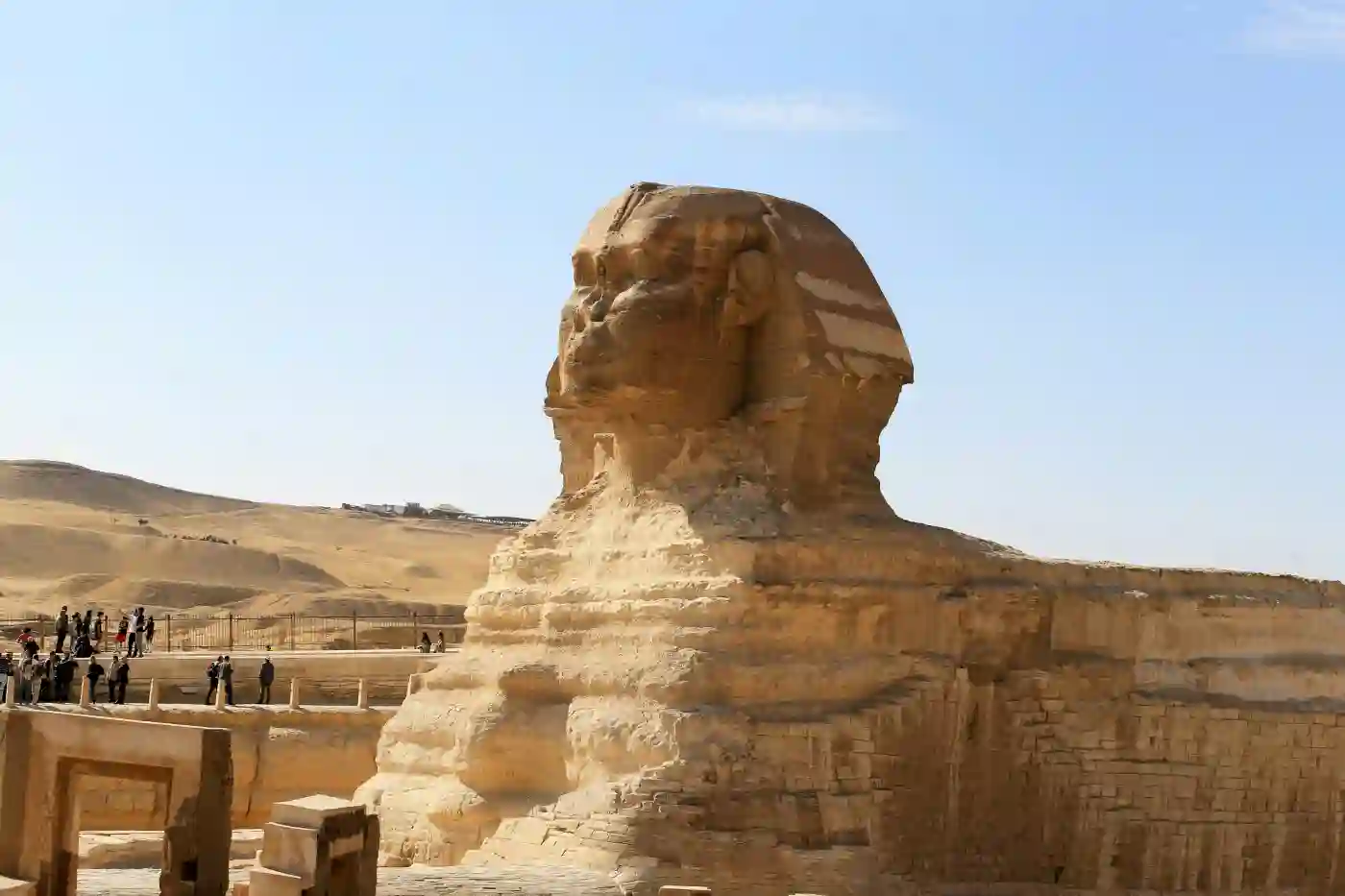
Before diving into the details, here are the essential numbers:
- Location: Giza Plateau, west bank of the Nile, near Cairo, Egypt
- Length: 73 meters (240 feet) — roughly the length of a city block
- Height: 20 meters (66 feet) — as tall as a six-story building
- Age: Approximately 4,500 years old, built around 2500 BC
- Material: Natural limestone bedrock, carved as a single monolith
- Builder (most likely): Pharaoh Khafre, Fourth Dynasty, Old Kingdom
- Ancient Egyptian name: Hor-em-akhet (“Horus of the Horizon”)
- Record: The world’s largest monolithic statue
The Sphinx has a lion’s body and a human head, believed to represent Pharaoh Khafre, wearing the royal nemes headdress. The remains of a uraeus (royal cobra) are still visible on the forehead. Its face once bore a ceremonial beard — fragments of which are now in the British Museum and the Cairo Museum.
How Old Is the Great Sphinx of Giza?
The Great Sphinx of Giza is approximately 4,500 years old. Most Egyptologists date its construction to around 2500 BC, during the reign of Pharaoh Khafre in ancient Egypt’s Fourth Dynasty Old Kingdom period.
That said, the age of the Sphinx is not universally agreed upon — and the debate is genuinely fascinating.
The mainstream Egyptological position, supported by the Egyptian Ministry of Antiquities, places construction between 2558 and 2532 BC during Khafre’s reign. The archaeological evidence is compelling:
- The Sphinx sits directly in alignment with Khafre’s pyramid and valley temple
- The facial features closely match surviving statues of Khafre
- The limestone blocks cut during the Sphinx’s construction were reused in the adjacent Sphinx Temple, suggesting the two were built at the same time
However, a minority of scholars — most notably geologist Robert Schoch of Boston University — argue the Sphinx is far older. Schoch identified deep water erosion on the body of the statue that, he argues, could only have been caused by prolonged heavy rainfall. Since Egypt hasn’t seen that kind of rainfall since before 5000 BC, this would push the Sphinx’s origins back to at least 7,000 years ago, and possibly much further.
The Egyptian Antiquities Authority rejects this theory. The debate continues.
Who Built the Great Sphinx of Giza?
The most widely accepted answer is Pharaoh Khafre, who ruled Egypt around 2558–2532 BC and built the second-largest pyramid at Giza. However — and this is the part that surprises most people — there is not a single ancient inscription that directly says “Khafre built this.”
Three main theories exist:
Theory 1: Pharaoh Khafre (most supported) The Sphinx sits within Khafre’s funerary complex. Its face resembles surviving statues of Khafre. The construction timeline matches. Egyptologist Zahi Hawass considers this “indisputable.”
Theory 2: Pharaoh Khufu (Khafre’s father) Some scholars, including former German Archaeological Institute director Rainer Stadelmann, argue the facial style is more consistent with Khufu, the builder of the Great Pyramid. They suggest Khafre’s causeway was built to work around a pre-existing Sphinx.
Theory 3: Djedefre (Khafre’s half-brother) In 2004, Egyptologist Vassil Dobrev proposed that Djedefre built the Sphinx in the image of his father Khufu, to honor him as a solar deity. This theory has fewer supporters but hasn’t been dismissed.
The honest answer is that we don’t know for certain — and that’s part of what makes the Sphinx so endlessly compelling.
How Big Is the Great Sphinx?
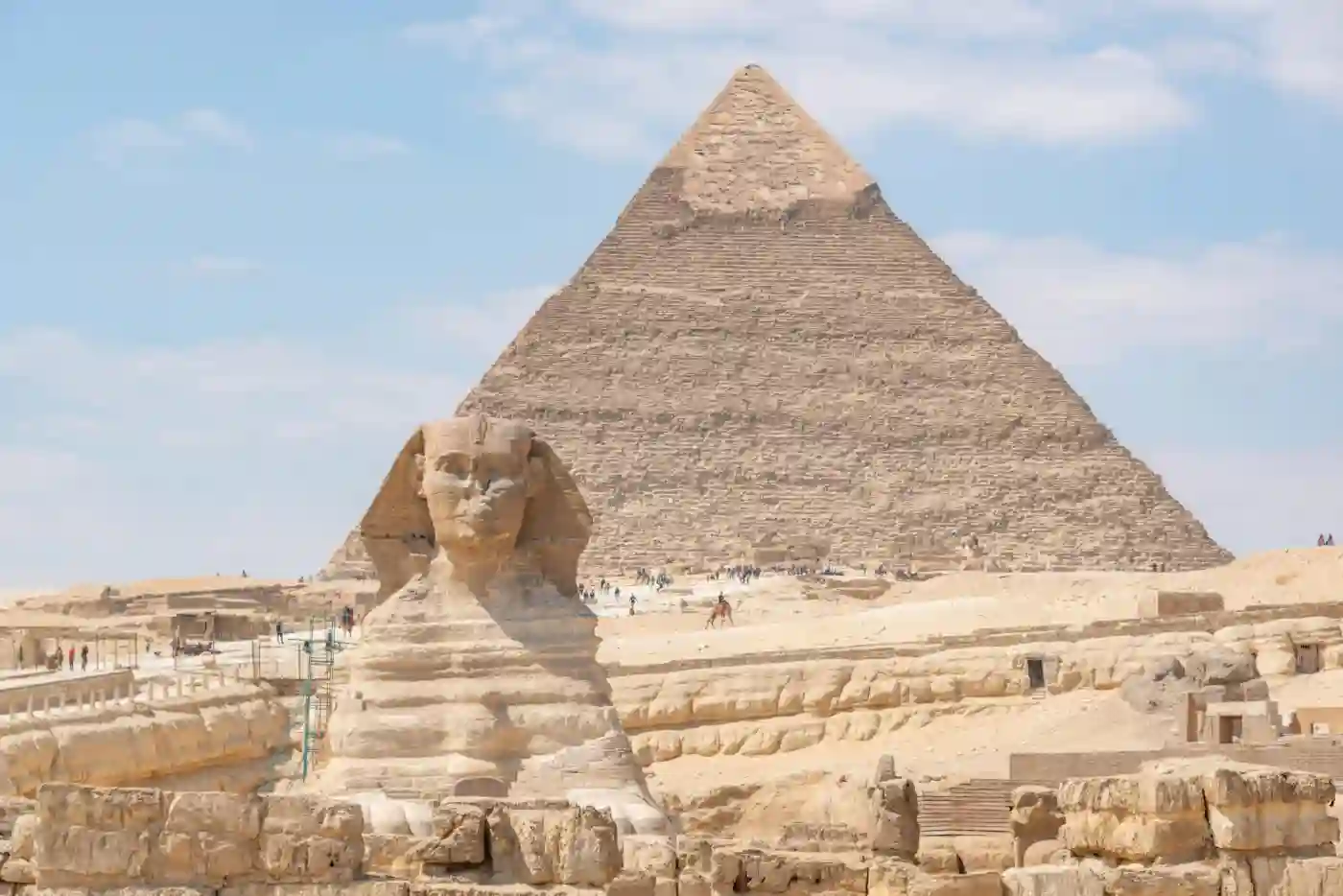
The Great Sphinx of Giza measures 73 meters (240 feet) long and 20 meters (66 feet) high. The face alone is approximately 4 meters (13 feet) wide. It is the largest monolithic statue in the world — meaning it was carved from a single piece of natural stone rather than assembled from separate blocks.
To put the scale in perspective: the Sphinx is roughly the same height as the White House in Washington D.C., and as long as a standard city block. Standing at ground level beside its paws, which are each about 15 meters long, the sheer size is difficult to process.
The body and head are made from different grades of limestone, which explains why they’ve aged so differently. The body was carved from softer yellowish stone and has eroded significantly. The head, carved from harder grey limestone, is far better preserved despite the missing nose and beard.
Why Is the Sphinx’s Nose Missing?
The short answer: it was deliberately broken off, almost certainly in the 14th or 15th century AD.
The Napoleon story is false. This is one of the most persistent myths in all of Egyptology. The story claims Napoleon’s soldiers shot off the nose with a cannon during the Egyptian Campaign of 1798. It is entirely fabricated. Drawings made by Danish explorer Frederic Louis Norden in 1737 — more than 30 years before Napoleon was even born — already show the Sphinx completely without its nose.
What actually happened? The most credible account comes from medieval Egyptian historian Al-Maqrizi, who wrote that a Sufi Muslim named Muhammad Sa’im al-Dahr deliberately chiseled off the nose around 1378 AD, reportedly offended by local Egyptians making offerings to the statue as an act of worship. According to the account, he was later punished for the act.
Egyptologist Mark Lehner, one of the world’s leading Sphinx scholars, considers the existing evidence consistent with an intentional break rather than gradual natural erosion. Notably, the fragments of the nose have never been found — which supports the theory of deliberate removal rather than a fall.
10 Great Sphinx of Giza Facts You Need to Know
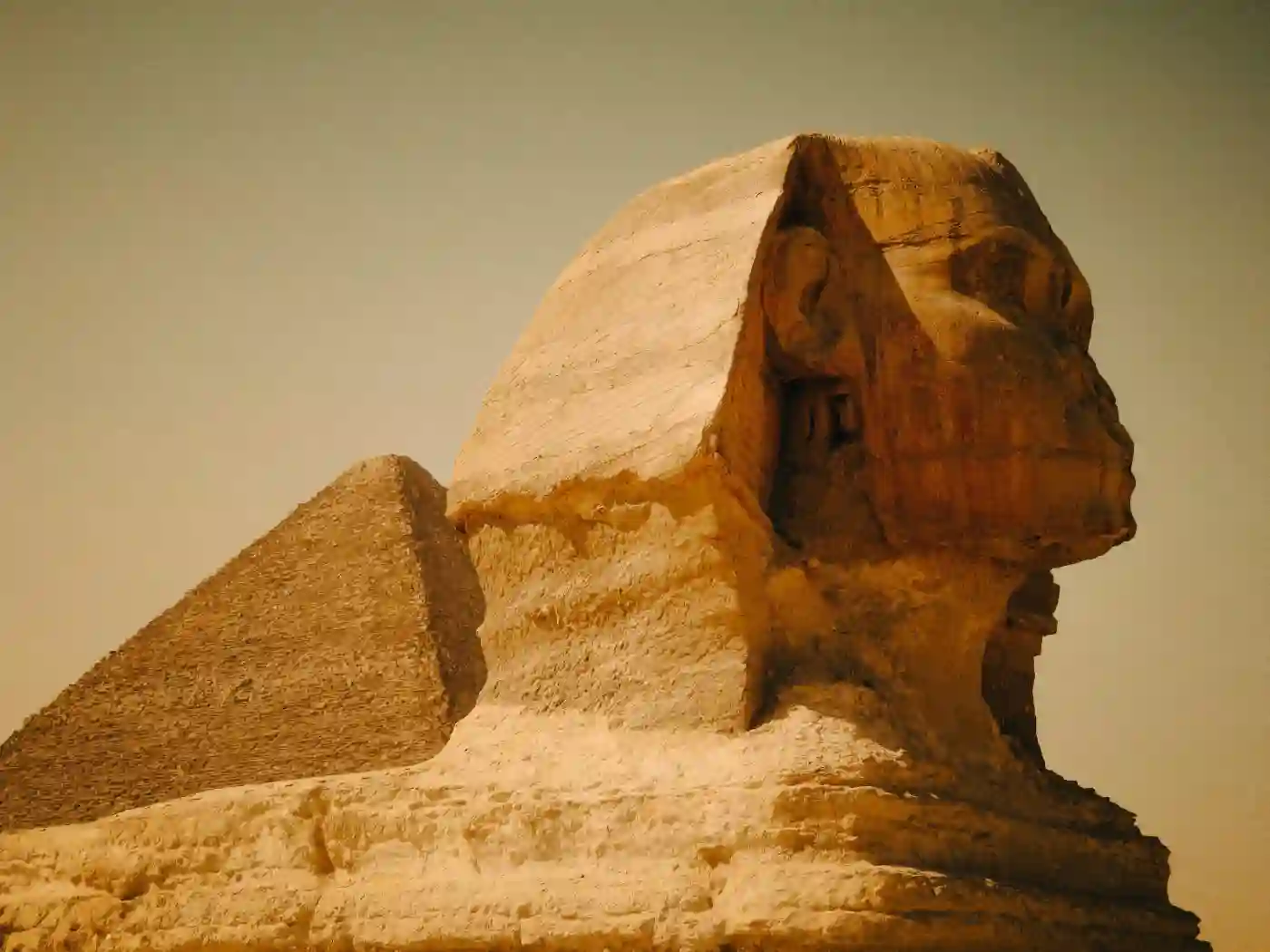
Here are the facts that go beyond the standard tourist brochure — verified, specific, and genuinely interesting.
1. It’s carved from a single piece of bedrock. The Sphinx wasn’t assembled from separate blocks — it was carved directly out of the natural limestone plateau at Giza. The stones removed during carving were immediately reused to build the adjacent Sphinx Temple in front of it.
2. No one took credit for building it. The ancient Egyptians were obsessive record-keepers. Temples and tombs are covered in inscriptions claiming credit for everything. The Sphinx has none — not a single contemporary text confirms who commissioned or built it.
3. It was once painted in vivid colors. Traces of red pigment survive on the face, with hints of blue and yellow found on the body. In its original form, the Sphinx looked nothing like the pale sandy stone we see today — it was brilliantly, dramatically painted.
4. The Napoleon nose story is completely false. Drawings made by Danish explorer Frederic Louis Norden in 1737 already show the Sphinx without its nose — 32 years before Napoleon was even born. The most credible account names a medieval Sufi iconoclast, Muhammad Sa’im al-Dahr, who deliberately chiseled it off around 1378 AD.
5. A pharaoh had a dream about it in 1400 BC. The Dream Stele — a pink granite slab still standing between the Sphinx’s paws — tells how Prince Thutmose IV fell asleep in the Sphinx’s shadow and dreamed it promised him the throne of Egypt if he cleared the sand burying it. He did. He became pharaoh.
6. It spent most of history completely buried. For the majority of its existence, only the head was visible above the desert dunes. The full body was not excavated until 1936 — meaning the Sphinx was essentially invisible for thousands of years of human history.
7. It faces the sunrise with astronomical precision. The Sphinx is oriented due east, facing the rising sun directly at the spring equinox near the 30th parallel — equidistant between the equator and North Pole. Most Egyptologists believe this alignment was entirely intentional.
8. Roman emperors visited it as tourists. By the Greco-Roman era, Giza had already become a tourist destination — ancient visitors carved graffiti on the monuments much like selfies today. Emperor Nero visited the Sphinx, and the site was cleared of sand specifically in his honor.
9. Construction may have been abandoned mid-project. Archaeologists Mark Lehner and Zahi Hawass discovered abandoned stone blocks, forgotten tools, and — one of the stranger finds in Egyptology — workers’ lunches left uneaten in place, suggesting the original plans were more ambitious than what was ever completed.
10. It was later worshipped as a god. Nearly 1,000 years after it was built, the Sphinx was actively worshipped as the solar deity Hor-em-akhet (“Horus of the Horizon”). Pharaoh Amenhotep II built an entire temple nearby dedicated to this cult — the statue had transformed from a guardian monument into a living deity.
What Does the Great Sphinx Symbolize?
The Great Sphinx represents the dual nature of the pharaoh: the lion’s body conveys physical power and strength, while the human head signifies wisdom, intelligence, and divine authority. Together, they express the Egyptian ideal of the ruler as both human and god.
In practical religious terms, the Sphinx served as a guardian of the Giza necropolis — a spiritual protector of the royal tombs. Its eastward gaze connected it to solar worship: facing the sunrise each morning associated it with Ra, the sun god, and with the concept of daily rebirth and renewal.
During the New Kingdom, this symbolism deepened. The Sphinx was actively worshipped as Hor-em-akhet, with pharaohs commissioning temples, stelae, and offerings in its name. It shifted from a guardian statue to a divine deity in its own right — a rare transformation for any monument.
Visiting the Great Sphinx: What Every Traveler Should Know
Seeing the Sphinx in person is a different experience from any photograph. The scale catches most visitors off guard — standing beside its paws, each of which is roughly the size of a London double-decker bus, rearranges your understanding of ancient ambition.
A few practical notes for travelers:
Tickets: The Sphinx is included in the standard Giza Pyramids ticket. No separate admission is required. Arrive early — the site opens at 8:00 AM and crowds build quickly after 10:00 AM.
Best time to visit: Early morning gives you the best light for photography (the sun hits the face directly from behind you at sunrise) and the coolest temperatures. Late afternoon creates long shadows and a different, more dramatic mood.
Photography: The most underrated angle is low to the ground, shooting upward with the paws in the foreground. It removes the crowd, shows the true scale, and produces a far more powerful image than the standard frontal shot.
The Sound and Light Show: Every evening, the Sphinx “narrates” the history of ancient Egypt while the plateau is bathed in colored light. It is genuinely worth an evening, particularly for first-time visitors.
Combine it with a Nile cruise: Cairo and the Sphinx are a natural starting point for an Egypt itinerary that continues south along the Nile. A Dahabiya Nile cruise from Luxor to Aswan takes you to Karnak, the Valley of the Kings, Edfu, Kom Ombo, and Philae — the rest of the civilization the Sphinx was built to guard.
Great Sphinx vs. Other Famous Sphinxes: A Quick Comparison
The Great Sphinx of Giza is not the only sphinx in Egypt — or the world. Here’s how it compares:
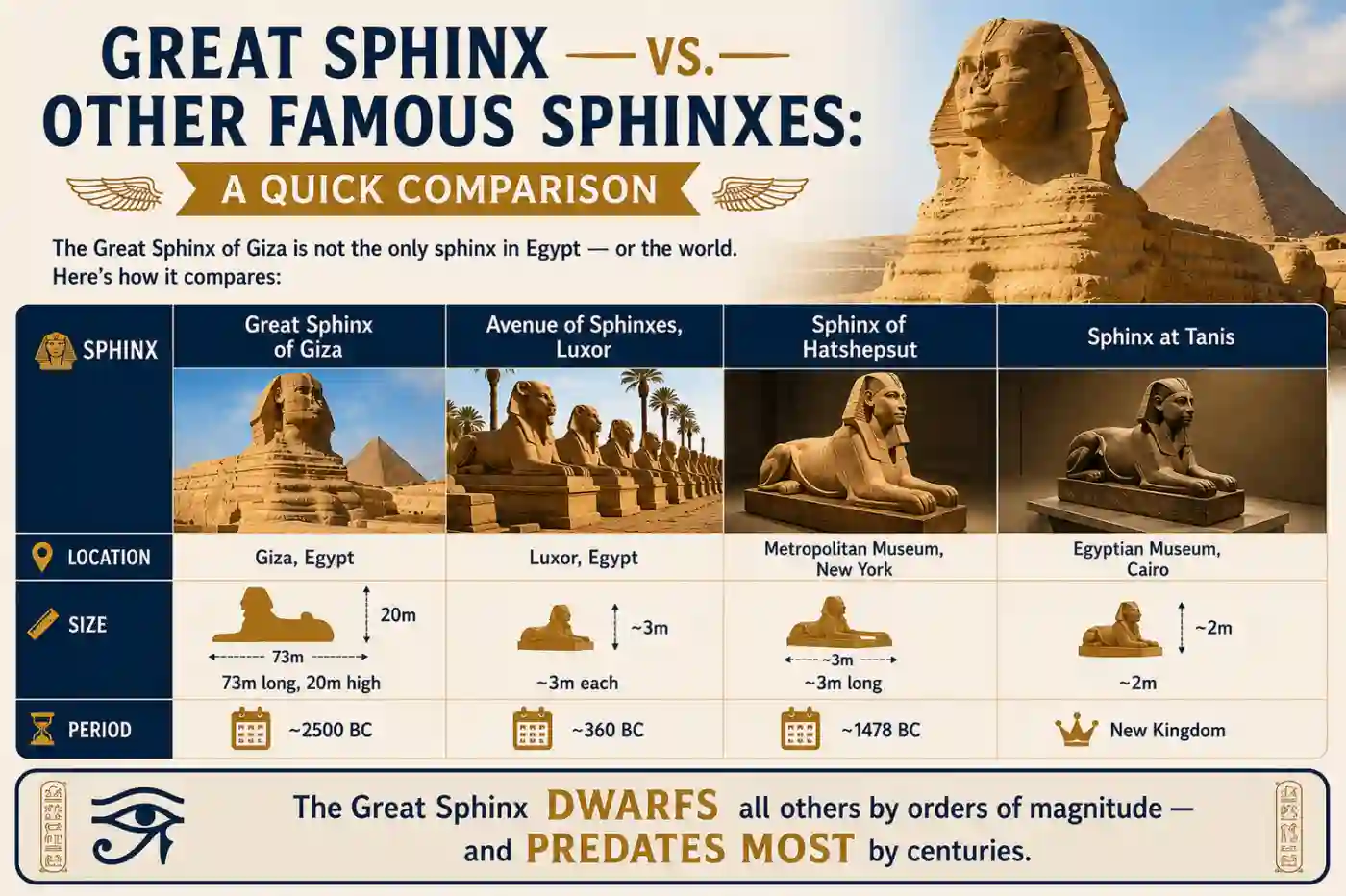
The Great Sphinx dwarfs all others by orders of magnitude — and predates most by centuries.
Myths About the Great Sphinx — Debunked
A monument this old accumulates myths faster than sand. Here are the most persistent ones and what the evidence actually shows:
Myth: Napoleon’s army destroyed the nose. False. Drawings from 1737 show it already missing. Napoleon was born in 1769.
Myth: There is a secret chamber or “Hall of Records” beneath the Sphinx. No confirmed chamber exists. Multiple investigations, including ground-penetrating radar surveys, have found no evidence of undiscovered artificial rooms beneath the monument.
Myth: Slaves built the Sphinx. False. Archaeological evidence from the workers’ village at Giza confirms the builders were skilled, paid laborers who received food, medical care, and organized working conditions.
Myth: The Sphinx is mentioned in the Bible. It is not. The Sphinx predates most biblical events and is not referenced in any biblical text.
Myth: The face of the Sphinx was originally that of a lion. This theory — popular in some alternative history circles — has no archaeological support. The head has always been human, though its specific identity remains debated.
FAQs About the Great Sphinx of Giza
How old is the Great Sphinx of Giza?
The Great Sphinx is approximately 4,500 years old, built around 2500 BC during the reign of Pharaoh Khafre in ancient Egypt’s Fourth Dynasty.
How big is the Great Sphinx of Giza?
The Sphinx is 73 meters (240 feet) long and 20 meters (66 feet) high. It is the world’s largest monolithic statue, carved from a single piece of natural limestone bedrock.
Who built the Great Sphinx of Giza?
Most Egyptologists credit Pharaoh Khafre, who ruled around 2558–2532 BC. However, no ancient inscription directly confirms this. Some scholars argue for Khufu or his son Djedefre.
Why is the Sphinx’s nose missing?
The nose was deliberately broken off, most likely in the 14th or 15th century AD. The story blaming Napoleon is false — drawings from 1737 already show the Sphinx without its nose. The most credible account names a medieval religious iconoclast as responsible.
Is there a hidden chamber beneath the Great Sphinx?
No confirmed hidden chamber exists. Ground-penetrating radar and multiple excavations have found only natural fissures and historical explorers’ dead-end shafts. The Egyptian Ministry of Antiquities states there are no undiscovered artificial chambers beneath the monument.
Final Thoughts
The Great Sphinx of Giza has been watching the desert sunrise for 4,500 years. Empires have risen and collapsed in its shadow. The sand has buried it and revealed it more times than history remembers. And still, after all of that, the most basic questions — who exactly built it, what it was truly meant to represent, and what (if anything) remains buried beneath its limestone feet — don’t have definitive answers.
That’s not a failure of archaeology. It’s the nature of deep time. Some things happened so long ago, in a world so different from our own, that certainty may simply be impossible.
What is certain is this: no photograph, no documentary, and no article — including this one — substitutes for standing in front of it. The scale, the silence of the early morning plateau, the weight of what you’re looking at — these things don’t translate.
If Egypt is on your list, a Dahabiya Nile cruise remains the most intimate and authentic way to experience the civilization the Sphinx was built to protect. From Luxor to Aswan, you sail the same river the pharaohs sailed — past temples, tombs, and landscapes that haven’t fundamentally changed in millennia.
Ready to experience Egypt? Explore our Nile cruise options →