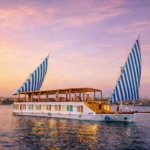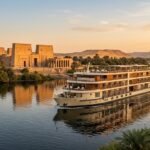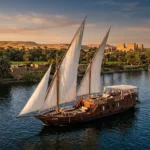

Have you ever wondered if the smaller towns between Luxor and Aswan are truly worth your time, or whether they’re just dusty stops on a rushed itinerary? Esna Egypt erases that doubt the moment you step inside its newly restored temple, where ceiling frescoes glow in blues and golds untouched for millennia, where hieroglyphs tell creation stories beneath a modern street, and where the Nile’s oldest lock system welcomes travelers into a world of unhurried discovery. With Turquoise Dahabiya, Esna becomes more than a checkpoint—it transforms into an intimate encounter with ancient wisdom, vibrant local culture, and the golden rhythm of slow Nile travel.
The Timeless Charm of Esna
Before you enter the temple that made this town legendary, take a moment to absorb Esna City itself. The air hums with the familiar sounds of Upper Egyptian life—vendors calling out prices for spices and fresh bread, children laughing near the corniche, feluccas bobbing gently at wooden docks. The scent of cardamom coffee drifts from roadside cafés, mingling with the earthy sweetness of the Nile at dawn.
Positioned approximately 55 kilometers south of Luxor, Esna Luxor connections have always been strong—both geographically and historically. Ancient Egyptians knew Esna as Latopolis, a thriving center where trade caravans met riverboats, where fishermen worshipped Khnum the creator, and where pilgrims traveled to honor the gods of fertility and craft. Today, that legacy remains palpable. The town rises from the western bank of the Nile with a quiet dignity, its streets layered with centuries of stories, its people carrying forward traditions of hospitality that predate the Pharaohs.
Unlike the grand sprawl of Luxor or the tourist bustle of Aswan, Esna offers something rarer: authenticity without performance. Markets serve locals first, visitors second. Workshops still produce traditional pottery using techniques passed down through generations. And at the heart of it all, buried nine meters below the modern street level, lies one of Egypt’s most astonishing—and most overlooked—archaeological treasures.
With Turquoise Dahabiya, Esna becomes more than a checkpoint—it transforms into an intimate encounter with ancient wisdom, vibrant local culture, and the golden rhythm of slow Nile travel.
This experience is beautifully captured in our 4-Day Dahabiya Nile Cruise from Aswan to Esna, designed for travelers who want depth, serenity, and authentic cultural moments rather than rushed sightseeing.
The Ancient Temple of Esna: A Hidden Treasure Beneath the Modern City
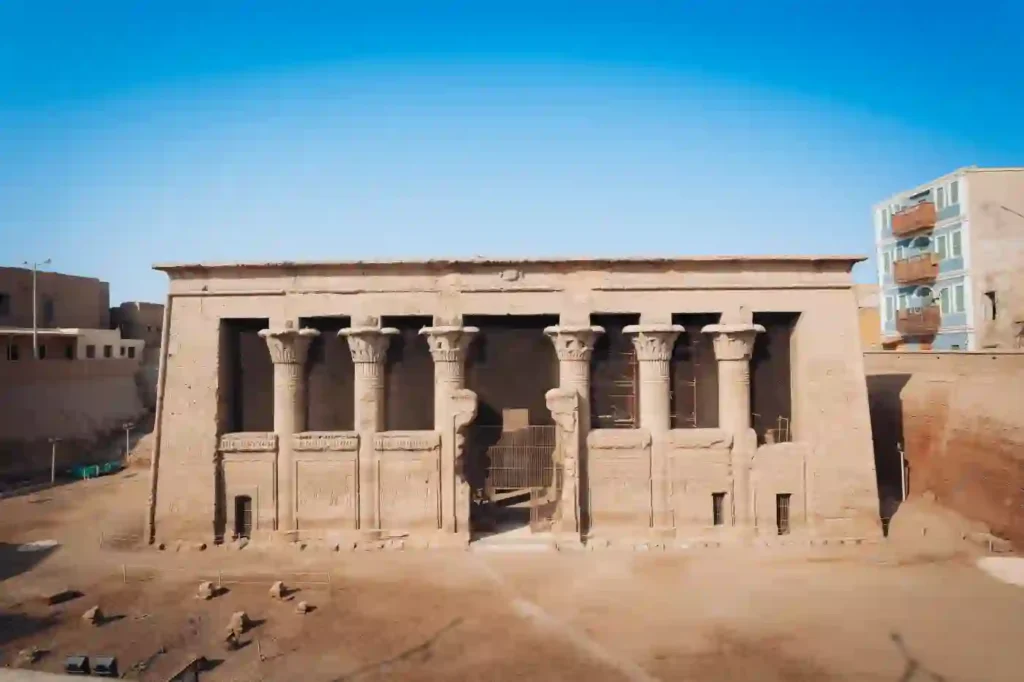
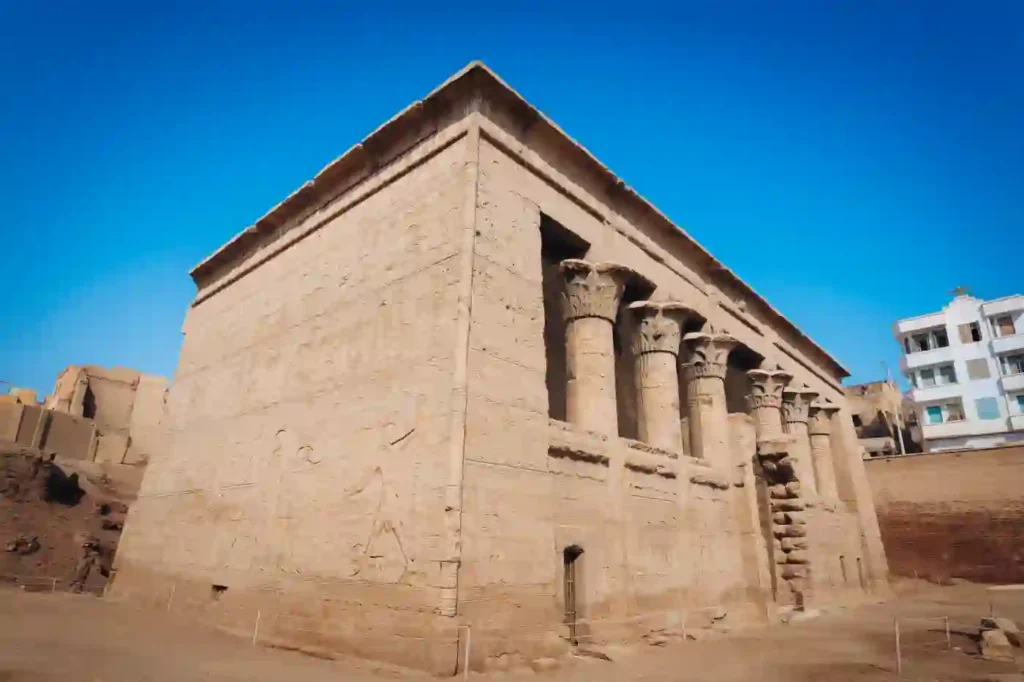
The ancient temple of Esna doesn’t announce itself with towering pylons or vast courtyards. Instead, it reveals its magnificence slowly, almost shyly, as you descend a modern staircase that cuts through layers of time itself. What was once ground level during the Ptolemaic and Roman periods now rests beneath centuries of accumulated earth, protected by the very sediment that buried it.
For over a millennium, the Esna temple lay hidden—its sanctuary filled with sand, its hypostyle hall converted into a cotton warehouse, its sacred carvings obscured by soot and neglect. Excavation began in the 1840s, but restoration work truly accelerated in recent years, culminating in a breathtaking 2023 unveiling that stunned Egyptologists worldwide. Teams painstakingly removed centuries of grime to reveal painted ceilings in cobalt blue, terracotta red, and brilliant gold—colors so vibrant they appear freshly applied rather than 2,000 years old.
The temple of Esna stands as a testament to resilience. While sand and darkness preserved it from looters and weathering, they also kept it from the world’s gaze. Now, as sunlight filters down into the hypostyle hall through protective coverings, visitors witness something extraordinary: a sacred space frozen at the height of Greco-Roman Egypt, where pharaohs wearing double crowns kneel before gods whose names stretch back to prehistory.
This isn’t merely a stop on a river cruise. The ancient temple of Esna is an invitation to step into a sanctuary where creation itself was said to begin, where artisans carved hymns into stone, and where priests once performed rituals by lamplight beneath these very same painted stars.
Want to witness Esna’s restored temple colors in person? Explore our Dahabiya itineraries featuring expert-guided temple visits at optimal times.
Inside the Temple of Khnum Esna: A Masterpiece of Color and Mythology
The khnum temple esna belongs entirely to one deity—Khnum, the ram-headed god who sat at his potter’s wheel shaping humanity from Nile clay, who controlled the annual flood that brought life to Egypt, who breathed souls into newborn children. Ancient Egyptians believed creation began here, at Esna, where Khnum molded the first gods and then the first people, spinning their bodies into being with divine precision.
Inside the esna temple of khnum, that mythology comes alive across every surface. Twenty-four columns rise like stone forests, each crowned with elaborate capitals depicting palm fronds, lotus blossoms, and papyrus umbels—the flora of the Nile rendered in stone and paint. Your eyes travel upward, following the columns to a ceiling covered entirely in astronomical reliefs and hieroglyphic texts. Constellations map across the plaster. Zodiac symbols merge Egyptian and Greek traditions. Sacred barks carry gods across painted skies.
The temple of khnum at esna preserves some of the finest examples of Ptolemaic temple art in Egypt. Unlike the stripped limestone of older temples, this sanctuary retains its original polychromy—reds that pulse like fresh ochre, blues that echo lapis lazuli, yellows that shimmer like desert sun. Hieroglyphs haven’t faded into abstraction; they remain sharp enough to read, their carved depths still holding traces of pigment.
Look closely at the walls and you’ll find hymns to Khnum inscribed in raised relief—prayers praising his role as “Lord of Destiny,” songs celebrating his creation of the cosmic egg, invocations calling him “Fashioner of Fashioners.” Priests would have chanted these texts during festivals, their voices echoing off columns that amplified sound in ways modern acousticians still study.
The temple of khnum esna also captures a unique historical moment. Built primarily during the reigns of Ptolemy VI through Ptolemy XII, and later expanded under Roman emperors including Claudius, Vespasian, and Domitian, it represents that fascinating period when Greek rulers adopted Egyptian religion, when Roman emperors carved their names in cartouches, when Mediterranean aesthetics blended with pharaonic tradition. You’ll see Roman emperors depicted as traditional pharaohs, Greek inscriptions alongside hieroglyphs, hybrid artistic styles that bridge civilizations.
Stand in the center of the hypostyle hall. Let your gaze wander across the painted ceilings. Feel the coolness of stone that has witnessed millennia. This is the temple of Esna at its most powerful—not as a museum relic behind glass, but as a living architectural poem where every column, every carving, every faded prayer speaks of humanity’s eternal questions about creation, purpose, and the divine.
Experience Khnum Temple with an Egyptologist who brings hieroglyphs to life. Request a customized Dahabiya journey designed around your interests and travel style.
Passing Through the Esna Locks: A Classic Nile Experience
Before you can continue your journey south toward Edfu and Aswan, every Nile vessel must navigate the Esna lock—a critical piece of infrastructure that’s become one of river cruising’s most memorable rituals. Built in 1906 and later expanded, the lock system manages the river’s changing water levels, allowing boats to pass between different elevations safely.
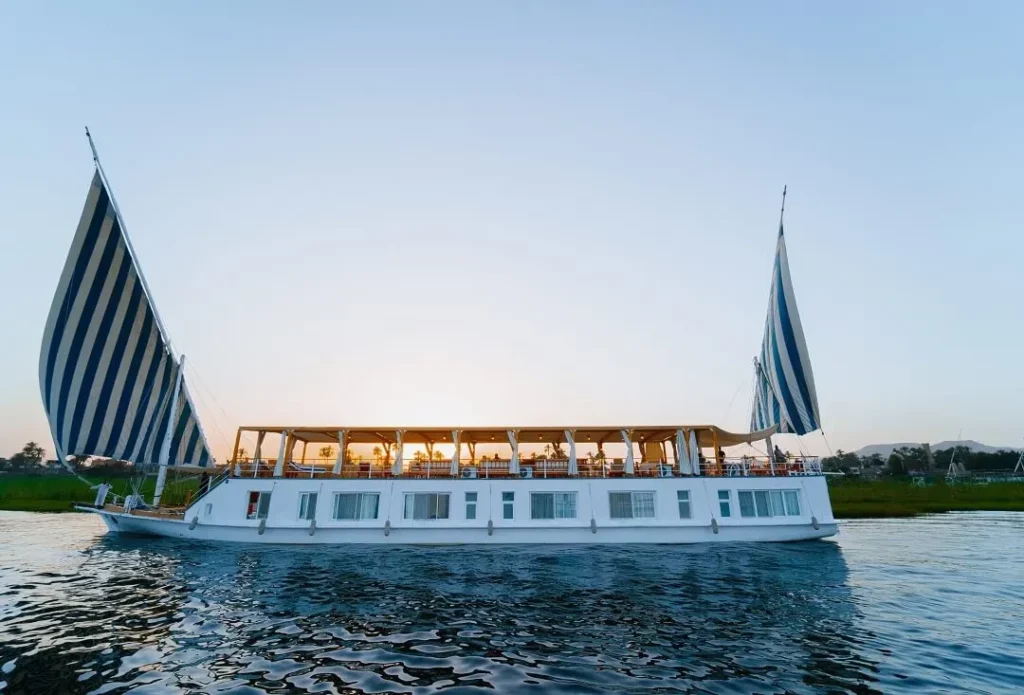
For travelers aboard massive cruise ships, the Esna locks can mean hours of waiting as vessels queue in numerical order, engines idling under the midday sun. But aboard a Dahabiya—particularly with Turquoise Dahabiya’s carefully planned schedules—the lock experience transforms entirely.
Picture this: Your elegant wooden sailing vessel approaches the lock in the golden morning light. The crew ties off to massive iron rings set into stone walls built over a century ago. There’s no rush, no jockeying for position among a dozen identical cruise ships. Instead, you stand on the sun deck with mint tea in hand, watching the mechanics of the lock unfold with quiet fascination—gates opening like ancient temple doors, water levels rising or falling with mathematical precision, crew members exchanging greetings in Arabic with lock operators who’ve worked these gates for decades.
Local vendors in small wooden boats paddle up alongside, offering colorful scarves, alabaster souvenirs, and embroidered galabiyyas. The interaction becomes theater—scarves tossed up to the deck, negotiations conducted with humor and hand signals, packages lowered down in baskets with payment. It’s commerce as cultural exchange, a tradition that’s taken place at the esna lock for generations.
The entire process rarely takes more than thirty minutes aboard a Dahabiya, yet those minutes offer unexpected gifts: conversations with fellow travelers, photographs of Esna’s riverside buildings bathed in morning light, the simple pleasure of watching skilled professionals manage a complex system with practiced ease. The lock isn’t a delay—it’s a moment of connection, a pause that reminds you that the best travel happens not at the destinations alone but in the transitions between them.
If you’re looking for a concise yet immersive Nile experience that highlights towns like Esna, our 5-Day Dahabiya Nile River Cruise offers the perfect balance of culture, comfort, and unhurried sailing.
Why Turquoise Dahabiya Makes Esna Unforgettable?
Luxury Slow Travel Meets Ancient History
There’s a reason Esna reveals itself most beautifully to those traveling by Dahabiya. While large cruise ships arrive en masse during peak afternoon hours, creating crowds and noise around the temple entrance, Turquoise Dahabiya schedules its Esna visits strategically—often arriving in the quiet morning hours when sunlight angles perfectly through the hypostyle hall, or in the peaceful late afternoon when most tour groups have departed.
This isn’t accidental. It’s the philosophy that defines every Turquoise Dahabiya journey: fewer guests, deeper experiences, expert guidance that transforms sightseeing into genuine understanding.
When you visit the khnum temple Esna with Turquoise Dahabiya, you’re accompanied by qualified Egyptologists who do far more than recite facts. They read hieroglyphs aloud, translating ancient hymns into modern context. They explain the mythological significance of carved scenes, connecting Khnum’s creation story to broader Egyptian cosmology. They answer your questions thoughtfully, tailoring their commentary to your interests—whether you’re fascinated by religious symbolism, architectural engineering, artistic techniques, or daily life in Greco-Roman Egypt.
The small group size makes an immense difference. With only 8-12 guests aboard, you’re never lost in a crowd, never straining to hear your guide over competing tour groups, never rushed through galleries because a coach is waiting. You can linger before a particular column. You can photograph ceiling details without a dozen strangers in your frame. You can sit quietly in the ancient space, absorbing its atmosphere without distraction.
But the Turquoise Dahabiya advantage extends beyond the temple visit itself. Consider the full experience: You wake in your elegantly appointed cabin to the sound of water lapping against the hull. You take morning tea on the sun deck as the boat docks near esna city, watching fishermen cast nets in techniques unchanged for centuries. After your guided temple visit, you return not to a crowded cruise ship but to a peaceful vessel where lunch is served with Egyptian wines and conversation flows naturally among new friends.
Later, as the Dahabiya glides through the esna locks, you’re standing on teak decking with a cool drink, chatting with the captain about Nile navigation while photographers capture the golden hour light painting Esna’s western hills in amber and rose. By evening, you’re moored at a quiet spot along the riverbank, far from tourist centers, dining under stars that Egyptian priests once mapped on temple ceilings.
This is luxury redefined—not as opulence for its own sake, but as time, space, and expertise thoughtfully orchestrated to create transformative cultural encounters. Explore our carefully crafted Dahabiya itineraries to see how Esna fits into the broader rhythm of an unhurried Nile journey. Or contact our travel specialists to discuss customizing a sailing that aligns perfectly with your travel style and interests.
Every detail matters aboard Turquoise Dahabiya. The crews are trained to anticipate needs without hovering. The cuisine celebrates Upper Egyptian flavors alongside international favorites. The cabins balance authentic wooden craftsmanship with modern comfort. And the pace—the blessed, unhurried pace—allows Egypt to work its magic the way it was meant to: gradually, deeply, memorably.
How to Prepare for Your Visit to Esna?
Making the most of your Esna experience requires a bit of thoughtful preparation. Here’s what you need to know:
Best Time to Visit
- Morning visits (before 10 AM) provide the best lighting inside the hypostyle hall and fewer crowds
- Golden hour photography opportunities are stunning, especially from the Nile during your approach or departure
Accessibility Considerations
- The descent to temple level involves stairs—currently about 40 steps depending on excavation progress
- The hypostyle hall floor is relatively level but consists of ancient stone paving
- Travelers with mobility concerns should discuss options with their Dahabiya team in advance
- Small group sizes allow for flexible pacing that accommodates different fitness levels
Cultural Etiquette
- Photography is generally permitted in the temple (check current rules with your guide)
- Avoid touching painted surfaces or carved reliefs—oils from skin can damage ancient pigments
- When exploring Esna City, asking permission before photographing local residents shows respect
- Learning a few Arabic phrases (“shukran” for thank you, “min fadlak” for please) opens doors and smiles
Why a Dahabiya Offers the Best Esna Experience
- Flexible scheduling allows visits during optimal times rather than rigid cruise ship timetables
- Onboard experts provide context before and after temple visits, deepening your understanding
- Comfortable, climate-controlled cabins offer a welcome retreat between cultural excursions
- Small vessel size means you can dock closer to town and experience the passage through Esna Locks without crowds
Ready to prepare for your Esna adventure? Connect with our travel specialists to discuss the perfect timing and itinerary for your Nile journey.
Discover the Magic of Esna with Turquoise Dahabiya
The temple of khnum at esna has waited beneath the modern world for centuries, its colors hidden, its stories silent. Now that restoration has returned it to glory, the question isn’t whether to visit Esna —it’s how to experience it in a way that honors both its ancient significance and your own travel dreams.
Turquoise Dahabiya offers that rare combination: the expertise to illuminate every hieroglyph’s meaning, the scheduling flexibility to visit when light and solitude align, the intimate vessel scale that turns fellow travelers into friends, and the commitment to slow luxury that allows Egypt’s magic to unfold naturally rather than hurriedly.
From the moment you descend into the hypostyle hall and look up at ceilings painted in colors that shouldn’t have survived, to the quiet satisfaction of watching your elegant wooden boat glide through the esna locks at golden hour, every moment becomes part of a larger story—one where ancient wisdom, artistic brilliance, and human connection weave together into an unforgettable journey.
Begin planning your Turquoise Dahabiya adventure and step inside the wonders of Esna Egypt with travelers who understand that the best way to see the Nile isn’t faster—it’s deeper, quieter, and infinitely more beautiful.
Why Esna Egypt Should Be on Your Nile Journey?
Esna Egypt is more than just a stop between Luxor and Aswan—it is a living testament to ancient history, vibrant local culture, and the timeless rhythm of the Nile. From the breathtaking colors of the Temple of Khnum to the charming streets of the city and the iconic Esna Locks, every moment here rewards travelers who slow down and pay attention. Experiencing Esna aboard a luxury Dahabiya transforms sightseeing into an intimate journey, where history, artistry, and human connection come together. For those seeking depth, authenticity, and unhurried discovery, Esna Egypt is a destination that lingers in memory long after the Nile waters have passed.
FAQs About Esna Egypt
Where is Esna located in Egypt?
Esna is a city in Upper Egypt on the west bank of the Nile, about 55 km south of Luxor.
What is Esna Egypt famous for?
Esna Egypt is famous for the Temple of Khnum, traditional local markets, and the Esna Lock on the Nile.
Is Esna Egypt worth visiting?
Yes, Esna Egypt is worth visiting for its ancient temple, authentic local culture, and peaceful Nile atmosphere.
What is the Temple of Esna dedicated to?
The Temple of Esna is dedicated mainly to Khnum, the ram-headed god of creation in ancient Egyptian mythology.
Can you visit Esna Egypt on a Nile cruise?
Yes, Esna Egypt is a popular stop on Nile cruises between Luxor and Aswan, especially on luxury Dahabiya cruises.