


Most visitors arrive having seen photographs. Few arrive having truly understood what they’re looking at. These fifteen facts about the temples of abu simbel are an attempt to fix that — and to prepare you for one of the most disorienting, deeply moving experiences Egypt has to offer.
At a Glance
- Built by Pharaoh Ramesses II, c. 1244 BC
- Located 280 km south of Aswan
- Two temples carved from solid rock
- Relocated in 1968 to escape flooding
- UNESCO World Heritage Site since 1979
- Sun Festival: Feb 22 & Oct 22 each year
What Makes Abu Simbel Unlike Anything Else
1- They Were Carved Into the Mountain, Not Built Upon It
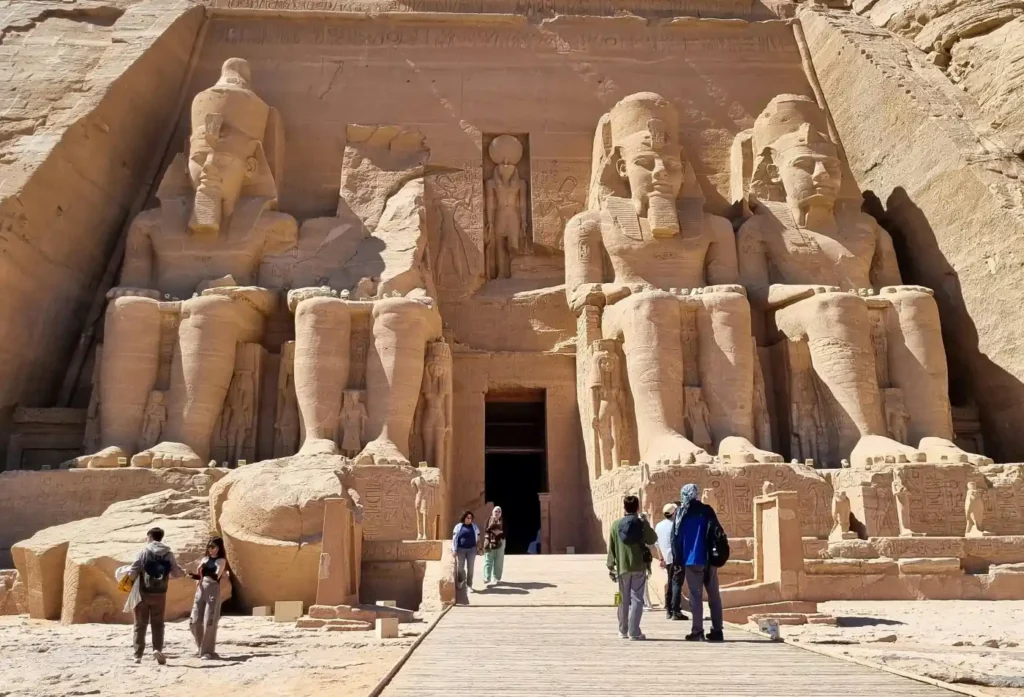
This distinction matters more than it might sound. The Pyramids of Giza were assembled, block by enormous block, from the ground up. Abu Simbel was excavated — chiseled inward, into an existing sandstone cliff above the Nile, by workers using copper tools and sheer human persistence. No cranes, no concrete, no scaffolding as we know it. The temples aren’t structures placed in a landscape; they are the landscape, subtracted.
2- The Great Temple’s Facade Is as Tall as a Six-Story Building
The numbers are worth sitting with: the facade stretches 35 meters wide and rises 30 meters high. The four colossal seated statues flanking the entrance each stand 20 meters tall — roughly the height of a standard European apartment block. And yet the statues were carved with such precision that the proportions feel natural the moment you stand in front of them. That’s not an accident. It’s mastery.
3- Ramesses II Chose This Location Because It Was Already Sacred
The site at the Second Cataract of the Nile was already associated with the goddess Hathor — deity of love, motherhood, and joy — long before construction began. By building here, Ramesses II wasn’t just claiming territory; he was absorbing and layering its existing spiritual authority. The temples announce Egyptian power to the south, but they do so in a language the Nubians already understood.
4- It Took Twenty Years to Build
Construction began around 1264 BC and concluded approximately 1244 BC. For two full decades, an organized workforce of Egyptian craftsmen and Nubian laborers chiseled steadily deeper into the sandstone. The scale of coordination required — managing logistics, artistic programs, astronomical calculations, all without modern surveying equipment — remains staggering to this day.
5- The Smaller Temple Is a Feminist Landmark (by Ancient Egyptian Standards)
The Small Temple, dedicated to Queen Nefertari and the goddess Hathor, breaks a 3,000-year convention: its facade depicts Nefertari at exactly the same scale as Ramesses II. In virtually every other Egyptian monument, royal women are carved significantly smaller than their husbands — a visual hierarchy that encoded political reality in stone. Here, she stands equal. It is, remarkably, only the second time in Egyptian history that a pharaoh dedicated a temple to his queen. The first was Akhenaten, for Nefertiti.
Astronomical Engineering
The Sun Festival: Ancient Egypt’s Greatest Trick
If the temples are extraordinary to look at, what happens inside them twice a year is genuinely difficult to process with a rational mind. It requires accepting that three thousand years ago, without GPS, without laser levels, without any computational tool, a team of Egyptian architects solved a problem that most modern engineers would consider excessive.
6- Twice a Year, the Sun Reaches the Very Heart of the Temple
Deep within the Great Temple — 60 meters from the entrance, in a chamber that sits in complete darkness for 363 days of the year — four statues are seated side by side: the gods Amun-Re, Ra-Horakhty, the deified Ramesses II, and Ptah. On two mornings a year, the rising sun sends a narrow beam of light that travels the full length of the temple and illuminates three of the four figures. Ptah, god of darkness, remains in shadow. This was entirely intentional.
7- The Dates Were Chosen to Honor the Pharaoh Personally
The two dates on which the solar alignment occurs are February 22nd and October 22nd — the anniversary of Ramesses II’s coronation and his birthday, respectively. The temple was not simply built to face east. It was oriented with sub-degree precision so that the sun’s path on these two specific dates would produce this exact effect. How the architects calculated this without a single modern instrument remains an open question among Egyptologists.
8- The Phenomenon Lasts Just Twenty Minutes
Just after sunrise, the light enters the temple mouth and slides slowly down the corridor. By the time it reaches the sanctuary, the entire inner chamber glows for approximately twenty minutes before the angle shifts and darkness returns. Each year, thousands of visitors gather at dawn — many having traveled specifically for this. The moment the light reaches the statues, the crowd typically falls silent. That silence is, according to everyone who has witnessed it, involuntary.
“The temple was not built to face the sun. It was built to catch it — on exactly the right two days, in exactly the right place.”
9- The Dates Have Shifted by One Day Since Antiquity
When the temples were originally completed, the solar event fell on February 21st and October 21st. The shift to the 22nd is a direct consequence of the relocation in the 1960s — more on that shortly. Moving 16,000 blocks of stone to higher ground is an extraordinary achievement, but even extraordinary engineers work within tolerances. The alignment shifted by roughly one day, which, given the circumstances, is a miracle of accuracy rather than a failure of it.
The Rescue Mission
The Most Ambitious Archaeological Operation in History
10- The Temples Were Scheduled to Disappear Underwater
In 1959, Egypt began constructing the Aswan High Dam — a genuinely necessary piece of infrastructure that would control flooding, generate electricity, and stabilize the country’s water supply. The reservoir it would create, Lake Nasser, would submerge an enormous stretch of the Nile Valley, including the site at Abu Simbel. At the time, the decision was stark: modern Egypt’s future, or ancient Egypt’s past.
11- Fifty Countries Funded the Rescue
Egypt and Sudan appealed to UNESCO, which launched an international campaign in 1960. The response was unprecedented: more than fifty nations contributed funds to save monuments that belonged, in a meaningful sense, to all of humanity. The total cost reached $80 million. Half came from foreign governments. It was the first major test of what international cultural solidarity could accomplish, and it worked.
12- The Temples Were Cut Into 16,000 Pieces and Reassembled
Between 1964 and 1968, engineers using wire saws cut both temples into more than 16,000 individual blocks, some weighing up to 30 tonnes each. Every block was numbered, catalogued, and transported to a purpose-built artificial cliff 64 meters above the original site and 180 meters inland. The temples were then reassembled in precise sequence. On September 22, 1968, Abu Simbel was inaugurated at its new location — functionally identical, astronomically near-identical, and dry.
A Note on What “Relocated” Actually Means
It is tempting to hear “the temples were moved” and picture something like shifting furniture. The reality was a decade of engineering, archaeology, and international negotiation carried out against a rising deadline — Lake Nasser was filling as the work progressed. Workers had months, not years, of margin. The fact that both temples stand today, correctly oriented, with their interior chambers intact and their astronomical alignment preserved to within a day, is an achievement that deserves to be mentioned alongside the original construction.
Details Worth Knowing
What Most Visitors Walk Past
13- The Name “Abu Simbel” Belongs to a Boy
The original name of the complex — whatever it was called in the time of Ramesses II — has been lost to history. The name in use today traces to the Swiss explorer Johann Ludwig Burckhardt, who was led to the site in 1813 by a local Nubian boy whose name was Abu Simbel. By the time the Italian explorer Giovanni Belzoni arrived to excavate it in 1817, the name had stuck. The most recognizable ancient monument in southern Egypt is named after a child whose face we will never know.
14- One of the Four Colossi Has Been Headless Since Ancient Times
The second colossus from the left on the Great Temple facade lost its head and upper torso in antiquity — most likely the result of an earthquake. Its remains sit, undisturbed, at the base of the statue. The Egyptian authorities made a deliberate choice not to restore it. That decision was, arguably, wise. The broken figure gives the facade something that perfect preservation would have erased: visible age. It reminds you that this is not a museum exhibit. It is a ruin that has survived three millennia on its own terms.
15- Greek Mercenaries Left Their Names on the Walls in 591 BC
On the southern pair of colossi, you can find inscriptions left by Greek soldiers serving in the Egyptian army during a military expedition to Nubia. Written in archaic Greek, they record the soldiers’ names and the fact that they came this far south. These casual ancient graffiti — the equivalent of someone carving their initials in a school desk — have provided linguists with crucial evidence about the early development of the Greek alphabet. The soldiers had no idea they were leaving a historical document. They were just bored.
Planning Your Visit
Getting There and What to Expect
Abu Simbel sits 280 kilometers southwest of Aswan, close to the Sudanese border. It is remote by any standard, and that remoteness is part of its character. Getting there requires intention — which is, perhaps, fitting for a place that was built to impress upon anyone who arrived just how far Egypt’s reach extended.
| By air | A 45-minute domestic flight from Aswan Airport. Flights are limited and fill quickly around the Sun Festival dates — book well in advance. |
| By road | A 3.5-hour drive through the Nubian desert, typically in a convoy. The journey itself is striking: flat, silent, and vast. |
| Best time to visit | October and February, to coincide with the Sun Festival. Otherwise, October through April for comfortable temperatures. |
| Sun Festival 2026 | February 21–22 and October 21–22. Arrive before dawn. The light reaches the sanctuary shortly after sunrise and lasts roughly twenty minutes. |
| Time needed | Allow at least two to three hours on site to do justice to both temples. |
The most natural way to include Abu Simbel in a wider Egyptian itinerary is as the southern anchor of a Nile journey — sailing from Luxor through Edfu and Kom Ombo to Aswan, and then continuing by road or air to the temples before returning north. This sequence follows the Nile’s own logic, and it means you arrive at Abu Simbel having already understood something of the civilization that built it.
See Abu Simbel the Right Way
Our luxury Nile voyages include a carefully arranged excursion to Abu Simbel — timed where possible for the Sun Festival, guided by Egyptologists who know these temples deeply.