


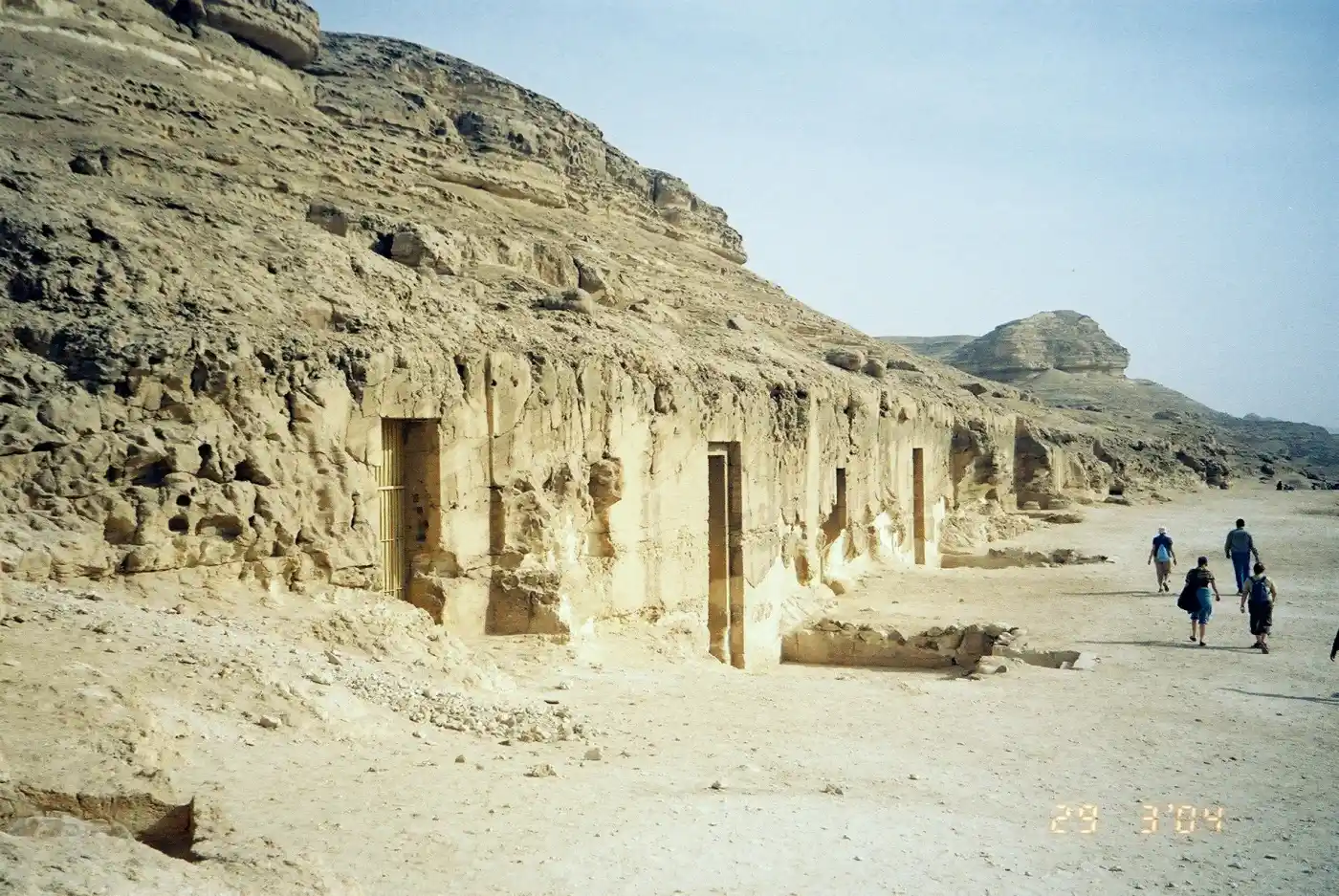
Hidden on the eastern bank of the Nile, carved deep into the limestone cliffs of Middle Egypt, the Beni Hasan tombs are among the most extraordinary archaeological sites in the entire country. Dating back to the Middle Kingdom (around 2055–1650 BCE), these rock-cut tombs are not simply burial chambers — they are vivid windows into daily life, power, and artistry in ancient Egypt. And the finest way to arrive at this legendary site is by sailing the Nile aboard a luxury dahabiya, drifting gently past villages and palm groves until these ancient cliffs rise into view. This is what Turquoise Dahabiya offers — not just transport, but a journey back in time.
What Are the Beni Hasan Tombs?
Located near the modern town of Minya in Upper Egypt, approximately 250 kilometres south of Cairo, Beni Hasan is a vast necropolis carved into the cliffs of the east bank of the Nile. The site contains 39 rock-cut tombs belonging to powerful provincial governors, nobles, and military officials who governed during the 11th and 12th Dynasties of the Middle Kingdom period.
Unlike the royal tombs of the Valley of the Kings in Luxor, the rock-cut tombs at Beni Hasan were built for regional elites — the nomarchs (governors) of the Oryx nome — who commanded considerable political and economic power during this fascinating transitional era of Egyptian history. Their tombs reflect not royal mythology, but real human stories: hunting, farming, wrestling, and governing.
The Architecture of the Rock-Cut Tombs at Beni Hasan
The rock cut tombs at Beni Hasan are masterpieces of ancient Egyptian engineering and design. They were excavated directly into the natural limestone cliff face, requiring no construction materials — only skilled craftsmen, copper chisels, and a vision of eternity. Each tomb follows a relatively consistent layout: an outer portico supported by elegant columns, a rectangular hall, and an inner sanctuary housing the burial shaft.
The Lotus and Proto-Doric Columns
One of the most astonishing architectural features at Beni Hasan Egypt is the presence of fluted columns — some resembling the later Greek Doric order by over a thousand years. These columns, cut from the living rock, give the tombs an almost classical appearance that has fascinated archaeologists since their rediscovery in the 19th century. They are typically sixteen-sided and stand with a simple elegance that remains striking today.
Architectural insight: The proto-Doric columns found at Beni Hasan predate the classical Greek Doric column by more than 1,000 years — a remarkable demonstration of ancient Egyptian architectural sophistication that continues to captivate historians and architects alike.
Beni Hasan Tomb Painting: A Gallery of Daily Life
The true glory of the Beni Hasan tombs lies in their paintings. These are not the mythological scenes of divine judgement and cosmic journeys found in royal tombs — they are detailed, joyful, and deeply human depictions of everyday life in ancient Egypt. The Beni Hasan tomb painting tradition represents one of the most complete surviving records of Middle Kingdom society.
Wrestling & Military Training
The tomb of Baqet III contains over 200 wrestling positions depicted in sequence — an extraordinary athletic record that some scholars describe as the world’s earliest illustrated martial arts manual. These scenes capture technique, strategy, and physical discipline with remarkable precision.
Hunting and Natural World
Vivid scenes of desert hunting, trapping birds in papyrus marshes, and Nile fishing fill the tomb walls with colour and movement. Animals are rendered with an accuracy and affection that reveals how closely the ancient Egyptians observed the natural world around them.
Agriculture and Craftsmanship
Agricultural cycles — planting, harvesting, threshing — are depicted alongside craftsmen weaving, potters at the wheel, and carpenters building furniture. Together they form an irreplaceable record of the Middle Kingdom economy and the daily rhythms of Egyptian provincial life.
The Famous Asiatic Procession
In the tomb of Khnumhotep II, a stunning scene depicts a group of 37 Asiatic people — possibly from Canaan — arriving in Egypt with goods and tribute. Scholars have connected this to the biblical story of Jacob’s family, making it one of the most debated and fascinating paintings in all of Egyptian archaeology.
Beni Hasan and the Middle Kingdom: A Smart History
Understanding Beni Hasan smart history means understanding the political landscape of the Middle Kingdom — a period of reunification, artistic flowering, and expanding trade following the chaos of the First Intermediate Period. The nomarchs buried here were powerful enough to commission elaborate tombs, yet their authority was slowly eroded as the 12th Dynasty pharaohs centralised power.
The Beni Hasan Middle Kingdom tombs are therefore historically unique: they represent a brief window when regional governors had both the wealth and the freedom to memorialise themselves in grand style. By the late 12th Dynasty, this era was over — and Beni Hasan fell silent.
According to Beni Hasan smart history sources, the four most important tombs belong to Khnumhotep I, Amenemhat, Khnumhotep II, and Baqet III — each offering distinct artistic and biographical details. Khnumhotep II’s tomb alone contains over 890 individual scenes, making it the most information-rich non-royal tomb from the entire Middle Kingdom.
Key historical fact: The Beni Hasan tombs were first systematically documented by Percy Newberry and Francis Griffith in the 1890s for the Egypt Exploration Fund — their meticulous copies of the wall paintings remain essential references for Egyptologists to this day.
From Beni Hasan to Abu Simbel: Egypt’s Greatest Ancient Sites
Any serious journey through ancient Egypt’s history must eventually compare its great monuments. Among the most important facts about the Abu Simbel temples is that they represent a completely different era and style: commissioned by Ramesses II during the New Kingdom (c.1264 BCE), Abu Simbel was carved into the Nubian mountain to project divine royal power across the southern frontier.
Where the Beni Hasan tombs celebrate provincial life and earthly accomplishments, Abu Simbel screams divine kingship across the desert. Both sites were carved into living rock — yet the contrast in scale, purpose, and artistic language reveals how dramatically Egyptian civilisation evolved over 700 years. Visiting both with Turquoise Dahabiya is to witness the full arc of this extraordinary culture.
Among essential facts about the Abu Simbel temples: the four colossal statues of Ramesses II at the Great Temple are each 20 metres tall; the inner sanctuary was engineered so that sunlight illuminates the statues of the gods twice a year on specific solar dates; and in the 1960s, the entire temple was relocated 65 metres uphill to save it from rising Nile waters after the Aswan Dam construction — one of the greatest archaeological rescue operations in history.
Why Visit Beni Hasan by Dahabiya? The Turquoise Experience
Most visitors to Beni Hasan Egypt arrive by road, rushing through a crowded bus tour with minutes to spare. The Turquoise Dahabiya approach is fundamentally different: you sail the same Nile that ancient nomarchs once commanded, arriving at the site rested, unhurried, and fully immersed in the landscape.
A dahabiya is a traditional Egyptian sailing vessel — wide-beamed, elegantly furnished, and perfectly designed for slow exploration of the upper Nile. Unlike large cruise ships that race between temples, a dahabiya moves at the speed of wind and current, stopping where the history demands it. Beni Hasan, often bypassed by standard itineraries, becomes a centrepiece of the journey rather than an afterthought.
What Makes Turquoise Dahabiya Different
Turquoise Dahabiya offers small-group, expert-guided visits to Beni Hasan tombs as part of immersive Nile itineraries that connect the major sites of Middle and Upper Egypt. With a maximum of 8–10 guests, each visit becomes a private archaeological experience. Your Egyptologist guide will decode the Beni Hasan tomb painting scenes in real time, connecting the wrestling figures on the wall to the political tensions of the Middle Kingdom, and the Asiatic procession to questions of identity and migration that resonate even today.
Frequently Asked Questions About Beni Hasan Tombs
What are the Beni Hasan tombs and why are they important?
The Beni Hasan tombs are 39 rock-cut burial chambers carved into limestone cliffs on the Nile’s east bank in Middle Egypt, dating to the Middle Kingdom (c.2055–1650 BCE). They are important because they contain the most complete surviving paintings of daily life from this era — including wrestling, hunting, farming, and foreign trade — offering an unmatched record of provincial Egyptian society.
How old are the rock-cut tombs at Beni Hasan?
The rock-cut tombs at Beni Hasan were constructed during Egypt’s Middle Kingdom period, primarily during the 11th and 12th Dynasties, making them approximately 3,900 to 4,000 years old. The oldest significant tombs date to around 2055 BCE.
What paintings can you see inside the Beni Hasan tombs?
Visitors can see remarkable Beni Hasan tomb paintings depicting wrestling matches, bird trapping, cattle herding, agricultural scenes, military processions, and the famous Asiatic caravan in the tomb of Khnumhotep II. The paintings are vivid, detailed, and extraordinarily well-preserved for their age.
Where exactly is Beni Hasan in Egypt?
Beni Hasan is located in the Minya Governorate of Middle Egypt, approximately 250 km south of Cairo and 20 km north of the city of Minya, on the eastern bank of the Nile. It is best reached by Nile cruise dahabiya or private vehicle from Minya city.
Can you visit Beni Hasan on a Nile cruise?
Yes — and it is by far the best way to visit. Turquoise Dahabiya offers luxury small-group Nile cruises that include a dedicated stop at Beni Hasan with expert Egyptologist guidance. The dahabiya experience allows you to arrive at the site from the river, just as ancient Egyptians themselves would have approached it.
What is the connection between Beni Hasan and the Bible?
The tomb of Khnumhotep II contains a painting of 37 Asiatic people arriving in Egypt c.1890 BCE, dated to the same general era as the biblical accounts of Jacob’s family migrating to Egypt. Some scholars speculate this painting may depict a historical context related to the biblical narrative, though this remains a subject of academic debate.
What are key facts about Abu Simbel compared to Beni Hasan?
Key facts about Abu Simbel: built by Ramesses II around 1264 BCE (over 600 years after Beni Hasan), located in Nubia near the Sudanese border, features four 20-metre colossal statues, and was physically relocated in the 1960s to avoid flooding. Both are rock-cut Egyptian monuments, but Abu Simbel is royal and New Kingdom, while Beni Hasan is provincial and Middle Kingdom.
Conclusion: Beni Hasan Deserves a Place on Every Egypt Itinerary
The Beni Hasan tombs are not a footnote in Egyptian history — they are a chapter that most tourists never read, and that makes them all the more precious. Here, away from the crowds of Luxor and Giza, you stand inside chambers where nomarchs were buried 4,000 years ago, surrounded by paintings so vivid they seem to breathe. Wrestlers frozen mid-throw. Geese rising from papyrus marshes. A caravan of Asiatic traders crossing the painted desert toward an Egyptian official who waits with open arms.
This is Beni Hasan Egypt — raw, human, and unforgettable. And the only way to truly honour a site of this depth is to arrive unhurried, with an expert beside you, having sailed the same Nile that once carried these governors to power.
Sail to Beni Hasan with Turquoise Dahabiya
Experience the Beni Hasan tombs the way they were meant to be experienced — arriving by the Nile, with expert Egyptologist guidance, as part of a luxury small-group dahabiya journey through the heart of ancient Egypt. Limited places available on each sailing.