


What If the Most Powerful Pharaoh in Egyptian History Was Also the One You Know the Least About?
When travelers think of Egypt’s great pharaohs, the names Ramesses II, Tutankhamun, and Cleopatra come immediately to mind. Yet none of them presided over Egypt at quite the height Amenhotep III did. His reign — nearly four decades of unbroken peace, artistic explosion, and diplomatic mastery — is what Egyptologists call the true peak of ancient Egyptian civilization. The monuments he left behind still stand in Luxor today, visited by millions of people who often don’t realize whose shadow they’re standing in.
If you’re planning a journey along the Nile, these Amenhotep III facts will transform what you see — from the Colossi at sunrise on the West Bank to the columns of Luxor Temple glowing gold at dusk — from impressive ruins into the coherent vision of one of history’s most remarkable rulers.
Who Was Amenhotep III? The Pharaoh Behind the Golden Age
Amenhotep III (c. 1386–1353 BCE) was the ninth pharaoh of Egypt’s Eighteenth Dynasty, son of Thutmose IV and his minor wife Mutemwiya, grandson of the legendary Thutmose III. He would become the grandfather of Tutankhamun and the father of Akhenaten — two of the most talked-about names in Egyptology. Yet Amenhotep III himself often slips between them in popular accounts, which is a genuine injustice.
His name translates to “Amun is Satisfied” — and by the time his reign ended, Amun had reason to be. Under Amenhotep III, Egypt reached the apex of its international power, artistic sophistication, and architectural ambition. He ruled for approximately 38 years, commissioning more statues than any pharaoh before or after him, building temples that rivaled anything in the ancient world, and conducting diplomacy that kept Egypt at peace while accumulating wealth that still dazzles scholars today.
He was also — and this is the fact most articles overlook — one of the very few pharaohs to be worshipped as a god during his own lifetime.
17 Amenhotep III Facts That Go Deeper Than the Standard Accounts
1. He Became Pharaoh as a Child — With No Recorded Regent
Most historians believe Amenhotep III ascended to the throne between the ages of 6 and 12. While it is likely that an adult regent governed in his name during his earliest years, no such regent is ever named in any surviving record. This is extraordinary: a child ruler in the most powerful nation on earth, and history has erased every trace of whoever actually held the reins. Egyptologists continue to debate whether this was deliberate — the official record shaped to present Amenhotep as solely and divinely in charge from the very beginning.
2. His Throne Name Told a Different Story Than His Birth Name
His birth name, Amenhotep (Amun is Satisfied), honored the great god of Thebes. But his throne name — Nebmaatra — means “Lord of Truth is Ra,” invoking the sun god Ra rather than Amun. This dual allegiance, to both Amun and the solar cults, was not just theological housekeeping. It reflected a careful political balancing act between the powerful priesthood of Amun and the rising solar theology that his own son Akhenaten would later push to its radical extreme. Amenhotep III was quietly laying groundwork for a religious revolution he himself never triggered.
3. He Married a Commoner — and Announced It to the Entire Empire
Royal marriages were almost universally political instruments: alliances sealed, kingdoms bound, heirs secured. Amenhotep III’s marriage to Queen Tiye broke this pattern entirely. Tiye was not of royal blood. She came from a family of provincial administrators from the town of Akhmim. And yet Amenhotep did something astonishing — he issued large commemorative scarabs across the entire empire, inscribed with her name and her parents’ names, publicly declaring this non-royal woman his Great Royal Wife. By ancient Egyptian standards, this was a declaration of personal feeling over political convention. It was almost unheard of.
4. He Built Her a Lake — as a Wedding Gift
In the eleventh year of his reign, to honor Queen Tiye, Amenhotep commanded the construction of an artificial lake at her hometown of Djakaru. The lake measured approximately 3,600 cubits long by 600 cubits wide — roughly one mile by a quarter mile. He then sailed across it with Tiye on a royal barge named Aten-tjehen (“the Dazzling Sun Disk”) and hosted a festival to celebrate its opening. An entire lake, constructed in a matter of weeks according to the commemorative scarab, as a gift from a pharaoh to his wife. The scale of the gesture is almost impossible to comprehend.
5. More Statues Survive of Amenhotep III Than Any Other Pharaoh in History
Over 250 statues of Amenhotep III have been identified in museum collections and excavation sites around the world — more than any other ancient Egyptian ruler. The statues span his entire reign, from his youth to his final years, creating what amounts to a biographical portrait in stone across four decades. Many of the finest statues later attributed to Ramesses II — particularly those collected during the era of early modern Egyptology — were actually made by Amenhotep III and simply reappropriated by later rulers who carved their own cartouches over his.
6. He Erected 600 Statues of the Goddess Sekhmet in a Single Temple
Around the Mut Temple at Karnak, Amenhotep III commissioned approximately 600 statues of Sekhmet, the lion-headed goddess of healing and destruction — one for each day and night of the year, ensuring that every hour was under divine protection. This was not decoration. Each statue functioned as a ritual instrument, with priests performing ceremonies at each one. The sheer logistical ambition of this project — quarrying, transporting, and placing 600 large stone figures — staggers the imagination. Many of these Sekhmet statues have since been dispersed to museums across Europe and North America.
7. He Was the First Pharaoh to Use Royal Bulletins as a Media Strategy
Amenhotep III was a pioneer of what we might today call public relations. He issued large commemorative scarabs — tens of thousands of them — inscribed with official accounts of his achievements: his lion hunts, his marriage to Tiye, the construction of the lake, his diplomatic marriages to foreign princesses. These scarabs were distributed across Egypt and into neighboring kingdoms. This was not vanity. It was a calculated communications strategy, broadcasting royal achievement to an audience spread across thousands of miles at a time when no other medium existed. Amenhotep III essentially invented the royal press release.
8. He Claimed to Have Killed 110 Lions in the First Ten Years of His Reign
Commemorative scarabs from the early part of Amenhotep’s reign record that he killed 110 lions in his first decade as pharaoh. Whether these numbers are precisely accurate or carry ritual exaggeration is debated by scholars. What is not debated is that lion hunting was a royal activity of deep symbolic importance — a demonstration of the pharaoh’s physical power and divine protection of his people. Amenhotep’s hunting scarabs are among the finest surviving examples of New Kingdom royal propaganda.
9. His Mortuary Temple Was the Largest Ever Built in Egypt — and Almost Nothing Remains
Amenhotep III’s mortuary temple on the West Bank of Luxor was, at its peak, the largest temple complex in Egypt — larger than Karnak, larger than anything Ramesses II would later build at Abu Simbel. Covering approximately 35 hectares, it contained vast courtyards, multiple pylons, hundreds of statues, obelisks, and sphinxes, linked by processional avenues to the Nile. Today, virtually nothing remains except the two Colossi at its entrance. The temple was built on low-lying ground near the Nile’s flood plain, and successive annual inundations eroded its limestone foundations until later pharaohs used it as a quarry for their own projects. What was once the greatest temple in Egypt is now a field of scattered rubble — except for two colossal figures that refused to fall.
10. The Colossi of Memnon Are Made of Stone Quarried 675 Kilometers Away
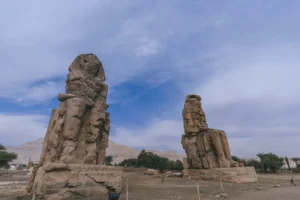
The two famous seated statues that mark the entrance to Amenhotep’s vanished temple — the Colossi of Memnon — are each approximately 18 meters tall and weigh an estimated 720 tons. They are carved from quartzite sandstone quarried at Gebel el-Ahmar, near modern Cairo, over 675 kilometers north of Luxor. Scholars believe the blocks were transported overland during the Nile’s flood season on massive sledges, a feat of logistics that — even by today’s standards — would be considered a major engineering challenge. Each statue was, effectively, a moving mountain.
11. One of the Colossi Once “Sang” at Dawn — and Attracted Roman Emperors
In 27 BCE, an earthquake cracked the northern Colossus. From that point on, the damaged statue began emitting a whistling or singing sound at dawn, as the rising sun warmed the stone and caused dew-soaked cracks to release moisture and air. The ancient Greeks and Romans were transfixed. They named the statues after the mythological hero Memnon, son of the dawn goddess Eos, and believed the sound was Memnon greeting his mother at sunrise. The phenomenon drew pilgrims, poets, and emperors from across the Mediterranean. The Roman Emperor Hadrian visited in 130 CE with his wife Vibia Sabina; the court poet Julia Balbilla inscribed her experience — in Greek verse — directly onto the statue’s legs, where it remains readable today. When the Roman Emperor Septimius Severus repaired the cracked colossus in the early 3rd century CE, the sound stopped. It has never been heard since.
12. Amenhotep III Was Worshipped as a Living God — With His Own Cult Temple
Most pharaohs claimed divine status in theory. Amenhotep III did something far more concrete: he established an active cult of his own divine self during his lifetime. In Nubia, at the temple of Soleb, he built a sanctuary in which he was worshipped alongside the god Amun — as an equal deity, not merely as Amun’s representative. This was not posthumous deification. Priests served his cult, offerings were made in his name, and worshippers prayed to Amenhotep III the god while Amenhotep III the man was still sitting on his throne in Thebes. The theological audacity of this act is extraordinary even by ancient Egyptian standards.
13. His Diplomatic Correspondence Survives — in Babylon’s Archives
The Amarna Letters, a collection of clay tablets discovered in 1887 near the ancient city of Akhetaten, contain diplomatic correspondence from the later part of Amenhotep III’s reign and the early years of Akhenaten’s. These letters — written in Akkadian cuneiform, the diplomatic language of the ancient Near East — reveal an Egypt at the center of a vast international network. Rulers from Assyria, Mitanni, Babylon, the Hittites, and Cyprus wrote to Amenhotep requesting gold, sending princesses, and negotiating alliances. The tone is striking: foreign kings address him with obsequious deference and barely concealed envy of Egypt’s inexhaustible gold supply. In one famous exchange, the Babylonian king writes: “Gold in your land is like dust — just send some.”
14. He Refused to Give His Daughters as Diplomatic Wives — to Anyone
Despite accepting multiple foreign princesses into his royal household as diplomatic marriages, Amenhotep III maintained an absolute rule: no Egyptian princess would be given in marriage to a foreign ruler. When the Babylonian king Kadashman-Enlil I pressed for an Egyptian princess as a bride, Amenhotep’s reply — preserved in the Amarna Letters — was unequivocal: “From time immemorial, no daughter of the king of Egypt has been given to anyone.” This was not xenophobia. It was a masterful diplomatic asymmetry: Egypt accepted foreign women, elevating the status of other kingdoms by connection, while never placing an Egyptian royal woman under foreign authority.
15. He Built the Core of Luxor Temple — the Building Still Standing in the Middle of Modern Luxor City
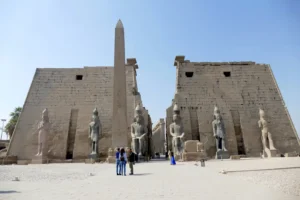
The Temple of Luxor, one of the most visited ancient monuments in the world, was primarily the creation of Amenhotep III. He built the inner sanctuary, the colonnaded hall, and the processional colonnade that remain the heart of the temple today. Ramesses II later added his famous pylon and colossal statues at the front — and his additions are what most tourists photograph first. But walk deeper into the temple, past the Ramesses sections, and you enter Amenhotep’s Egypt: larger, more elegant columns, finer proportions, the subtle architectural confidence of a pharaoh at the absolute height of his civilization’s power.
16. He Celebrated Three Sed Festivals — a Feat Achieved by Almost No Other Pharaoh
The Sed festival was the ancient Egyptian ritual of royal renewal: a series of physical and ceremonial tests designed to prove the pharaoh’s continued fitness to rule, traditionally held in the 30th year of a reign. Most pharaohs never lived long enough to celebrate one. Amenhotep III celebrated three: in his 30th, 34th, and 37th regnal years. He built an entire palace complex at Malkata on the West Bank specifically for these celebrations, complete with festival halls, harbor, and a vast artificial lake. The festivals, which may have lasted months, involved elaborate ritual performances, diplomatic receptions, and the symbolic rebirth of the king as a god. Three Sed festivals, in the ancient Egyptian worldview, meant a king who had transcended ordinary mortality.
17. His Son’s Religious Revolution May Have Been His Idea First
One of the most provocative theories in modern Egyptology is that Amenhotep III himself laid the intellectual groundwork for the monotheistic revolution his son Akhenaten would later impose on Egypt. Amenhotep III increasingly identified himself with Aten, the solar disk, in the later years of his reign — adopting the epithet “the Dazzling Aten” (Aten-tjehen) and naming his palace, his royal barge, and even the lake he built for Tiye after the Aten concept. When Akhenaten later outlawed all other gods and declared Aten the sole deity, he may not have been breaking entirely with his father’s theology. He may have been accelerating it.
Where to Encounter Amenhotep III’s Legacy Along the Nile
Understanding these facts on the page is the beginning. Standing in the actual spaces Amenhotep III designed — with the Nile visible, the desert light shifting, and 3,400 years of history pressed into stone around you — is something else entirely.
The Colossi of Memnon (West Bank, Luxor): These two seated giants, each weighing 720 tons, are the surviving sentinels of the greatest temple Egypt ever built. Arriving here at sunrise — as the Dahabiya anchors overnight in Luxor and you cross to the West Bank in the early morning — gives you the landscape the Romans described: low light, desert silence, two stone kings gazing east toward the river they’ve watched for three and a half millennia.
Luxor Temple: Walk past the Ramesses pylon and into the inner colonnade. You are now in Amenhotep’s Egypt — the elegant, proportioned, unhurried world of a pharaoh who had nothing to prove through force because his civilization’s power was already self-evident. The avenue of sphinxes that connected Luxor Temple to Karnak was part of his processional vision. Much of it is now excavated and visible.
Karnak Temple Complex: The Third Pylon at Karnak was Amenhotep’s addition. He also built a colonnade within the precinct and commissioned work throughout. Look for the Sekhmet statues — fragments of the original 600 are displayed in Karnak’s open-air museum and scattered through the temple precincts. The Mut Temple, where the full 600 stood, is currently undergoing excavation.
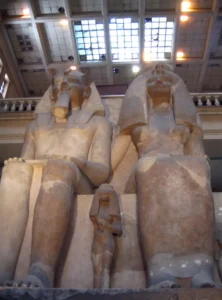
Luxor Museum: The colossal double statue of Amenhotep III and Sobek (the crocodile god) is one of the finest surviving pieces of New Kingdom royal sculpture — and one of the few portraits that shows the pharaoh in his mature years, serene and authoritative in equal measure.
The Nile Itself: Amenhotep III’s Egypt was a civilization built on this river. The flood that eroded his mortuary temple, the water that carried the 720-ton quartzite blocks from Cairo to Thebes, the lake he built for Tiye, the royal barge named for the sun disk — all of it runs through the Nile. Sailing it slowly, the way the ancient Egyptians did, gives the monuments on its banks a context no road journey can replicate.
Why Sail the Nile to Experience Amenhotep III’s Egypt
The monuments of Amenhotep III are not evenly distributed across Egypt. They are concentrated along a specific stretch of the Nile, between Luxor and Aswan — the same route sailed by Turquoise Dahabiya. The Colossi, Luxor Temple, Karnak, the Luxor Museum, the Soleb temple in Nubia — the geography of his legacy is a river itinerary.
More than that: Amenhotep III understood the Nile as theater. His festivals were staged on water. His diplomatic barge was named for the sun. His mortuary temple faced the river so that the faithful approaching by boat would see its gleaming pylons first. To experience his Egypt as he intended it to be experienced is to arrive by water, at a pace that allows the landscape to unfold.
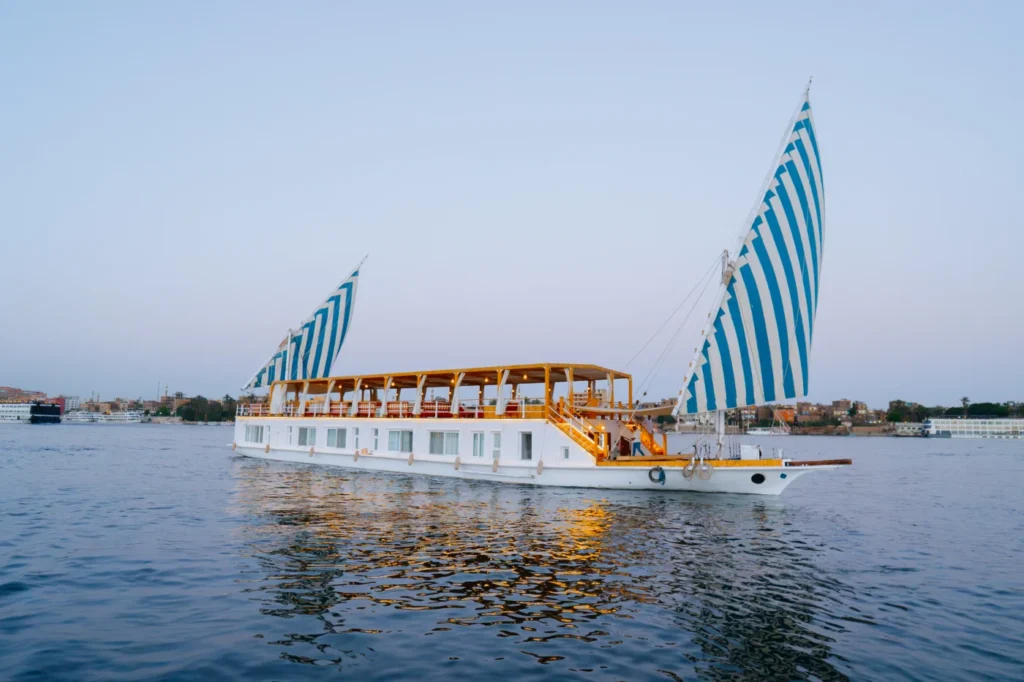
Turquoise Dahabiya offers exactly this. Our boutique luxury Nile cruises carry small groups of guests between Luxor and Aswan on carefully curated itineraries — intimate boats, no crowds, expert Egyptologist guides, and the unhurried pace of traditional Dahabiya sailing. Our guests reach the Colossi before the tour buses. They see Luxor Temple at night, when the floodlights turn the colonnade gold and the city goes quiet. They arrive at Karnak as the morning opens.
Frequently Asked Questions About Amenhotep III
Who was Amenhotep III?
Amenhotep III (c. 1386–1353 BCE) was the ninth pharaoh of Egypt’s Eighteenth Dynasty, known as “Amenhotep the Magnificent.” His nearly 40-year reign marked the peak of ancient Egyptian artistic, diplomatic, and architectural achievement. He was the grandfather of Tutankhamun and the father of Akhenaten.
What is Amenhotep III most famous for?
Amenhotep III is most famous for commissioning the Colossi of Memnon, building the core of Luxor Temple, erecting the largest mortuary temple in Egyptian history, and conducting the sophisticated diplomacy recorded in the Amarna Letters. He also has more surviving statues than any other pharaoh — over 250.
What are the Colossi of Memnon?
The Colossi of Memnon are two massive quartzite sandstone statues of Amenhotep III, each standing 18 meters tall and weighing approximately 720 tons, located on the West Bank of Luxor. They originally guarded the entrance to his mortuary temple — the largest ever built in Egypt. One of the statues famously “sang” at dawn in antiquity, drawing visitors including the Roman Emperor Hadrian.
Where are the best places to see Amenhotep III’s monuments?
The main Amenhotep III sites are on the West Bank of Luxor (Colossi of Memnon and the partially excavated mortuary temple site), within Luxor Temple (the inner colonnade and sanctuary), at Karnak (the Third Pylon and Sekhmet statues), and in the Luxor Museum (the outstanding Amenhotep III and Sobek statue). All are accessible on a Nile cruise between Luxor and Aswan.
Why did Amenhotep III’s mortuary temple disappear?
The temple was built on low-lying ground near the Nile’s flood plain. Over centuries, annual Nile inundations eroded its limestone foundations. Later pharaohs quarried its stones for their own building projects. Ramesses II and others dismantled large sections. Today, ongoing archaeological excavations are slowly revealing the temple’s original extent — an ongoing project that continues to produce significant discoveries.
Was Amenhotep III worshipped as a god?
Yes — uniquely, Amenhotep III established an active cult of his own divine self during his lifetime. At the Soleb temple in Nubia, he was worshipped as a deity alongside Amun, with priests, offerings, and an active religious cult in his name while he was still alive. This was extremely rare in ancient Egyptian practice.
What is the connection between Amenhotep III and Tutankhamun?
Amenhotep III was Tutankhamun’s grandfather. His son Amenhotep IV (later Akhenaten) was Tutankhamun’s father. The revolutionary religious changes Akhenaten imposed, and the political chaos that followed, were ultimately reversed by Tutankhamun — who died young and was buried in the Valley of the Kings near monuments his grandfather had commissioned.
Can I visit Amenhotep III’s monuments on a Nile cruise?
Yes. The Colossi of Memnon, Luxor Temple, Karnak, and the Luxor Museum are all key stops on Turquoise Dahabiya’s Luxor–Aswan itineraries. Arriving by Dahabiya means reaching these sites directly from the river — the same approach Amenhotep III himself would have intended for visitors to his monuments.
The Pharaoh Who Touched Everything — Including the Nile You’re Sailing
The most remarkable Amenhotep III fact may be this: after 3,400 years, his fingerprints are still on the landscape. The temple you visit in central Luxor, the statues you photograph at the West Bank, the museum pieces that stop you in your tracks — an extraordinary proportion of them trace back to one reign, one vision, one pharaoh who understood that civilization is most powerfully expressed not through conquest, but through beauty.
You don’t need to be an Egyptologist to feel this. You need to be on the Nile, moving at the pace it was meant to be moved at, with enough time and enough quiet to let the monuments speak.
Turquoise Dahabiya is Egypt’s boutique Dahabiya Nile cruise, sailing weekly between Luxor and Aswan on journeys of 4, 5, 7, 11, and 14 days. Our intimate small-boat cruises combine expert Egyptologist-guided temple visits with the unhurried elegance of traditional Dahabiya sailing — full-board dining, private suites, and the freedom of a boat that can moor wherever the landscape demands it.
Contact our team to plan your journey
Amenhotep III built his civilization to be seen from the river. We’ll take you there.