


Did You Know the Egyptian God Who Ruled the Sky Was Also Encoded in the Mathematics of the Moon?
Most travelers arrive in Egypt having heard the name Horus. Fewer know that this ancient deity was not just a mythological figure — he was a living political system, a calendar, a medical formula, and a royal title all wrapped into one falcon-headed icon. If you’re planning a journey along the Nile, understanding Horus isn’t just fascinating history. It transforms what you see carved into temple walls from decoration into a conversation that has been going on for over 5,000 years.
In this guide, we’ll unpack the most interesting facts about Horus — including several that most popular travel articles overlook entirely — and show you exactly where his legacy comes alive along the route sailed by Turquoise Dahabiya, Egypt’s boutique luxury Nile cruise.
Who Was Horus? A Quick Orientation Before the Facts
Before diving into the deeper details, it helps to know that “Horus” isn’t a single, fixed deity. Egyptologists recognize multiple distinct forms of the god, each worshipped in different eras and regions. The two most important are:
- Horus the Elder (Haroeris): One of the original five gods, born of the union between Geb (earth) and Nut (sky). He predates the famous Osiris myth entirely.
- Horus the Younger (Hor-pa-khered): Son of Osiris and Isis, the avenger-king whose battle with Set defines much of Egyptian royal ideology.
Understanding this distinction matters because many “facts about Horus” online confuse the two — a detail that makes Egypt’s mythology seem contradictory when it’s actually extraordinarily layered.
15 Interesting Facts About Horus That Go Deeper Than the Textbooks
1. Horus Is One of the Oldest Documented Gods in Human History
Horus worship predates the pyramids. Falcon imagery linked to his cult has been found on pottery from the Naqada II period (around 3500 BCE), making him one of the earliest deities for whom we have physical archaeological evidence anywhere in the world. The town of Hierakonpolis (“City of the Falcon”) in Upper Egypt was a major early center of his worship — and it sits in the same region that Turquoise Dahabiya sails through today.
2. Every Pharaoh Was Considered a Living Horus
This is commonly mentioned, but rarely explained fully. When a new pharaoh ascended the throne, he didn’t just take political power — he became Horus. Each king bore an official “Horus name,” the first and most sacred of their five royal titles, inscribed within a rectangular frame called a serekh. When the pharaoh died, he became Osiris (the god of the dead), and the next pharaoh again became Horus. This cycle was not metaphor. To ancient Egyptians, it was constitutional law.
3. The Eye of Horus Is a Precise Mathematical System
Most people know the Eye of Horus (the wedjat) as a protective symbol. Fewer know that its six parts correspond to specific fractions in ancient Egyptian mathematics: 1/2, 1/4, 1/8, 1/16, 1/32, and 1/64. These fractions were used in medical prescriptions for measuring ingredients. The eye of a god was, quite literally, a measuring tool. The sum of all six parts equals 63/64 — the missing 1/64 was said to have been supplied by Thoth, representing the magic that makes medicine whole.
4. He Was Two Eyes: One Sun, One Moon
As lord of the sky, Horus contained both celestial bodies. His right eye was the sun — bright, dominant, representing power and the morning star. His left eye was the moon — softer, cyclical. Ancient Egyptians explained the moon’s phases through the story of Horus’s left eye being damaged in battle against Set and then restored by Thoth over fifteen days, with each day of healing represented by a separate deity. This made the lunar calendar a mythological narrative, not just an astronomical observation.
5. Horus Had Over a Dozen Different Names and Forms
Beyond Horus the Elder and Horus the Younger, ancient texts record forms including:
- Ra-Horakhty (“Horus of the Two Horizons”) — a fusion with the sun god Ra, representing the daily arc of the sun
- Horus of Edfu (Horus Behdety) — the winged sun disk, protector of pharaohs in battle
- Horus of Nekhen — the original royal falcon, patron of the earliest Egyptian kings
- Harpocrates — the Greek adaptation, god of silence and secrets, depicted with a finger to his lips
Each form served a distinct theological purpose. Horus wasn’t one character wearing different costumes — he was a system.
6. The Conflict Between Horus and Set Lasted Over 80 Years in Some Texts
The Contendings of Horus and Set, a papyrus from the New Kingdom, describes the divine tribunal convened to settle who would inherit Osiris’s throne. The texts suggest the dispute dragged on for eighty years before the gods finally ruled in Horus’s favor. During this time, the two gods engaged in contests of strength, magic, and shapeshifting — at one point both transforming into hippopotamuses to see who could remain submerged longer. The story is part legal drama, part epic combat, part cosmic comedy.
7. Set Damaged Horus’s Eye, But It Was Hathor — Not Just Thoth — Who Healed It
Depending on which ancient text you read, the restoration of Horus’s eye is credited to Thoth, to Hathor, or to a combination of both. In some traditions, Hathor poured gazelle milk into Horus’s damaged eye to restore his sight. This made the gazelle sacred and connected Hathor — goddess of love, music, and joy — to the healing power of Horus’s restored vision. It’s a detail that almost never appears in modern retellings but explains why Hathor appears alongside Horus at so many Nile-side temples.
8. The Peregrine Falcon’s Markings Inspired the Eye of Horus Symbol
The distinctive teardrop markings beneath the eye in the wedjat symbol aren’t artistic invention — they mirror the dark facial stripe found on the peregrine falcon (Falco peregrinus), a bird of prey still found along the Nile today. If you scan the riverbanks during a Dahabiya cruise, there is a real chance you will spot this exact bird — the living model for one of ancient Egypt’s most iconic symbols.
9. Horus Absorbed Dozens of Local Falcon Gods Across Egypt
Before Horus became the dominant deity, each region of Egypt had its own falcon god. Over centuries, these local cults were absorbed into the Horus identity — a process of mythological consolidation that mirrors Egypt’s own political unification. Gods like Dunanwi, Montu (the war falcon), and Sopdu were all gradually folded into or aligned with Horus, making him an amalgamation of regional spiritual identities as much as an individual deity.
10. The “Horus Name” Was the Most Sacred of a Pharaoh’s Five Titles
Egyptian pharaohs carried five official names, but the Horus name was the oldest, most sacred, and most politically charged. It was the name that appeared on the serekh — a rectangular frame topped by a falcon — carved into monuments and tombs. Choosing a Horus name was a theological statement about what kind of king you intended to be. Pharaohs with names referencing “Horus the Strong” or “Horus the Fighter” were signaling military ambition. Names referencing “Horus of the Sky” implied celestial authority.
11. The Temple of Horus at Edfu Is One of the Best-Preserved in All of Egypt
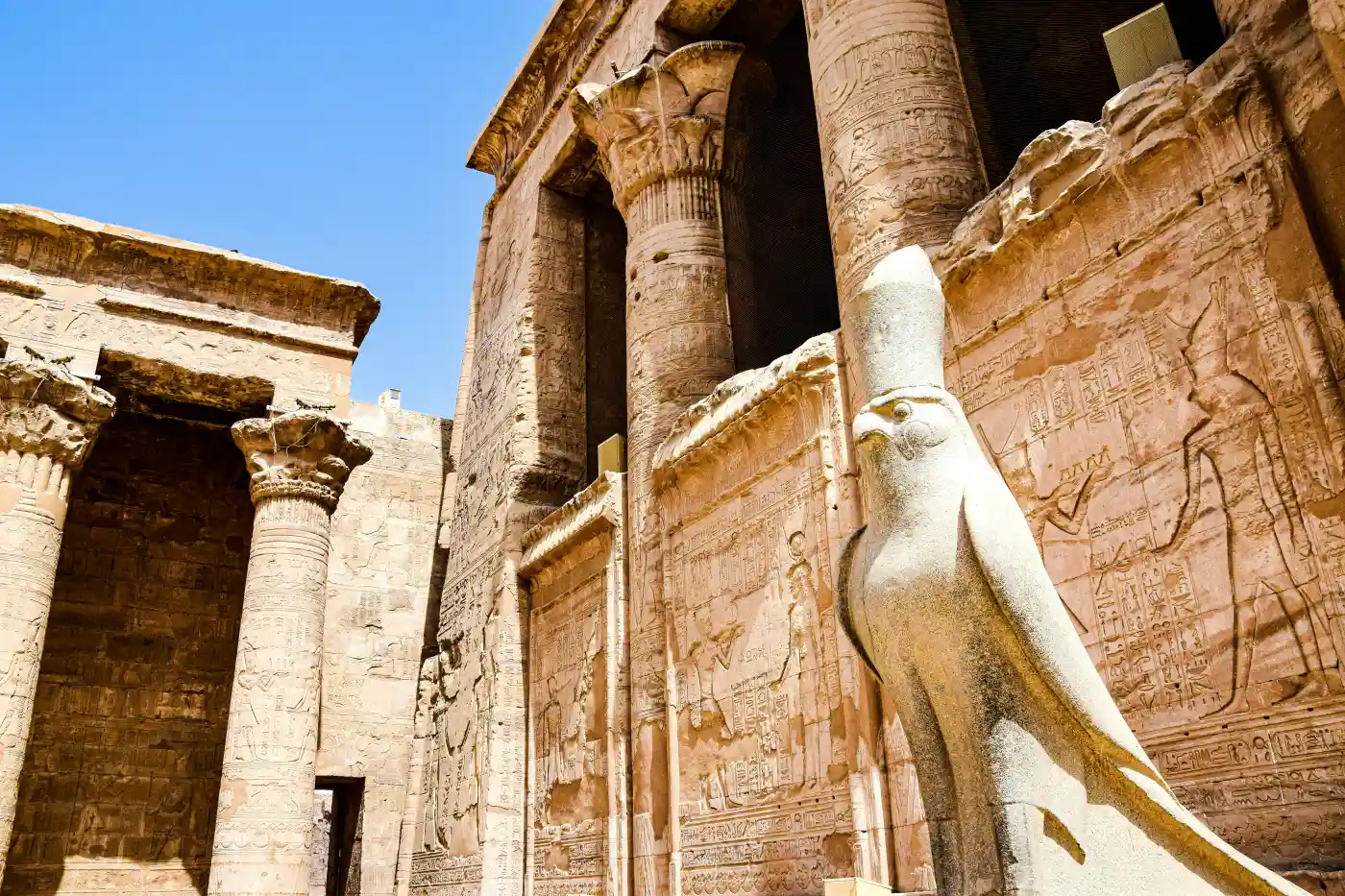
Built during the Ptolemaic period (237–57 BCE), the Temple of Horus at Edfu is one of the largest and most complete temples in Egypt. Its walls preserve detailed accounts of the myth of Horus and Set, including ritual dramas in which the pharaoh symbolically speared Set — depicted as a hippopotamus — to re-enact the triumph of order over chaos. This wasn’t just ceremony: in regions like Edfu, where rebellions frequently interrupted temple construction, the ritual carried urgent political meaning. Turquoise Dahabiya’s itineraries include Edfu as a key stop.
12. Greeks Identified Horus With Their God Apollo
The practice of interpretatio graeca — mapping Greek gods onto foreign deities — led ancient writers including Claudius Aelianus to note that Egyptians called Apollo “Horus.” The identification was based on shared solar attributes and the sense of divine youthfulness. Plutarch, however, was more precise: he distinguished between “Horus the Elder” (identified with Apollo) and “Horus the Younger,” whom he treated as a separate deity.
13. The Winged Sun Disk — Found Across Egypt’s Temple Gateways — Is Horus
One of the most ubiquitous images in Egyptian temple architecture is the winged sun disk carved above doorways and gateways. This is Horus Behdety — Horus of Edfu in his solar, battle-ready form — placed at every entrance as a protective guardian. Walk through any temple gateway along the Nile and you are passing beneath the protection of Horus. Most visitors walk under it without ever knowing what they’re seeing.
14. In the Ptolemaic Period, Horus Became a Symbol of Anti-Colonial Resistance
After Alexander the Great’s conquest of Egypt in 331 BCE and the subsequent rule of Ptolemaic kings (who were Macedonian Greeks), the myth of Horus defeating Set took on a charged new meaning. Set came to represent foreign occupation, and Horus’s victory became a symbol of Egyptian identity and resistance. The rituals enacted at Edfu during this period were acts of cultural and political defiance as much as religious ceremony.
15. Horus’s Name Means “The Distant One” — and It Still Describes Him Perfectly
The original Egyptian name Hor translates to “the distant one” — a reference to the sky falcon seen from far below, soaring at a height no human could reach. After 5,000 years, the name remains precise. Horus remains slightly out of reach: endlessly studied, never fully pinned down, always rewarding another look.
Where to Encounter Horus Along the Nile: A Traveler’s Guide
Understanding Horus on the page is one thing. Standing inside a temple where his image covers every wall, with the Nile visible through the gateway and a felucca drifting past — that is something entirely different. These are the key Horus sites along the Turquoise Dahabiya route:
Edfu (Temple of Horus): The definitive Horus site in Egypt. Two granite falcon statues guard the entrance. Inside, the walls carry the most complete surviving account of the Horus and Set conflict. Allow at least ninety minutes.
Kom Ombo Temple: A unique double temple dedicated to Horus the Elder (Haroeris) and Sobek (the crocodile god). The symmetrical layout — mirrored sanctuaries for two gods — is unlike anything else in Egypt. Arrived at by Dahabiya at dusk, it is one of the most atmospheric stops on the entire Nile.
Karnak (Luxor): The hypostyle hall at Karnak contains references to Horus in his solar form throughout. Look for the winged sun disk above doorways and reliefs of pharaohs wearing the double crown — the crown of Horus the King.
The Nile Itself: Horus is the sky. His right eye is the sun. Every sunrise watched from the deck of a Dahabiya is, in the language of ancient Egypt, the eye of Horus opening over the water.
Why a Dahabiya Is the Right Way to Experience Horus’s Egypt
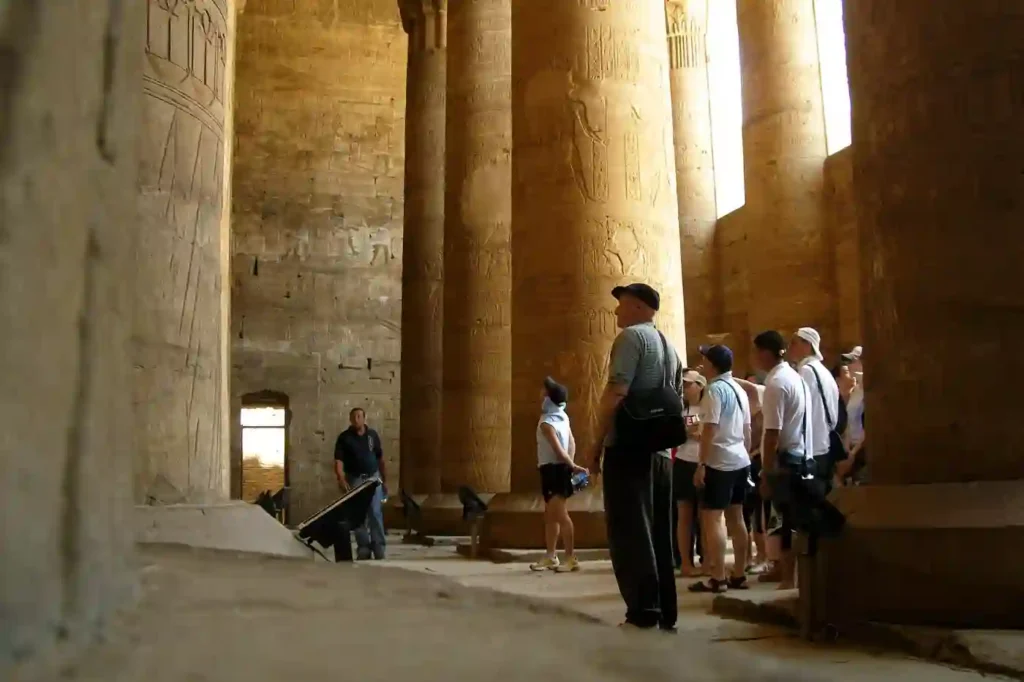
The ancient Egyptians experienced Horus through water. The Nile was the artery of their civilization and the path of the sun barge carrying Horus-Ra across the sky. Arriving at Edfu or Kom Ombo by boat — the way travelers did for 4,000 years before roads existed — restores a sense of proportion that bus tours can’t replicate. You approach the temples from the river. You see them the way ancient priests saw them.
Turquoise Dahabiya offers exactly this experience. Our small-boat, boutique Nile cruises carry an intimate group of guests (no crowds, no mass tourism) between Luxor and Aswan on itineraries that pass every major Horus site along the route. Guests sleep on the Nile, wake to sunrise over the water, and reach temples before the day-trip buses arrive.
Our expert Egyptologist guides don’t just walk you through the facts — they bring the myths alive in the spaces where they were told. By the time you stand before the granite falcon at Edfu, you won’t be reading a plaque. You’ll be completing a conversation you started on the river.

Frequently Asked Questions About Horus
What is Horus the god of?
Horus is primarily the god of the sky, kingship, healing, and protection in ancient Egyptian religion. He also represented the sun (right eye) and moon (left eye) and was the patron deity of the pharaohs.
What is the Eye of Horus and what does it mean?
The Eye of Horus (wedjat) is one of ancient Egypt’s most powerful symbols, representing protection, royal power, and healing. Its six parts also correspond to fractions used in ancient Egyptian medical measurements.
Where is the most important temple of Horus in Egypt?
The Temple of Horus at Edfu, built during the Ptolemaic period, is the largest and best-preserved Horus temple in Egypt. It contains detailed accounts of the Horus and Set myth and features iconic granite falcon statues at its entrance.
How many forms of Horus existed in ancient Egypt?
Egyptologists recognize over a dozen distinct forms of Horus, each worshipped in different regions and periods. The two main forms are Horus the Elder (Haroeris), one of the original five gods, and Horus the Younger, son of Isis and Osiris.
Why was Horus depicted as a falcon?
The falcon was chosen for its mastery of the sky — soaring at heights no other bird could match, with vision sharp enough to spot prey from great distances. These qualities aligned perfectly with Horus’s roles as sky god, divine protector, and all-seeing guardian of Egypt.
Can I visit Horus temples on a Nile cruise?
Yes. The temples of Edfu and Kom Ombo — two of Egypt’s most important Horus sites — are key stops on Turquoise Dahabiya’s Luxor–Aswan itineraries. Guests arrive by boat, experiencing the temples from the river exactly as ancient travelers did.
The Gods Are Still Here — You Just Have to Arrive the Right Way
The interesting facts about Horus don’t end at the edge of a Wikipedia page or a museum label. They continue in the hieroglyphs carved into temple walls that haven’t been touched since a Ptolemaic priest placed a torch before them 2,000 years ago. They live in the peregrine falcon that still nests along the Nile banks, the same bird that gave Horus his face.
The way to understand them is to be on the river.
Turquoise Dahabiya invites you to sail the same water that carried Egypt’s mythology for five millennia. Our 4-day, 5-day, 7-day, 11-day, and 14-day Nile cruises depart regularly from Luxor and Aswan, combining expert-guided temple visits with the unhurried pace of traditional Dahabiya sailing. Suites and standard cabins available, with full-board dining, personalized service, and weekly guaranteed departures.
Explore our Nile itineraries → Plan your journey with our team →
Horus has been waiting here for 5,000 years. The Nile isn’t going anywhere. But your perfect travel dates might be. Reach out today and let us build your Egyptian journey.