

What does it take to carve a monument so powerful that it inspired one of the greatest poems in the English language — and still stops travelers in their tracks 3,200 years later?
The answer is a pharaoh named Ramesses II. And the best place to understand him is not in a museum — it is standing at the foot of his colossal statues on the banks of the Nile in Luxor, the city where he left more stone self-portraits than any ruler in history. This guide explores every major statue of King Ramses II — where each one stands, what it means, and what most visitors never notice when they look at them.
Who Was Ramses II? The Man Behind the Stone
Before the stone, there was the man — and the man was extraordinary by any measure.
Ramesses II, known universally as Ramesses the Great, was the third pharaoh of Egypt’s 19th Dynasty. He took the throne around 1279 BC at approximately 25 years old and ruled for 66 years — one of the longest reigns in recorded human history. He died around 1213 BC, at roughly 90 years of age, having outlived most of his own children.
During those six decades, he did the following: led at least 15 military campaigns (all recorded as victories), fought the Hittite Empire to a standstill at the Battle of Kadesh and then negotiated the world’s first known peace treaty, fathered an estimated 100 or more children with multiple royal wives, built more temples and commissioned more statues than any pharaoh before or after him, and left his cartouche carved onto monuments from Nubia to the Nile Delta.
His throne name was Usermaatra-Setepenra — meaning “the justice of Ra is powerful, chosen of Ra.” The Greeks later corrupted this into “Ozymandias,” the name that Percy Bysshe Shelley immortalized in his famous 1818 sonnet, written after encountering a fragment of one of Ramesses’ colossal statues.
What Shelley captured — the paradox of a king who built for eternity and yet crumbled — is exactly what makes standing before a statue of King Ramses II such an unexpectedly moving experience.
The Statue of King Ramses II: Not One Colossus, But Many
One of the most important things to understand about the statue of King Ramses II is that there is no single definitive piece. There are at least 350 surviving statues depicting this pharaoh — scattered across Egypt, hidden in desert sand, displayed in museums from London to Turin, and standing in their original locations along the Nile. More are still being discovered: as recently as 2024, the missing upper half of a colossal Ramesses statue was unearthed in southern Egypt by a joint Egyptian-American archaeological mission.
Each statue was not simply a portrait — it was a theological object. Positioned at temple gateways, these figures were believed to be living embodiments of the pharaoh’s ka (life force), capable of receiving offerings, communicating with gods, and protecting sacred spaces. They were not meant to be admired from a distance. They were meant to be approached — and the scale of their creation was designed to make every approaching worshipper feel the full weight of divine kingship.
The Most Important Statues of King Ramses II: A Complete Guide
1. The Colossi at Luxor Temple — The Most Photographed in the World
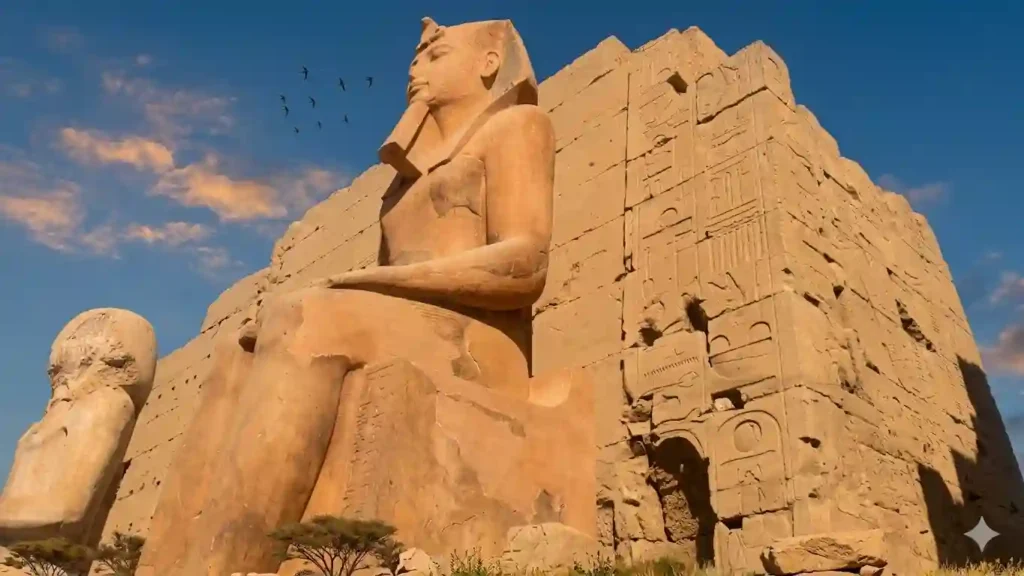
The most iconic surviving statues of King Ramses II stand at the entrance to Luxor Temple on the east bank of the Nile. At the temple’s great pylon — its massive entrance gateway — six colossal figures of Ramesses were originally positioned: two seated and four standing, flanking the entrance alongside two 25-meter obelisks.
Today, two seated colossi dominate the pylon face, along with surviving standing figures within the first courtyard. The scale is staggering: the restored black granite colossus at Luxor Temple stands 11 meters (36 feet) tall and weighs 82 tons. It was found in 58 pieces in 1958–60 and fully restored in 2017 in a ceremony floodlit against the temple walls by the Nile — a spectacle that drew crowds in the same tradition as the ancient Opet Festival processions that once took place here.
What most visitors miss when standing before these statues is the detail at their feet. Look closely at the base of the seated colossi, and you will find diminutive female figures carved standing beside the legs of the king. These are Queen Nefertari, Ramesses’ chief and most beloved wife — depicted small not out of insignificance, but in accordance with Egyptian artistic convention where scale indicated divine hierarchy. In private, their relationship was said to be a genuine love match; in stone, she stands eternally beside him.
One significant detail that even experienced guides sometimes overlook: five of the eleven surviving standing colossi in the first courtyard at Luxor Temple were not originally Ramesses II at all. They were statues of Amenhotep III, carved two centuries earlier, which Ramesses “renewed” — recutting the cartouches and subtly reshaping the faces. This practice, sometimes called damnatio memoriae in reverse, was actually understood as an act of renewal: breathing new sacred life into ancient monuments rather than erasing the original owner.
2. The Ramesseum Colossi — The Ones That Inspired Shelley
On the west bank at Luxor, directly across the Nile from the temples of Karnak and Luxor, stands the Ramesseum — Ramesses II’s mortuary temple, his “mansion of millions of years.” It is the second largest temple in Egypt, covering roughly 10 hectares, and at its heart once stood the most colossal single statue of King Ramses II ever attempted.
This statue — called “Sun of the Princes” by its makers — was carved from a single block of syenite granite and stood 17 meters (56 feet) tall, weighing an estimated 1,000 tonnes. It was the largest monolithic statue ever attempted in ancient Egypt. Today, only scattered fragments of the base and torso survive: the sheer scale of the original made it one of the first targets for stone robbers in later centuries, who quarried its massive blocks for building material.
The upper body of one of the Ramesseum colossi — a magnificent granite bust — was removed in 1817 and transported to London, where it now resides in Room 4 of the British Museum. This is the piece, known as the “Younger Memnon,” that a fragment of first inspired Shelley’s Ozymandias. Even at 2.67 meters tall (just the head and torso) and weighing 7.25 tons, it retains a calm, timeless authority. Traces of original paint — blue and yellow on the headcloth, red on the skin, black in the eyes — hint at the vividly colored figure it once was.
The Ramesseum itself, though ruined, is one of the most hauntingly beautiful sites on the west bank. Visiting it is a very different experience from the polished grandeur of Luxor Temple: here, fallen columns lie where they collapsed, hieroglyphs weather in the sun, and the scale of what was lost becomes almost tangible.
3. The Abu Simbel Colossi — The Greatest Achievement of Ramesses’ Self-Image
In Egypt’s far south, 280 kilometers south of Aswan near the Sudanese border, stand the four most famous seated statues of King Ramses II in the world. Carved directly into a sandstone cliff face around 1264 BC, the four seated colossi at the Great Temple of Abu Simbel each stand approximately 21 meters (65 feet) tall — roughly the height of a five-story building.
These are not freestanding sculptures. They were cut from the living rock of the cliff, meaning the entire mountain is the statue — the mountain is the temple. The effect, intended to intimidate Nubian populations approaching from the south, was one of the most calculated displays of power in the ancient world.
What is less known is the alignment. The temple was oriented with such precision that twice a year — on February 22 and October 22, believed to correspond to Ramesses’ birthday and coronation day — the rising sun penetrates the full 60-meter length of the temple and illuminates the four seated figures in the innermost sanctuary: Ramesses II himself, flanked by Amun-Ra, Ra-Horakhty, and Ptah. Only Ptah, god of the underworld, remains in shadow.
Abu Simbel was saved from Lake Nasser’s rising waters in a remarkable UNESCO operation in the 1960s — the same campaign that also saved the Temple of Debod (now in Madrid) and the Temple of Philae. The entire complex was cut into 1,036 numbered blocks and reassembled 65 meters higher on the cliff — maintaining its original astronomical alignment with extraordinary precision.
4. The Grand Egyptian Museum Colossus — The Most Traveled Statue in History
The colossal standing statue of King Ramses II at the Grand Egyptian Museum in Giza has arguably the most traveled biography of any ancient sculpture. Originally carved from red Aswan granite around 1200 BC for the Temple of Ptah at Memphis (the ancient capital of Egypt, 20 kilometers south of modern Cairo), it stands 11 meters (36 feet) tall and weighs 83 tons.
In 1820, it was discovered broken into six pieces at Mit Rahina by explorer Giovanni Battista Caviglia. In 1955, Egyptian Prime Minister Gamal Abdel Nasser ordered it reassembled and erected in Cairo’s central Ramses Square, where it stood for half a century as the city’s unofficial guardian. In 2006, concerned that traffic pollution and subway vibrations were corroding the ancient granite, the Egyptian government moved it to Giza — a ten-hour journey through Cairo’s streets, during which thousands of residents lined the route waving and calling the statue “Grandfather.”
It now stands at the entrance of the Grand Egyptian Museum — the world’s largest archaeological museum, built adjacent to the Giza pyramids. Its permanent home there reunites it, symbolically, with the landscape of Egypt’s imperial glory.
5. The Turin Statue — The One Most Scholars Consider the Masterpiece
The statue of Ramesses II in the Museo Egizio in Turin, Italy, is rarely mentioned in tourist guides but is considered by many Egyptologists to be among the finest surviving sculptures of this pharaoh. Carved from granodiorite (a dark speckled granite), it was originally at the Temple of Amun in Karnak — Ramesses’ most sacred precinct — and was acquired by the museum in the 19th century.
What sets this statue apart is its sculptural detail and the figures at the king’s feet. Standing beside his left leg is Queen Nefertari, wearing the distinctive Hathor headdress with its solar disk and two tall feathers. At his right stands Prince Amunherkhepeshef, Ramesses and Nefertari’s eldest son and heir.
The presence of Amunherkhepeshef allows scholars to date the statue: the prince died in approximately 1254 BC, in the 25th year of Ramesses’ reign. The statue was therefore carved during the first quarter of his reign — the same period when his father’s artistic influence was still strong and Nefertari was alive. Art historians note that the face of this statue bears a strong stylistic resemblance to statues of Ramesses’ father, Seti I, suggesting it was made while the memory of Seti’s sculptural workshop was still fresh — and possibly when the young Ramesses was consciously presenting himself as his father’s worthy successor.
What Every Statue of King Ramses II Is Actually Saying
Reading a statue of King Ramses II is not simply an aesthetic exercise — it is an act of theological decoding. Every element was chosen deliberately:
The Double Crown (Pschent): The combination of the white crown of Upper Egypt and the red crown of Lower Egypt, signaling sovereignty over the entire nation from the Nile Delta to Nubia.
The Uraeus: The rearing cobra on the forehead, sacred to the goddess Wadjet, believed to protect the pharaoh by spitting fire at his enemies. Its presence on the statue was not decorative; it was a spiritual weapon.
The Nemes Headcloth: The striped linen headdress falling forward over both shoulders. More intimate than a crown, it appears frequently in royal statues to suggest accessibility alongside divinity.
The False Beard: A ceremonial attachment symbolizing divine kingship, connected to the god Osiris. Even queens wore false beards in their divine representations.
The Ankh: When carved holding an ankh (the looped cross), the pharaoh holds the literal hieroglyph for “life” — stating that he is the conduit through which divine life force flows to Egypt.
The Scale: More than any other element, the sheer size of these statues communicated a theological message: the pharaoh exists at a different scale of being than ordinary humans. To approach a 20-meter statue is to physically experience the doctrine of divine kingship in your body.
The Ramesseum: Where You Can Still Stand in His Shadow Today
For travelers sailing the Nile, the west bank at Luxor offers the most layered encounter with Ramesses II’s stone legacy. The Ramesseum, while ruined, is one of the most uncrowded major monuments in Upper Egypt — a striking contrast to the tourist density of Luxor Temple and Karnak.
Visiting early morning, when the light falls golden across the fallen columns and broken colossi, is an experience that no museum display can replicate. The partially preserved reliefs on the inner walls still show the Battle of Kadesh in remarkable detail — Ramesses in his chariot, the Egyptian army crossing the Orontes River, the Hittite chariots in disarray. These are not later propaganda additions; they are the original accounts, recorded in stone within years of the actual battle.
The Ramesseum is best reached from the Nile itself — which is precisely how it was intended to be approached. Ramesses oriented his mortuary temple to face the river and the living temples of Karnak and Luxor on the opposite bank, so that his eternal worship would be conducted across the water that gave Egypt its life.
Sail the Nile That Ramesses Built Along: Turquoise Dahabiya
To understand the statue of King Ramses II is to understand the Nile. Every granite block quarried in Aswan for his colossus traveled north by river. Every temple he built along the Upper Nile was oriented toward its banks. The Ramesseum was designed to be seen from the water. Even Abu Simbel — carved into a cliff in Nubia — was positioned to dominate the approach by boat.
There is no more fitting way to encounter this legacy than by sailing it — slowly, at eye level with the riverbanks, stopping where the temples stand.
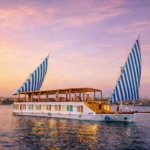
Turquoise Dahabiya operates intimate luxury Nile cruises between Luxor and Aswan — the heart of Ramesses II’s Egypt. Our small-boat Dahabiya carries a limited number of guests, offering what large cruise ships cannot: the silence of the river at dawn, the ability to approach temples as ancient pilgrims did, and the time to absorb rather than simply photograph.
Our Nile Journeys — Where Ramesses Still Stands
4-Day Sacred Waters — Aswan to Esna Begin at Aswan — the source of the red granite that built every Ramesses colossus. From here, sail north to the temples of Kom Ombo and Edfu. This is the direction the stone traveled; you are following the same river current that carried the raw material for the statues of King Ramses II from quarry to temple three thousand years ago. From €750.
5-Day Serenity Retreat — Luxor to Aswan Begin in Luxor, where the colossi stand at the temple entrance, and sail south through the same landscape Ramesses II commanded. Stop at the perfectly preserved Temple of Horus at Edfu — the most complete ancient temple in Egypt — and at Kom Ombo, with its extraordinary double dedication. From €1,000.
7-Day Elegant Scape — Luxor, Qena, and Aswan The most comprehensive Upper Egypt itinerary, extending north to Dendera Temple near Qena. Dendera’s extraordinary preservation includes the famous Dendera Zodiac — the only complete ancient astronomical ceiling found in Egypt, created by the same Ptolemaic-era civilization that built temples around Ramesses’ legacy. From €1,500.
11-Day Royal Nile Escape — Luxor to Cairo From the colossi at Luxor Temple all the way to Cairo, where the great colossal statue of King Ramses II now greets visitors at the entrance of the Grand Egyptian Museum. The full arc of Ramesses’ Egypt — south to north, temple to museum, ancient to modern. From €3,000.
14-Day Golden Horizons — Cairo to Aswan The complete journey: beginning where Ramesses’ colossus now stands at the Grand Egyptian Museum, traveling by Dahabiya the full length of his kingdom to Aswan — the granite quarry where it all began. From €3,500.
What Makes Sailing Different
The temples of Upper Egypt were designed to be approached by water. When you sail toward Kom Ombo on the Turquoise Dahabiya as the sun sets over the desert behind it, you see exactly what ancient priests and Ptolemaic pilgrims saw — the temple rising from the bank, its columns reflected in the river below. No bus, no minivan, no coach tour can replicate that angle.
Our expert Egyptologist guides bring the symbolism of every statue and relief to life — not as a lecture, but as a conversation. Guests often describe the difference between a standard guided tour and the Dahabiya experience as the difference between seeing Egypt and understanding it.
FAQs: Statue of King Ramses II
Where is the most famous statue of King Ramses II?
The most photographed statues are the colossal seated figures at the entrance pylon of Luxor Temple, on the east bank of the Nile in Luxor, Egypt. The most famous single piece in a museum is the “Younger Memnon” bust at the British Museum in London. The most complete surviving colossi in their original setting are the four 21-meter figures at Abu Simbel in Aswan Governorate.
How many statues of Ramses II exist?
At least 350 surviving statues of Ramesses II have been identified by archaeologists. More continue to be discovered — the missing upper half of a colossal Ramesses statue was unearthed as recently as March 2024 by a joint Egyptian-American mission in southern Egypt.
What does the statue of King Ramses II symbolize?
Each statue was a theological statement communicating divine kingship. The uraeus cobra on the forehead represented protection and power. The double crown signified rule over all Egypt. The false beard connected the pharaoh to Osiris. The colossal scale physically enacted the doctrine that the pharaoh exists at a divine scale above ordinary humanity. Every carved detail carried specific religious meaning.
Where is the statue of King Ramses II now — the one that was in Cairo’s Ramses Square?
The famous 83-ton red granite colossal statue that stood in Cairo’s Ramses Square from 1955 to 2006 now stands at the entrance atrium of the Grand Egyptian Museum in Giza, Egypt, where it has been permanently installed. It was moved there in a carefully staged multi-step operation, the final short move taking place in 2018.
Was Ramses II the pharaoh of the Exodus?
This is a popular cultural association but is not supported by archaeological or historical evidence. Egypt’s Supreme Council of Antiquities has stated there is no evidence connecting Ramesses II to the biblical Exodus narrative. Most Egyptologists consider the association a later tradition without historical basis.
What material were the statues of King Ramses II made from?
Most colossal statues were carved from Aswan granite — red, pink, grey, or black — quarried near modern Aswan and transported north by the Nile. Some statues used limestone, granodiorite, or syenite. The choice of red granite for the most important pieces was deliberate: the color associated the statue with solar divinity and with Ra, the sun god whose name formed part of Ramesses’ throne name.
Can you see the original statues of Ramses II at Luxor if you visit Egypt?
Yes. The colossal statues at Luxor Temple’s entrance are still standing in their original location, fully accessible to visitors. The Ramesseum on the west bank also contains surviving statue fragments in situ. Abu Simbel requires a flight or long drive south from Aswan but is one of Egypt’s most overwhelming experiences.
Conclusion: Stand Where the Stone Still Speaks
The statue of King Ramses II is not a single monument — it is a language. Spoken in granite across every temple from the Delta to Nubia, it says the same thing in every form: I was here. I was powerful. I endured.
Three thousand years later, the stone is still speaking. And the river that carried every block of that granite from Aswan to Thebes is still flowing — the same Nile, the same current, the same light on the same water.
The best way to hear what it says is to travel it.
👉 Explore Turquoise Dahabiya’s Nile cruise itineraries — from 4-day intimate journeys to 14-day complete passages through the Egypt of Ramesses the Great. Our small-boat luxury Dahabiya offers the silence, the space, and the expert guidance to transform a list of monuments into a genuine understanding of the civilization that built them.
Reserve your place on the river. The colossi have been waiting since 1279 BC — they can wait a little longer.